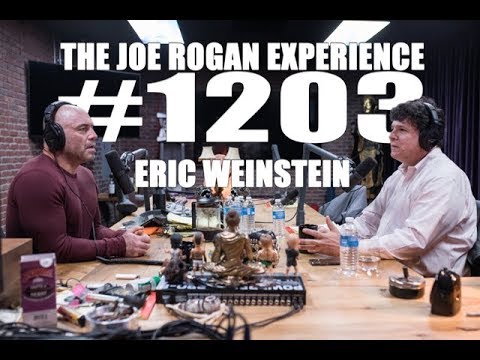
Joe Rogan Experience #1203 - Eric Weinstein
Joe Rogan (host), Eric Weinstein (guest), Guest (guest), Guest (guest), Narrator
In this episode of The Joe Rogan Experience, featuring Joe Rogan and Eric Weinstein, Joe Rogan Experience #1203 - Eric Weinstein explores eric Weinstein and Joe Rogan Deconstruct Reality, Conflict, and Institutions Joe Rogan and Eric Weinstein explore why modern social and political life feels unstable, focusing on group identity, virtue signaling, and the need for intellectual honesty under pressure. They discuss how adversity and 'the unforgiving' (fighting, wilderness, disasters) forge character and real community, contrasting that with online outrage culture and sheltered modern lives.
Eric Weinstein and Joe Rogan Deconstruct Reality, Conflict, and Institutions
Joe Rogan and Eric Weinstein explore why modern social and political life feels unstable, focusing on group identity, virtue signaling, and the need for intellectual honesty under pressure. They discuss how adversity and 'the unforgiving' (fighting, wilderness, disasters) forge character and real community, contrasting that with online outrage culture and sheltered modern lives.
Weinstein pivots into deep physics and mathematics—gauge symmetry, quantum mechanics, spinors, and exotic structures like the Hopf fibration and E8—as examples of profound truths that almost no one understands because institutions and education fail to communicate them. He argues that theoretical physics and math are near the 'end of the story' for understanding bedrock reality, but the priesthood guarding this knowledge is tiny and vulnerable.
They examine masculinity, group bonding, teasing vs bullying, social-emotional learning, and how overprotective norms may be preventing people—especially men—from forming deep bonds through mild adversity and rough play. This leads into jiu-jitsu, MMA, weight cutting, and the ethics of hunting, where Rogan emphasizes skill, responsibility, and respect for reality.
Throughout, both criticize institutional media, politicized expertise, and deplatforming, framing podcasts and independent media as a new, more honest 'arena' where ideas can clash like mixed martial arts—exposing bad heuristics and contradictions in mainstream narratives about gender, race, immigration, and religion.
Key Takeaways
Being disagreeable in a principled way is a defense against mass hysteria.
Weinstein argues that a strong internal model of the world and a willingness to resist group pressure (even when it feels lonely) helps prevent people from being swept up in ideological frenzies from any side.
Get the full analysis with uListen AI
Vice signaling can create more trust than polished virtue signaling.
Openly acknowledging one's vices or selfish motives, like Dan Bilzerian's 'ruin your life but it'll be fun' persona or meta-honest humor about false advertising, often inspires more trust than moral posturing that hides flaws.
Get the full analysis with uListen AI
Adversity and the 'unforgiving' are essential for real growth and bonds.
Rogan’s fire evacuation story, firefighters, ultra-runners, and hard hikes illustrate that voluntarily confronting difficulty reveals character, creates deep connection, and counters the 'reality drought' of cushioned modern life.
Get the full analysis with uListen AI
Overprotective social norms can unintentionally destroy healthy bonding.
Weinstein suggests that blanket crackdowns on hazing, teasing, and anything adjacent to bullying can eliminate the mild discomfort and shared hardship through which many men form lifelong, high-trust relationships.
Get the full analysis with uListen AI
Combat sports are paradoxically safer than they look—except for weight cutting.
Rogan contends MMA’s rule set makes near-unrestricted fighting survivable, but extreme dehydration to make weight is the sport’s most dangerous, unnecessary practice, vastly increasing health and brain-injury risks.
Get the full analysis with uListen AI
Our education system hides the most important conceptual tools.
Concepts like groups, gauge symmetry, spinors, and high-dimensional structures (Hopf fibration, E8) underpin modern physics but are never taught to most people; Weinstein believes visually grounded teaching could open this 'portal' to the broader public.
Get the full analysis with uListen AI
Deplatforming bad ideas may be less effective than exposing contradictions.
Instead of silencing, Weinstein favors letting ideological opponents fully state their principles and then rigorously revealing where those principles conflict, much like the UFC exposed ineffective martial arts in open competition.
Get the full analysis with uListen AI
Notable Quotes
“We’ve been in something of a reality drought.”
— Eric Weinstein
“If you really understand biology, the world is so dark and interesting and beautiful and crazy that it’s very hard to recover simple ideas about how people should be.”
— Eric Weinstein
“You don’t want to be that guy that two hours into the hike says, ‘I want to go home.’”
— Joe Rogan
“Theoretical physics has been faking that it’s in a healthy state for a long time.”
— Eric Weinstein
“Bad ideas facilitate comprehension. You need to see shitty ideas broadcast to appreciate good ideas.”
— Joe Rogan
Questions Answered in This Episode
How much 'vice signaling' is honest self-disclosure versus just another form of branding or manipulation?
Joe Rogan and Eric Weinstein explore why modern social and political life feels unstable, focusing on group identity, virtue signaling, and the need for intellectual honesty under pressure. ...
Get the full analysis with uListen AI
Where should we draw the line between healthy male teasing that forges bonds and toxic hazing that truly harms people?
Weinstein pivots into deep physics and mathematics—gauge symmetry, quantum mechanics, spinors, and exotic structures like the Hopf fibration and E8—as examples of profound truths that almost no one understands because institutions and education fail to communicate them. ...
Get the full analysis with uListen AI
If weight cutting in combat sports is as dangerous as Rogan describes, what realistic incentive changes or regulations could actually end it?
They examine masculinity, group bonding, teasing vs bullying, social-emotional learning, and how overprotective norms may be preventing people—especially men—from forming deep bonds through mild adversity and rough play. ...
Get the full analysis with uListen AI
What would a high-school curriculum that includes groups, symmetry, and visualizations like the Hopf fibration look like—and how might it change society’s relationship to science?
Throughout, both criticize institutional media, politicized expertise, and deplatforming, framing podcasts and independent media as a new, more honest 'arena' where ideas can clash like mixed martial arts—exposing bad heuristics and contradictions in mainstream narratives about gender, race, immigration, and religion.
Get the full analysis with uListen AI
Are independent podcasts and long-form conversations enough to counterbalance institutional media and academic distortions, or do we need structural reforms as well?
Get the full analysis with uListen AI
Transcript Preview
And we're live. Are you, you gonna update the, the people out there?
No.
Oh, you shut your phone off?
Yeah.
Oh, you're professional.
Try.
How are you, sir? Good to see you.
I'm doing well.
What's going on?
Um, everything. It's all pretty weird out there.
It is very weird out there. We were just talking about how weird it is out there, um, before the podcast, about how it just seems like it's very difficult to keep together during these times, and to, to ha- to keep a reasonable position, and to handle all of the pressure of all the people that get upset at anything you do, left or right, in the middle, centrist. You're too centrist, you're too left, you're too right. You're unreasonable, you're too reasonable, you're too nice, you're not nice enough.
Wow. Suddenly, I feel like I'm in a marriage.
(laughs)
(sniffs) .
Doesn't it seem like that, though?
Yeah. It does. I think that this is why dis- ... This is the era for disagreeability. If you're not easily swayed, um, because you're somehow, uh, insensitive enough that you just wanna keep, uh, to first principles, whatever it is that you believe, that seems to be the best hedge against getting swept up in the madness of others.
How so?
Well, um, I guess I ... When I go metacognitive, I look at my yearning for group belonging, and then I also watch my inability to belong to groups that say crazy things.
Yeah.
And so, those are, those are two conflicting feelings. I think sometimes when people look at me, they say, "Wow, you're really contrarian, and you have an easy time standing up to, you know, the conventional wisdom." And I don't think it's, it's, it's that true. I just think when those two things fight inside me, uh, dialectically, the disagreeability is so strong because it's protecting a comprehensive view of the world. And so, since everything already kinda fits together fairly well, I would say I'm l- much ... It's much harder to sway me because the number of things I would have to move cognitively to accommodate a wrong idea-
Hmm.
... is, is quite large.
It seems unnecessary, but it also seems like it ... We should be able to disagree on things, and you should be able to point out, with reasonable courtesy, that there's something wrong with someone's idea and it not become a big personal thing. But oftentimes, that's not the case.
Well, so a lot of the things, I think, that we're, we're exploring are what I would think of as heuristics. They're sort of rules of thumb that work fairly well within some domain of definition. And we've gotten so many of these conflicting rules ... I mean, the rules of thumb themselves conflict. So for example, "He who hesitates is lost," uh, conflicts with, um, "Nothing ventured, nothing gained," or something like that. Uh, sorry-
Install uListen to search the full transcript and get AI-powered insights
Get Full TranscriptGet more from every podcast
AI summaries, searchable transcripts, and fact-checking. Free forever.
Add to Chrome