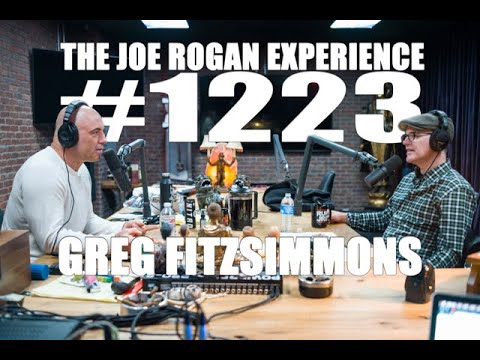
Joe Rogan Experience #1223 - Greg Fitzsimmons
Narrator, Joe Rogan (host), Narrator, Greg Fitzsimmons (guest), Narrator, Narrator, Narrator
In this episode of The Joe Rogan Experience, featuring Narrator and Joe Rogan, Joe Rogan Experience #1223 - Greg Fitzsimmons explores joe Rogan and Greg Fitzsimmons Roam From Comedy To Human Nature Joe Rogan and Greg Fitzsimmons have a long, loose-form conversation that jumps between stand-up comedy, physical health, psychedelics, mental illness, and human behavior. They reminisce about influential comics and shows like Damon Wayans and In Living Color, dissect how stand-up is written and refined, and talk honestly about aging bodies, injuries, and recovery methods such as PRP, cryotherapy, and TMS.
Joe Rogan and Greg Fitzsimmons Roam From Comedy To Human Nature
Joe Rogan and Greg Fitzsimmons have a long, loose-form conversation that jumps between stand-up comedy, physical health, psychedelics, mental illness, and human behavior. They reminisce about influential comics and shows like Damon Wayans and In Living Color, dissect how stand-up is written and refined, and talk honestly about aging bodies, injuries, and recovery methods such as PRP, cryotherapy, and TMS.
The discussion frequently zooms out into big-picture reflections: how culture changes, what’s now considered offensive, the realities of immigration and privilege, and how much of people’s behavior is shaped by trauma, childhood, and brain chemistry. They also explore the ethics of drugs, psychedelics, and prohibition, linking them to societal control and pharmaceutical interests.
Along the way, they detour into vivid stories about wildlife (bears, sharks, alligators), survival, and death, often using those as metaphors for risk, modern comfort, and how disconnected most people are from nature’s brutality.
Overall, the episode is less a focused interview and more a meandering, candid hang between two veteran comics, blending dark humor with surprisingly thoughtful commentary on psychology, culture, and mortality.
Key Takeaways
Stand-up material is built slowly through repetition and audience feedback.
Both Rogan and Fitzsimmons describe how bits start clunky, evolve over months through nightly tweaking, and sometimes morph into something almost unrecognizable from the original idea.
Get the full analysis with uListen AI
Aging bodies demand smarter risk–reward choices around sports and training.
They detail ski injuries, knee problems, and how older athletes must prioritize longevity—considering treatments like PRP/Regenokine and being more conservative with high-impact activities.
Get the full analysis with uListen AI
New medical and quasi-medical therapies can meaningfully change mood and pain.
Fitzsimmons talks about getting Transcranial Magnetic Stimulation (TMS) for depression with strong results, while Rogan explains PRP/Regenokine and whole-body cryotherapy as powerful tools against inflammation and chronic issues.
Get the full analysis with uListen AI
Cultural standards for what’s “acceptable” comedy change fast—and retroactively.
They use In Living Color, Handiman, and other 1990s sketches to illustrate how jokes that were mainstream then would be unairable now, arguing that social media accelerates shifts in what’s deemed offensive.
Get the full analysis with uListen AI
Many ‘moral’ debates ignore root causes like trauma, poverty, and brain damage.
Rogan repeatedly reframes criminals, addicts, and “assholes” as former babies shaped by genetics, abuse, head injuries, and bad environments—arguing society rarely targets early-childhood causes.
Get the full analysis with uListen AI
Prohibition of psychedelics is as much political and economic as medical.
They reference Michael Pollan’s work and 1950–60s research on LSD/psilocybin for alcoholism, depression, and smoking, and suggest that fear, politics, and pharma interests helped bury promising data.
Get the full analysis with uListen AI
Modern humans underestimate how lethal nature is—and how sheltered we are.
Stories of shark attacks, bear predation, alligators on golf courses, and historical plagues highlight how rare it is for today’s Westerners to face real existential threat compared to much of history.
Get the full analysis with uListen AI
Notable Quotes
“You look at a 40-year-old asshole and forget that was a baby.”
— Joe Rogan
“If I accept that I ‘changed your life’ in a positive way, then I have to accept I might have ruined somebody else’s too.”
— Joe Rogan
“Comedy isn’t supposed to be a morality tale; it’s one person’s inner vision. You go for the ride or you don’t.”
— Greg Fitzsimmons
“It’s weird how your body changes from no urge to fuck to fucking is your whole life.”
— Greg Fitzsimmons
“You’re not around things that can eat you enough.”
— Joe Rogan
Questions Answered in This Episode
How should we judge older comedy that’s offensive by today’s standards—should it be suppressed, contextualized, or left alone as a historical artifact?
Joe Rogan and Greg Fitzsimmons have a long, loose-form conversation that jumps between stand-up comedy, physical health, psychedelics, mental illness, and human behavior. ...
Get the full analysis with uListen AI
If psychedelics are as promising for mental health as described, what systems would be needed to use them safely and fairly on a large scale?
The discussion frequently zooms out into big-picture reflections: how culture changes, what’s now considered offensive, the realities of immigration and privilege, and how much of people’s behavior is shaped by trauma, childhood, and brain chemistry. ...
Get the full analysis with uListen AI
To what extent are individuals truly responsible for their actions if early trauma, poverty, or brain injury heavily shape their behavior?
Along the way, they detour into vivid stories about wildlife (bears, sharks, alligators), survival, and death, often using those as metaphors for risk, modern comfort, and how disconnected most people are from nature’s brutality.
Get the full analysis with uListen AI
Where is the ethical line in eating intelligent animals like pigs, octopus, or dolphins, and should intelligence be the main factor in our food choices?
Overall, the episode is less a focused interview and more a meandering, candid hang between two veteran comics, blending dark humor with surprisingly thoughtful commentary on psychology, culture, and mortality.
Get the full analysis with uListen AI
How might your own views on risk, health, and aging change after hearing comedians openly discuss their injuries, depression, and recovery methods?
Get the full analysis with uListen AI
Transcript Preview
(knocking) Two.
That's it? Wow. A- a two count from young Jamie.
Ah.
(laughs)
Messing with the buttons and hit the wrong one.
Oh.
Sorry.
Gregory, how are you, fella?
Joe Rogan, always a pleasure to be back in the ... What I love is that you kept the studio the same as the old one, 'cause the vibe was perfect.
I tried to recreate it.
Yeah.
I felt like as long as we had the desk, we have the heart.
Yep.
We have the heart of the studio. The rest of it's just stuff.
And Jamie, the heart.
And Jamie.
Fucking guy does-
And we need, um ... There's something about, uh, I, I, I really think that when you use a desk for a long time, there's something about desks. Like if you found out like Hunter S. Thompson's desk was for sale-
Yeah.
... you'd be like, "Holy shit."
Fuck yeah.
"I wanna get my hands on that thing."
Yeah.
Like that's got some ooze.
Right.
You know he wrote on this?
Yeah.
Holy shit.
Yeah, nice old, one of those old like-
Yeah.
... railway station rolltop desks.
Yeah. Oh, those are the best.
Yeah. I gotta protect my shit while I'm out.
Yeah.
So nobody reads my journal.
One of my all time favorite photos of him was him typing in Big Sur, like sitting on like this, this outside table typing. I think he's on the edge of a cliff or something like that. In the background you see the water.
Yeah.
(clears throat) You know that photo, Jamie? Yeah, that's it right there.
Oh, look at that. With the pipe, yeah.
Dude, that is one of the most iconic writing photos of all time.
Yeah.
Hunter S. Thompson with hair-
Yeah.
... with a typewriter in front of the water at Big Sur in probably like 1960 something.
And you know his schedule, did you ever read his schedule?
Mm-hmm.
His daily schedule? (laughs)
Not only did I read it- (coughs)
You lived it.
... I read it on air. And I might've read it on air with you.
Yeah, I think you did.
It's a self-portrait.
Oh, wow.
So he took the picture himself by setting-
Wow.
... it up.
So this was in-
No shit.
Well, it's what it's listed as.
This is in Big Sur. That was when he was in like the, the early stages of his eruption. That was like right around when he was writing Hells Angels probably.
Yeah.
1961.
'61?
Yeah.
Yeah. That motherfucker was unique.
Yeah.
Did you ever see his documentary?
Install uListen to search the full transcript and get AI-powered insights
Get Full TranscriptGet more from every podcast
AI summaries, searchable transcripts, and fact-checking. Free forever.
Add to Chrome