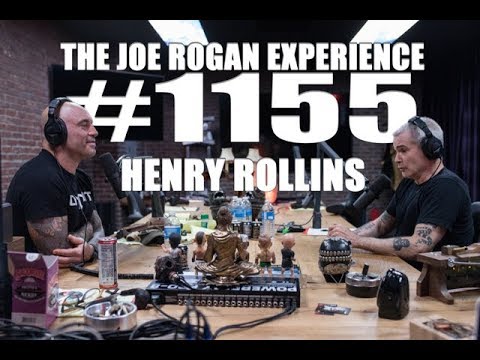
Joe Rogan Experience #1155 - Henry Rollins
Joe Rogan (host), Henry Rollins (guest), Narrator, Narrator, Narrator, Joe Rogan (host)
In this episode of The Joe Rogan Experience, featuring Joe Rogan and Henry Rollins, Joe Rogan Experience #1155 - Henry Rollins explores henry Rollins On Work, Speech, Anxiety, Politics, Pain, And Purpose Henry Rollins joins Joe Rogan for a long-form conversation about his obsessive work ethic, his evolution from punk singer to spoken-word performer and author, and the personal rules that govern how he speaks and lives.
Henry Rollins On Work, Speech, Anxiety, Politics, Pain, And Purpose
Henry Rollins joins Joe Rogan for a long-form conversation about his obsessive work ethic, his evolution from punk singer to spoken-word performer and author, and the personal rules that govern how he speaks and lives.
They discuss navigating ideological differences with people like Ted Nugent, the responsibilities that come with a public platform, and Rollins’ approach to conflict, reputation, and not hiding behind social media.
Rollins explores his social anxiety, solitary lifestyle, and depression management through work, travel, exercise, and music, contrasting that with his high comfort level performing on stage.
The discussion branches into health and recovery (diet, fasting, cryotherapy, yoga), world travel and water scarcity, U.S. politics and Trump/Putin, and why Rollins believes in offering solutions instead of just outrage.
Key Takeaways
Treat public speech as if the subject is standing in front of you.
Rollins avoids saying anything in interviews or online that he wouldn’t defend face-to-face, rejecting anonymous “keyboard activism” and remembering that words can provoke real-world harm.
Get the full analysis with uListen AI
Channel disagreement into dialogue instead of caricature.
His proposed show with Ted Nugent stems from respecting Nugent’s musicianship while sharply disagreeing with some of his statements, illustrating that you can argue ideas without dehumanizing the person.
Get the full analysis with uListen AI
Use work and physical exertion as structured tools against depression.
Rollins manages lifelong depression through relentless productivity, strict routines, and daily workouts, describing achievement and movement as his primary “antidepressants” instead of medication.
Get the full analysis with uListen AI
Deliberate lifestyle constraints can supercharge output.
By choosing not to have a family, limiting friendships, and living simply (cheap car, basic habits), Rollins channels his time and energy almost entirely into touring, writing, and creative projects.
Get the full analysis with uListen AI
Diet, fasting, and recovery practices materially affect mood and performance.
Both men emphasize that cleaner eating, intermittent fasting, and tools like cryotherapy and sauna reduce inflammation, improve sleep, elevate mood, and support the demanding schedules they keep.
Get the full analysis with uListen AI
Travel and seeing scarcity firsthand radically reframes values.
Rollins’ work with water NGOs in Africa and experience in places like Uganda and South Sudan showed him how access to water ties directly to dignity, female literacy, and daily survival, deepening his sense of responsibility back home.
Get the full analysis with uListen AI
Criticize politics with solutions, not just outrage.
Onstage, Rollins avoids simply attacking Trump; instead he urges people to donate, organize, support civil liberties groups, and engage politically, arguing that crisis is also an opportunity to show character.
Get the full analysis with uListen AI
Notable Quotes
“I don't say anything about anybody without expecting them to hear it.”
— Henry Rollins
“It's easy for me to be in front of people. That's a very different thing than being with people.”
— Henry Rollins
“The only thing good about me, in my opinion, is what I do.”
— Henry Rollins
“If destruction be our lot, we must ourselves be its author and finisher.”
— Henry Rollins (quoting Abraham Lincoln and using it as a centering exercise)
“Fat shaming works. It got me off my ass.”
— Joe Rogan (relaying Tom Segura’s conclusion about his own weight loss)
Questions Answered in This Episode
How do you personally decide where the line is between honest, harsh criticism and language that risks inciting harm?
Henry Rollins joins Joe Rogan for a long-form conversation about his obsessive work ethic, his evolution from punk singer to spoken-word performer and author, and the personal rules that govern how he speaks and lives.
Get the full analysis with uListen AI
If Henry Rollins did create his ‘Henry And’ show today, which ideological opponents would be the most valuable — not just entertaining — to pair him with?
They discuss navigating ideological differences with people like Ted Nugent, the responsibilities that come with a public platform, and Rollins’ approach to conflict, reputation, and not hiding behind social media.
Get the full analysis with uListen AI
To what extent is Rollins’ level of solitary obsession healthy, and where might it cross into self-sabotage or avoidance of intimacy?
Rollins explores his social anxiety, solitary lifestyle, and depression management through work, travel, exercise, and music, contrasting that with his high comfort level performing on stage.
Get the full analysis with uListen AI
How can an ordinary person, without Rollins’ work capacity or platform, realistically emulate his “solutions, not just outrage” approach to politics and activism?
The discussion branches into health and recovery (diet, fasting, cryotherapy, yoga), world travel and water scarcity, U. ...
Get the full analysis with uListen AI
Does choosing to avoid antidepressant medication in favor of work and exercise reflect personal suitability, or could it unintentionally stigmatize people who do need pharmaceutical help?
Get the full analysis with uListen AI
Transcript Preview
Here we go. Four, three, two... Henry Rollins, ladies and gentlemen. How are you, fella?
I'm better now, being here with you.
I'm better now that you're here.
(laughs)
We were just talking about a show that you got you and Ted Nugent, apparently... Someone, did someone... Did you pitch it? Who pitched the show?
Um, it was an idea that, uh, my manager, Heidi and I came up with. Well, mostly Heidi. It was like, it was called basically Henry And. Uh, you put me and someone I might have some disagreements with, or a few agreements with, and we just go somewhere and we weigh in with a camera following us. And we're thinking, "W- what... It'll be like a six-part miniseries." Like, you know, f-... Me and plus six interesting people. And one of the names that came up was Ted Nugent because I, uh, y- I'm a fan of his music. I think he's one of the best guitar players I've ever seen. Yet, he and I would m-... Probably disagree on, uh, one or a few topics. And so we actually pickes- pitched it to Ted, who said he loved the idea, but he said, "I gotta go on... I'm busy with..." He had a d- a ton of tour dates, so I think he's on now. But he said, "I wanna talk to Henry to thank him for thinking of me." Okay. And so Ted called, like, on my phone in the office. I guess he got my number from the powers that be. (laughs) And suddenly, it's, it's Ted on my phone. I'm at my desk like, "Okay, this is surreal."
(laughs)
And we talked for a few minutes and y- he said, uh, you know, like, "What? You think I'm a bad guy?" I'm like, "N- no. I... D- you... Uh, just some of the things you say, I just like... I... It kind of (laughs) takes my breath away." And then we quickly got on the topic of music. He said, "You like all that old Detroit music." I go, "Yeah, man. I mean, y- you, Mitch Ryder, The Stooges, MC5. I mean, it's kind of the best... It's some of the best music I've ever heard." I mean, as far... And I, I asked him, I go, "What is it? Is it Something in the Water? What is it with you Michigan guys and guitar tone? Like, no one gets tone like you, uh, Ron Ashton, Stooges, uh, Fred "Sonic" Smith, MC5." I go, "You guys, I mean, you're so good." And he said, "You gotta... We gotta hang out sometime and we'll just talk about music." I went, "I'll do that with you. So I'll be taking notes." And he was just telling me, you know, like, "Yeah, I used to hang out at the MC5 house and go see The Stooges." And I'm like, "You're killing me 'cause this is like..." You know, I... That would have been heaven for me to see those bands, like back in 1969 or whatever.
Install uListen to search the full transcript and get AI-powered insights
Get Full TranscriptGet more from every podcast
AI summaries, searchable transcripts, and fact-checking. Free forever.
Add to Chrome