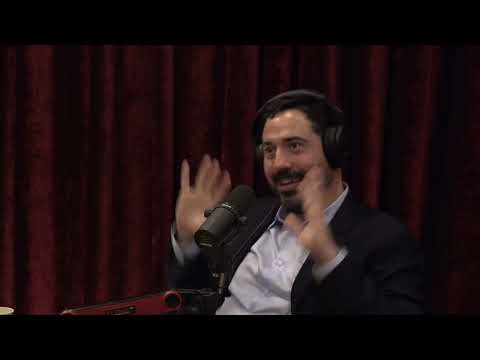
Joe Rogan Experience #1795 - Antonio Garcia Martinez
Antonio García Martínez (guest), Narrator, Joe Rogan (host), Narrator
In this episode of The Joe Rogan Experience, featuring Antonio García Martínez and Narrator, Joe Rogan Experience #1795 - Antonio Garcia Martinez explores from Ukraine’s Frontlines to Big Tech’s Power: Martinez Unfiltered Antonio García Martínez joins Joe Rogan to recount a recent trip to Poland and Ukraine, describing the immense human cost of Russia’s invasion, the logistics of refugees, and the intense national resolve he witnessed on the ground.
From Ukraine’s Frontlines to Big Tech’s Power: Martinez Unfiltered
Antonio García Martínez joins Joe Rogan to recount a recent trip to Poland and Ukraine, describing the immense human cost of Russia’s invasion, the logistics of refugees, and the intense national resolve he witnessed on the ground.
They contrast the brutal reality of war with the distorted, U.S.-centric discourse on Twitter and cable news, criticizing conspiracies, culture-war framing, and the American habit of projecting domestic politics onto global crises.
The conversation then pivots to Martínez’s insider view of Big Tech: his role building Facebook’s ad-targeting engine, Apple’s privacy moves and their impact, his own ‘cancellation’ at Apple, and broader concerns about censorship, free speech, and digital power.
Throughout, they discuss human nature under stress—war, tribalism, religion, hustle culture, and fame—asking what people really need (and sacrifice) for meaning, safety, and honesty in a hyper-networked world.
Key Takeaways
The scale and gendered nature of Ukraine’s refugee crisis is staggering and underappreciated.
Around a quarter of Ukrainians are displaced, with millions of women and children crossing borders on foot or by ad-hoc transport, supported largely by volunteers and NGOs rather than tightly coordinated state systems.
Get the full analysis with uListen AI
The on-the-ground reality in Ukraine bears little resemblance to U.S. online discourse.
Local concerns focus on survival, defense, and national independence, while American Twitter obsesses over biolabs, Hunter Biden, or partisan hypotheticals; these are essentially irrelevant in Ukraine itself.
Get the full analysis with uListen AI
Ukrainian resolve and nationalism make long‑term Russian occupation extremely unlikely.
Martínez describes a unified “we will win” mentality across demographics and notes Ukraine’s size, geography, and mud-season logistics, arguing Russia lacks the manpower and local compliance to hold the country even if it takes more territory.
Get the full analysis with uListen AI
Apple’s privacy moves severely weaken third‑party ad targeting and reshape the ad ecosystem.
By restricting device-level tracking and forcing app-level opt‑ins, Apple has undercut Facebook’s granular targeting, reducing ad efficiency and signaling a shift toward on-device data processing that Apple itself tightly controls.
Get the full analysis with uListen AI
People routinely trade privacy for convenience, community, and security—often unconsciously.
Martínez argues privacy is less an absolute right in practice and more a negotiable commodity; users happily give up data for better maps, free services, and social connection, rarely perceiving the trade-off clearly.
Get the full analysis with uListen AI
Internal activist mobs can drive high-profile corporate decisions, even in giant firms.
His Apple firing, triggered by a small but loud Slack campaign over selective quotes from his book, shows how management can panic in the face of internal outrage, despite prior knowledge of the work and minimal employee participation.
Get the full analysis with uListen AI
Censorship and deplatforming risk eroding foundational free-speech norms and trust.
Rogan and Martínez see bans like those of the Babylon Bee and Trump as part of a mission creep where platforms shift from policing direct harm to enforcing ideological norms, fueling interest in decentralized, censorship-resistant Web3 alternatives.
Get the full analysis with uListen AI
Notable Quotes
“The Ukrainians are super nationalistic. This is their nationhood birthing moment.”
— Antonio García Martínez
“It’s hell on earth that’s happening there.”
— Antonio García Martínez
“We have the freedom to be incredibly creative and innovative…and you also have to have the freedom to just follow stupid ideas to their event horizon.”
— Joe Rogan
“Are you actually an independent thinker, or are you really just a contrarian asshole?”
— Antonio García Martínez
“You never go further than when you don’t know where you’re going.”
— Joe Rogan
Questions Answered in This Episode
How should policymakers and media balance graphic real-time coverage of war with the risk of desensitization or propaganda overload?
Antonio García Martínez joins Joe Rogan to recount a recent trip to Poland and Ukraine, describing the immense human cost of Russia’s invasion, the logistics of refugees, and the intense national resolve he witnessed on the ground.
Get the full analysis with uListen AI
If internal activist groups can effectively ‘veto’ hires at massive companies, what safeguards or norms should exist to protect due process and viewpoint diversity?
They contrast the brutal reality of war with the distorted, U. ...
Get the full analysis with uListen AI
Where is the ethical line between useful ad personalization and manipulative surveillance, and who should have the power to draw that line?
The conversation then pivots to Martínez’s insider view of Big Tech: his role building Facebook’s ad-targeting engine, Apple’s privacy moves and their impact, his own ‘cancellation’ at Apple, and broader concerns about censorship, free speech, and digital power.
Get the full analysis with uListen AI
Could a decentralized, Web3-based social network meaningfully protect free speech at scale without devolving into abuse and lawlessness?
Throughout, they discuss human nature under stress—war, tribalism, religion, hustle culture, and fame—asking what people really need (and sacrifice) for meaning, safety, and honesty in a hyper-networked world.
Get the full analysis with uListen AI
Does modern comfort and abundance inevitably push societies toward manufactured conflicts (culture wars), and if so, what non-destructive outlets could replace that impulse?
Get the full analysis with uListen AI
Transcript Preview
(drumbeats) Joe Rogan podcast, check it out. The Joe Rogan Experience.
Train by day, Joe Rogan podcast by night, all day. (instrumental music)
Joe Rogan. So what's up, man? How are you?
Thanks for having me, Joe. I'm very excited to be here.
My pleasure. It's always interesting to meet somebody that you only know from their tweets.
(laughs)
You know, I only know you from your tweets, which I found very interesting, and then I started reading your book or listening to your book, or another person reads it, and, uh, I've seen some interviews with you, so I thought it'd be fun to have you in there.
Cool. Thank you.
Have a little chitchat.
Great. Thanks for having me, Joe.
(laughs) My pleasure. So you just got back from Ukraine?
Y- I know. I'm, I'm totally throwing a wrench in the agenda.
No, there was no agenda.
We're supposed to talk about cancellation or whatever, but, yeah, I, for a bunch of reasons, I just up and went to Poland and Ukraine to see what was going on there.
So this was just your own idea to just take a trip?
N- not totally. One of the gigs I have, I, I have a gig at a, at a DC think tank, and one of my colleagues who's done like real in the field correspondent work before proposed a trip, and a bunch of people expressed interest, and I'm basically the only one who didn't wimp out and (laughs) and went with him. Uh-
So it was just you and this one guy?
And we had, you know, drivers and fixers and stuff, 'cause I, I don't speak any Slavic languages, and y- you basically need it to sort of navigate that world. A- and also, in a, in a wartime economy, regular transport doesn't work, so y- you need to get around somehow, and so w- we did have, we, we tended to have a driver usually.
So what is that conversation like? So when someone says, "Hey, let's go to Ukraine"-
Yeah.
... y- w- like, w- what was the goal? Was it just to see it firsthand? Was it to get... Is there any information that you can get when you're on the ground that would sort of g- clarify the situation for you?
Yeah. I mean, we can get into this, but I think th- the view that you see of Ukraine from the United States I think is so blinded by both American domestic political, you know, priorities and the whole, the whole kaleidoscope that is the Twitter experience, I felt you have to go there to see the real thing. And, um, you know, it's, it's history with a capital H in the sort of, you know, Francis Fukuyama sense of, you know, th- this is, this is a real, this is a real invasion, th- the likes of which we haven't seen in Europe in, whatever, 70 plus years. And it's just something that... I've lived in Europe, I, I have an EU passport, so I, I feel a little bit European in, in that regard, so I think I engage with the story a little bit differently than maybe than Americans do, and so I felt I just had to go there and, and see it for myself.
Install uListen to search the full transcript and get AI-powered insights
Get Full TranscriptGet more from every podcast
AI summaries, searchable transcripts, and fact-checking. Free forever.
Add to Chrome