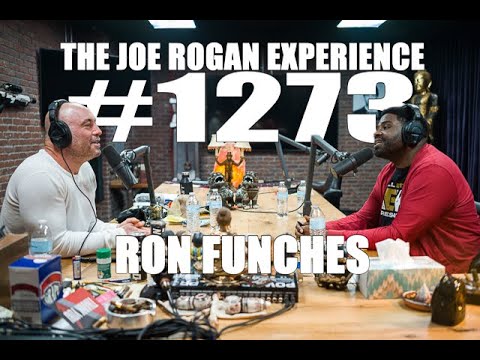
Joe Rogan Experience #1273 - Ron Funches
Ron Funches (guest), Joe Rogan (host), Jamie Vernon (guest), Guest (guest)
In this episode of The Joe Rogan Experience, featuring Ron Funches and Joe Rogan, Joe Rogan Experience #1273 - Ron Funches explores ron Funches and Joe Rogan Deconstruct Comedy, Hustle, Health, Humanity Joe Rogan and Ron Funches spend the episode dissecting standup comedy as both craft and psychology—how intent, energy, and honesty separate fake anger from real pain on stage and why great sets feel like mass hypnosis.
Ron Funches and Joe Rogan Deconstruct Comedy, Hustle, Health, Humanity
Joe Rogan and Ron Funches spend the episode dissecting standup comedy as both craft and psychology—how intent, energy, and honesty separate fake anger from real pain on stage and why great sets feel like mass hypnosis.
They trace Ron’s 160-pound weight loss and career rise from call-center worker and struggling single dad to established comic, tying discipline in health and writing to long‑term creative freedom and success.
The conversation ranges through drug policy, rap and pro wrestling, jiu-jitsu and chess, overfishing and plastic in the oceans, using these topics to probe how people learn, adapt, and find their own path in life.
Throughout, they stress that comedy is a meritocracy built on effort, authenticity, and constant improvement, and that most people underestimate both their own potential and how much their environment shapes them.
Key Takeaways
Comedy works when the audience can feel your intent, not just hear your words.
Rogan and Funches emphasize that the same joke can either crush or bomb depending on whether the anger is theatrically playful (Lewis Black, Brody Stevens) or rooted in real, fresh pain—audiences subconsciously read body language, tone, and that tiny ‘wink’ that signals safety.
Get the full analysis with uListen AI
Mastery in standup often emerges after a decade-plus of deliberate practice.
They describe the first 10 years as earning a ‘PhD in comedy’; only after long, hard years do many comics truly find their voice, structure, and confidence, sometimes doing their best work 15–16 years in.
Get the full analysis with uListen AI
Treat your craft like a professional even when the room is nearly empty.
Mooney’s praise of Rogan for doing a full, committed set for a tiny audience illustrates a key standard: real comics bring their best effort regardless of crowd size, instead of half‑assing and protecting their ego with excuses.
Get the full analysis with uListen AI
Sustainable creativity requires building new material, not just protecting your ‘best 15.’
Funches explains how over‑relying on his strongest bits left him with ‘nothing in the kitchen’; he now structures his life (joking household, notes everywhere) to constantly catch ideas and keep growing instead of stagnating.
Get the full analysis with uListen AI
Radical lifestyle change is possible but demands sustained discipline and mindset shift.
Ron’s move from 360 to ~220 pounds took about 2. ...
Get the full analysis with uListen AI
Health is foundational to both performance and quality of life.
Both note how good nutrition and regular exercise dramatically improve mood, endurance, and mental clarity; that perpetual ‘ugh’ many people feel is often a long‑term nutrition deficit and chronic inflammation, not an unavoidable baseline.
Get the full analysis with uListen AI
There is no single ‘right’ way to live or create; comparison is a trap.
They argue that most advice is filtered through the giver’s own limits and fears; careers, art, and even moral frameworks (religion, politics) are multiple overlapping ‘stories,’ and progress comes from understanding others’ paths rather than reflexively dismissing or copying them.
Get the full analysis with uListen AI
Notable Quotes
““Comedy is such a deep thing… it’s not just about the words, it’s about the intent behind the words.””
— Ron Funches
““You’re essentially a PhD in comedy when you got 10 years in.””
— Joe Rogan
““I’m a more of a fisher than a hunter… I make my house so that we’re constantly always joking around, notebooks everywhere, so when an idea comes I make sure I catch it.””
— Ron Funches
““If I don’t try my best and it doesn’t work, you feel like shit… If I do my best and it doesn’t work, I feel like a failure rather than a loser.””
— Joe Rogan
““So many people can do it… I’m a testament to that because I should not be here.””
— Ron Funches
Questions Answered in This Episode
How do you personally tell the difference between ‘fake’ and ‘real’ anger or emotion in a comedian’s performance?
Joe Rogan and Ron Funches spend the episode dissecting standup comedy as both craft and psychology—how intent, energy, and honesty separate fake anger from real pain on stage and why great sets feel like mass hypnosis.
Get the full analysis with uListen AI
What systems or environments could you create in your own life that, like Ron’s, keep you constantly catching and developing new ideas?
They trace Ron’s 160-pound weight loss and career rise from call-center worker and struggling single dad to established comic, tying discipline in health and writing to long‑term creative freedom and success.
Get the full analysis with uListen AI
If you treated your health as a requirement for doing your best work—not an optional side project—what specific changes would you make first?
The conversation ranges through drug policy, rap and pro wrestling, jiu-jitsu and chess, overfishing and plastic in the oceans, using these topics to probe how people learn, adapt, and find their own path in life.
Get the full analysis with uListen AI
Where might you be holding yourself back because you’re comparing your path to others instead of embracing your own timing and style?
Throughout, they stress that comedy is a meritocracy built on effort, authenticity, and constant improvement, and that most people underestimate both their own potential and how much their environment shapes them.
Get the full analysis with uListen AI
How should society balance individual freedom (e.g., drugs, diet, career choices) with the collective consequences we’re now seeing in health, crime, and the environment?
Get the full analysis with uListen AI
Transcript Preview
... the difference I'm learning between when I do comedy and acting is that, like, the last thing people really wanna see from y- you on stage is you really get emotional.
Yeah.
You know? But when you act, you have to go to that (snaps fingers) right away.
Big difference. (clicking sound) We're live? Is it working?
Just, just got it up, yeah.
Oh, my Jesus.
Just started working just now.
(laughs)
Right at the end of that.
A candid moment. No, I, I think you're totally right. We're ... Ron Funches and I were talking about people getting mad. First of all, welcome to the show, sir. Thanks for having me.
Thanks for being here, man. Appreciate it.
Of course.
Um, we were talking about people getting emo- getting emotional on stage, if people get angry on stage that, um, it shows. The audience can feel it. You could say the exact same words and with, with, like, a fake anger, as we were saying, like, Brody was really good at. Like, he'd, he would fake be mad at you.
Yeah.
And it was, it was-
Lewis Black.
Yes.
Yeah.
If you could see those exact same words, there's, like, a smile to it, right? You were saying that there's a nod or a hint-
Mm.
... hint of a nod.
Yeah, there's a little wink that lets you know that this isn't ... this is a joke.
Yeah.
I'm not really this mad about it. And there's usually an absurdity of the ... about the thing they're mad at.
Yes.
You know?
Yeah.
When you get ... We also see those sets sometimes when, like, someone's recently broken up with somebody-
Oh.
... or something and then you, like ... You get that real anger.
Mm-hmm.
And you could say something funny, but, like, it's too fresh. It's too-
Yeah.
... real and people just don't wanna hear it.
(laughs) They don't wanna hear it.
Yeah.
It makes them feel uncomfortable. We were talking about how weird it is that, that you could actually have something that sounded so similar to that, but we could tell the difference. Like, with the exact same words, you know, with enthusiasm. Just something's off about it.
Mm-hmm.
Something's off about it that you know it's funny, versus something's off about it where you know that person's serious. And a pers- ... Like, I was ... We were just saying, try to explain that to someone who doesn't understand English or doesn't understand human communication. They'd be like, "What?"
Yeah.
"How can you tell?" Like, "How can you tell it's fake? How can you tell it's fake anger?"
Yeah. That's what makes, I mean, the language so fun.
Yes.
Install uListen to search the full transcript and get AI-powered insights
Get Full TranscriptGet more from every podcast
AI summaries, searchable transcripts, and fact-checking. Free forever.
Add to Chrome