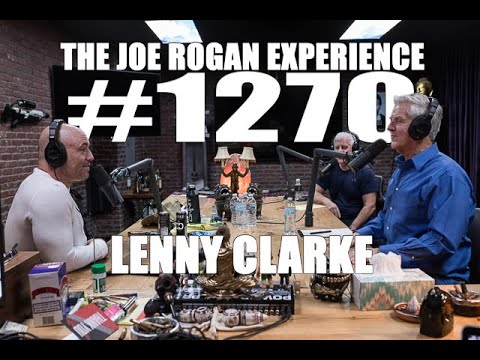
Joe Rogan Experience #1270 - Lenny Clarke
Joe Rogan (host), Lenny Clarke (guest), Mike Clarke (guest), Guest (unidentified, brief commenter) (guest), Joe Rogan (host)
In this episode of The Joe Rogan Experience, featuring Joe Rogan and Lenny Clarke, Joe Rogan Experience #1270 - Lenny Clarke explores cocaine, Comedy, And Comebacks: Lenny Clarke’s Wild Standup Saga Joe Rogan sits down with veteran Boston comic Lenny Clarke and his brother/club owner Mike Clarke for a sprawling, explicit tour through 40 years of standup, drugs, and show business. They revisit the legendary Boston comedy scene—its brutal club culture, cocaine-fueled pace, and the expectation to crush onstage every night. Lenny details his extreme substance abuse, near-death health scares, and eventual long-term sobriety, contrasting past chaos with his current disciplined lifestyle. Along the way they tell behind-the-scenes stories about figures like Rodney Dangerfield, Sam Kinison, Louis C.K., and network executives, touching on career sabotage, joke theft, the MeToo era, and the changing rules of comedy.
Cocaine, Comedy, And Comebacks: Lenny Clarke’s Wild Standup Saga
Joe Rogan sits down with veteran Boston comic Lenny Clarke and his brother/club owner Mike Clarke for a sprawling, explicit tour through 40 years of standup, drugs, and show business. They revisit the legendary Boston comedy scene—its brutal club culture, cocaine-fueled pace, and the expectation to crush onstage every night. Lenny details his extreme substance abuse, near-death health scares, and eventual long-term sobriety, contrasting past chaos with his current disciplined lifestyle. Along the way they tell behind-the-scenes stories about figures like Rodney Dangerfield, Sam Kinison, Louis C.K., and network executives, touching on career sabotage, joke theft, the MeToo era, and the changing rules of comedy.
Key Takeaways
The Boston comedy scene forged killers by demanding nonstop new material and unforgiving performances.
Comics worked 6–7 nights a week for cash in multiple clubs, where regulars saw every show and would openly heckle or dismiss weak sets, forcing comics to write fast, hit hard, and adapt to different crowds.
Get the full analysis with uListen AI
Heavy cocaine and alcohol use nearly killed Lenny and derailed multiple career opportunities.
He describes heart rates near 300 bpm, over 100 defibrillations, insane binges in Colombia, and blowing high-paying TV and film deals by being out of control in meetings and auditions.
Get the full analysis with uListen AI
Long-term sobriety for Lenny was driven by fear of death, relentless support, and replacing addictions with structure.
An AA intervention during a bender, a tough sponsor, and a commitment to meetings and physical training allowed him to stay clean for over two decades, lose massive weight, and rebuild his life and career.
Get the full analysis with uListen AI
Power and ego in Hollywood can end careers over a single misstep or offhand comment.
Lenny recounts being fired from Fox and losing a multi-million-dollar CBS film deal for small attempts at being “funny” with powerful executives, illustrating how fragile success can be.
Get the full analysis with uListen AI
The MeToo era has blurred lines between accountability, overcorrection, and opportunism.
The conversation about Louis C. ...
Get the full analysis with uListen AI
Joke theft has shifted from being culturally accepted to heavily policed by audiences.
Stories of comics lifting Carson’s monologue or Woody Allen bits contrast with today’s environment, where YouTube, social media, and fan scrutiny make stealing material much harder to get away with.
Get the full analysis with uListen AI
Standup comedy is evolving from a cutthroat, zero-sum game into a more collaborative ecosystem.
Rogan points out that podcasting, social media, and a larger market mean comics now often help each other with stage time and exposure, rather than competing for a few TV slots as in the Carson/HBO era.
Get the full analysis with uListen AI
Notable Quotes
“No one's fucked up my life more than myself.”
— Lenny Clarke
“He lost 30 million dollars, Joe. People that think he didn’t suffer are crazy.”
— Mike Clarke on Louis C.K.
“If you could be the richest person or the most famous person, what would it be? … Six weeks later: you’re right. I’d rather be the richest. The fame shit’s a bunch of bullshit.”
— Lenny Clarke recounting a conversation with Don Gavin
“You can’t stay clean on yesterday’s shower.”
— Lenny Clarke quoting his sponsor Phil Baroneau
“The problem with people that have so much power is they want you to suck their dick every second of the day.”
— Joe Rogan
Questions Answered in This Episode
How much of the old Boston comedy culture—its brutality and its drugs—was necessary for greatness, and how much was simply destructive?
Joe Rogan sits down with veteran Boston comic Lenny Clarke and his brother/club owner Mike Clarke for a sprawling, explicit tour through 40 years of standup, drugs, and show business. ...
Get the full analysis with uListen AI
What specific mental shifts and daily routines allowed Lenny to maintain sobriety after such an extreme lifestyle, and could they be generalized to others in entertainment?
Get the full analysis with uListen AI
Where should the line be drawn between serious sexual misconduct and socially awkward or consensual-but-weird behavior when determining if a performer deserves a career back?
Get the full analysis with uListen AI
How has the easy documentation of material (phones, YouTube) changed the craft of joke writing and the policing of joke theft?
Get the full analysis with uListen AI
Do modern, more collaborative comedy ecosystems produce standups as strong as the old cutthroat systems, or does some pressure and scarcity actually sharpen the art?
Get the full analysis with uListen AI
Transcript Preview
Five, four, three, two, one. Fucking yeehaw. (clapping) Lenny Clarke, ladies and gentlemen-
(laughs)
... and his brother, Mike. Mike Clarke, the second man to ever give me paid work ever in my entire professional career-
(laughs)
... opening up for Lenny at Jay's in Pittsfield.
(laughs) Yeah.
Right?
Right, yeah.
Shit, yeah.
Yeah, I remember that place, yeah.
Norm the Foe gig.
For... And I don't even know if Norm's around anymore, but I remember that gig like it was yesterday.
That guy paid my rent many times, many times.
Mm-hmm. Good guy.
And you did too.
Yeah.
Working for you paid my rent ma-... I worked for- (laughs)
(laughs)
I worked for Mike one of the craziest gigs I ever did. Yeah, I think it was a one-and-done. You never did it again. It was a restaurant. And I was in the seating area. And the microphone for the people when they announce their table was tied-
(laughs)
... to the PA system.
(laughs)
So you'd be in the middle of this punchline. You'd be like, "So I said to the guy, 'Clarke, party of two.'"
(laughs)
"Party of two, Clarke, your table's ready."
(laughs)
Like, oh, no.
Was that... That was at the Mexican place down at the Cape, wasn't it?
Down at the Cape? No, it wasn't a Mexican place.
(clears throat)
It was a seafood place.
Oh.
Yeah.
Oh, I, I had a lot of one-nighters back in the day.
(laughs)
Yeah.
Well, that was the beautiful thing about being a comic in Boston is that if you lived in Boston, you could go anywhere within, like, an hour or two hours outside the city and work basically every weekend.
Yeah, it was-
That w-
It was Tuesday through Sunday, Joe.
Yeah, yeah, yeah.
You know? There w- w- we were working seven nights a week at one point.
That's crazy.
There was so much b-... You know? And, and cash.
Yeah, cash.
Very cash. Cash is king.
Cash. Well, it was amazing, but it was also terrible because a lot of people were very bad with the taxes.
(laughs)
And they, uh, they-
I always p-... My mother told me, "Don't fool around with the taxes or the mob."
You might've been the only guy.
Oh, I paid. I, I paid.
But you might've been the only guy. Everybody else got hamstringing.
Yup, Noxie got killed. Kenny got killed. Yeah, yeah.
Yeah, they all got killed. And then when they got killed, it was like hundreds of thousands.
Oh, it was bad.
'Cause it was years and years. And, you know, and you gotta make that up, like fuck.
Install uListen to search the full transcript and get AI-powered insights
Get Full TranscriptGet more from every podcast
AI summaries, searchable transcripts, and fact-checking. Free forever.
Add to Chrome