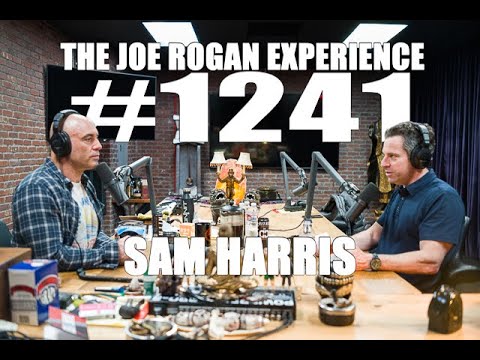
Joe Rogan Experience #1241 - Sam Harris
Joe Rogan (host), Sam Harris (guest), Narrator, Narrator
In this episode of The Joe Rogan Experience, featuring Joe Rogan and Sam Harris, Joe Rogan Experience #1241 - Sam Harris explores free Speech, Outrage Culture, and Redemption: Rogan and Harris Unfiltered Joe Rogan and Sam Harris dissect Rogan’s controversial interview with Twitter CEO Jack Dorsey, exploring platform censorship, advertiser influence, and the structural limits of CEOs’ knowledge and public answers.
Free Speech, Outrage Culture, and Redemption: Rogan and Harris Unfiltered
Joe Rogan and Sam Harris dissect Rogan’s controversial interview with Twitter CEO Jack Dorsey, exploring platform censorship, advertiser influence, and the structural limits of CEOs’ knowledge and public answers.
They compare their podcast models (live, ad-supported vs. edited, subscriber-supported), and unpack how social media, comments, and business incentives shape public perception and creator behavior.
The conversation broadens into online outrage culture, identity politics, redemption and apology norms, and high‑profile cases like Liam Neeson, Covington Catholic, Megyn Kelly, Norm Macdonald, and Louis C.K.
Harris also discusses his meditation app, the illusion of free will, and the need for mental training and mindfulness to navigate anger, conflict, and the escalating toxicity of digital life.
Key Takeaways
Advertiser relationships create perceived—but not always real—conflicts of interest.
Rogan stresses that Jack Dorsey’s Cash App sponsoring his podcast did not influence his questions, yet many viewers assumed soft treatment was bought. ...
Get the full analysis with uListen AI
Live vs. edited podcasts fundamentally change how candid and risky conversations can be.
Rogan’s live, unedited format amplifies blowback and leaves no room to ‘redo’ sensitive moments, while Harris’s edited model lets guests correct themselves and reduces career risk—shaping who will talk, and how boldly, on each platform.
Get the full analysis with uListen AI
Outrage culture punishes missteps but offers no coherent path to redemption.
Cases like Liam Neeson, Megyn Kelly, Norm Macdonald, and teenage yearbook scandals reveal that even sincere, detailed apologies often fail; there is no agreed standard for when someone has ‘done enough’ to rejoin public life.
Get the full analysis with uListen AI
Identity politics and extreme social‑justice policing may cost the left electoral ground.
Harris argues that framing all immigration concern or Trump support as racism alienates moderate voters (including Obama‑to‑Trump voters) and risks handing 2020 to Trump if Democrats center campaigns on purity tests and “oppression Olympics.”
Get the full analysis with uListen AI
We need to normalize mental training, not just physical training, to handle digital life.
Harris likens meditation and mindfulness to learning to read or exercise: once trained, they become automatic capacities. ...
Get the full analysis with uListen AI
Understanding free will as an illusion encourages more humane responses to wrongdoing.
Harris contends that people don’t author themselves; genes, environment, and brain states determine behavior. ...
Get the full analysis with uListen AI
Competence in violence should be paired with strong norms of avoidance and de‑escalation.
Stories about street fights, self‑defense law, and Mike Tyson’s upbringing illustrate that knowing how to fight (or wield weapons) without emotional regulation and respect for consequences can ruin lives in a single moment.
Get the full analysis with uListen AI
Notable Quotes
“Everyone expects their digital content for free. Ads have anchored people to the illusion of free.”
— Sam Harris
“We need to think through the whole process of redemption for people in our society.”
— Sam Harris
“I have plenty of money. I’m free to do whatever I want to do.”
— Joe Rogan
“It becomes a kind of superpower to be able to say, ‘Do I need to be angry about this?’”
— Sam Harris
“To be a human being is complicated. To be a man in the face of altercations with other men is uniquely complicated.”
— Joe Rogan
Questions Answered in This Episode
What should a fair, widely accepted standard for public apology and redemption look like in the social‑media era?
Joe Rogan and Sam Harris dissect Rogan’s controversial interview with Twitter CEO Jack Dorsey, exploring platform censorship, advertiser influence, and the structural limits of CEOs’ knowledge and public answers.
Get the full analysis with uListen AI
How can platforms like Twitter or YouTube increase transparency about enforcement without compromising safety or privacy?
They compare their podcast models (live, ad-supported vs. ...
Get the full analysis with uListen AI
Is there a sustainable middle ground between ad‑based and subscription‑based content models that preserves creator independence and audience access?
The conversation broadens into online outrage culture, identity politics, redemption and apology norms, and high‑profile cases like Liam Neeson, Covington Catholic, Megyn Kelly, Norm Macdonald, and Louis C.K.
Get the full analysis with uListen AI
To what extent are identity politics and cancel culture organic grass‑roots movements versus dynamics amplified and distorted by social platforms’ incentives?
Harris also discusses his meditation app, the illusion of free will, and the need for mental training and mindfulness to navigate anger, conflict, and the escalating toxicity of digital life.
Get the full analysis with uListen AI
How might integrating mindfulness and emotional regulation into school curricula change the way the next generation handles conflict, outrage, and digital life?
Get the full analysis with uListen AI
Transcript Preview
... five, four, three, two... (claps) Hello, Sam Harris.
Hey, man.
Good to see you.
Ha- happy to be here. It's great.
Good. I listened to your podcast with Jack. Let's just get right into the-
Let's jump in.
... the Jack stuff.
Yeah.
'Cause I listened to your podcast with Jack, and I found something very... When I did my podcast with Jack, first of all, was not anticipating the blowback that I received. It was-
Yeah.
... stunning. Uh, but, um, he... What, what I thought was... I was just gonna have a conversation with this guy, be fun, see what it's like to run this gigantic network that helps people communicate. You o- You okay, Jamie?
I'm good. I'm good.
All right. Helps people communicate-
(clears throat)
... and distribute information worldwide. What is it like to start something like that up and have it become what it is? Like, how have you managed to try to keep up with it and what have the headaches been?
Right.
Apparently, people online, particularly the people that wanna comment about this, all they wanted to know about was censorship. And that was an issue with me, there was a question with me, but it became a far... It was a far bigger question for people online. They felt like that I tossed him softball questions, um, and that I didn't press him.
Yeah.
And then I listened to your podcast. And, uh, one thing about Jack is very smart guy, very nice guy, but he talks in a very slow and methodical way. And when you ask him a question, he takes these routes. And if you don't wanna jump in and press him, like, you're in this weird situation where he's not totally answering your question-
Mm-hmm.
... but he's talking about the same subject that you're talking... Like, f- for instance, you brought up Louis Farrakhan.
Right.
Like how is Louis Farrakhan in good standing on the platform? And someone like, you know, fill in the blank, Milo Yiannopoulos or Laura Loomer or whoever it was, they get kicked off. He never got to that. He went around and around and around with you.
Yeah.
And, um, he recognized this after the podcast. Uh, I received a lot of blowback. He received a lot of blowback. So I, I contacted him and he said he'd be more than happy to come back on again and, and address all these things. And I said okay. What I'd like to do is address specific instances of people being censored. And he said, "Okay, what I'll do is I'll bring in someone from the company that's in charge of that stuff."
Right.
So I'm starting to put together a picture of what it's like to be a CEO of something as big... And he's also a CEO of Square. He's runs the Cash App. There's a lot of stuff going on there, right? So he's obviously busy. How much day-to-day involvement does he actually have and who gets censored and why they get censored and how much is he willing to share about that? So we're gonna find out in the next follow-up podcast, but I got accused of everything from being a shill, to being a cuck-
Install uListen to search the full transcript and get AI-powered insights
Get Full TranscriptGet more from every podcast
AI summaries, searchable transcripts, and fact-checking. Free forever.
Add to Chrome