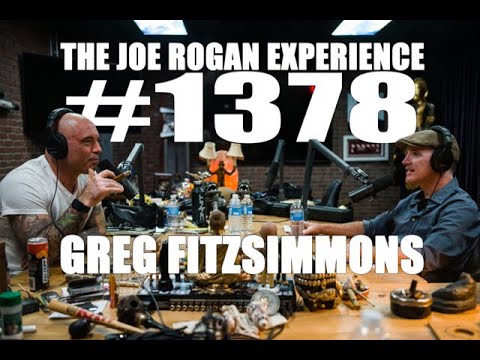
Joe Rogan Experience #1378 - Greg Fitzsimmons
Joe Rogan (host), Greg Fitzsimmons (guest), Narrator
In this episode of The Joe Rogan Experience, featuring Joe Rogan and Greg Fitzsimmons, Joe Rogan Experience #1378 - Greg Fitzsimmons explores joe Rogan and Greg Fitzsimmons Deconstruct Sobriety, Sex, and Society Joe Rogan and Greg Fitzsimmons have a long, free‑wheeling conversation that moves from sobriety, drugs, and creativity into comedy careers, TV, politics, and broader social issues. They compare their own relationships to alcohol and weed, talk about writing and stand‑up process, and trade stories from the road and from Hollywood. The discussion then swings into media culture, cancel culture, gender and trans issues in sports, homelessness, inequality, and how social media algorithms shape public discourse. Throughout, they mix serious social commentary with graphic, often absurd humor about bodies, sex, farts, and extreme fetishes.
Joe Rogan and Greg Fitzsimmons Deconstruct Sobriety, Sex, and Society
Joe Rogan and Greg Fitzsimmons have a long, free‑wheeling conversation that moves from sobriety, drugs, and creativity into comedy careers, TV, politics, and broader social issues. They compare their own relationships to alcohol and weed, talk about writing and stand‑up process, and trade stories from the road and from Hollywood. The discussion then swings into media culture, cancel culture, gender and trans issues in sports, homelessness, inequality, and how social media algorithms shape public discourse. Throughout, they mix serious social commentary with graphic, often absurd humor about bodies, sex, farts, and extreme fetishes.
Key Takeaways
Long‑term sobriety often means avoiding unnecessary risks, even if you technically “could” drink.
Fitzsimmons describes decades of sobriety shaped by witnessing his alcoholic father’s depression; he had a brief relapse around a friend’s death but deliberately chose not to reopen the door, framing it as, “Maybe I could drink, but why fuck with it?”
Get the full analysis with uListen AI
Psychoactive substances can supercharge creativity, but most of the output is disposable.
Rogan calls marijuana “steroids for writing,” saying his notebook explodes with ideas when he’s high, yet he freely admits at least half are garbage; the value is in volume and then ruthlessly extracting workable bits.
Get the full analysis with uListen AI
Effective creative work often comes from disciplined, unedited output followed by later refinement.
Both discuss freewriting methods (like “three pages without stopping” in the morning or late‑night essay‑style writing) as a way to surface subconscious material, then comb through it later to find the kernels that can become jokes or material.
Get the full analysis with uListen AI
Social media algorithms and shadowbanning now function as powerful, opaque gatekeepers of speech.
They argue that conservative and edgy viewpoints are often throttled or removed by platforms, citing examples of permanent bans for misgendering or joking about mild violence, and note that virality on YouTube or Twitter can outweigh traditional TV in influence.
Get the full analysis with uListen AI
Trans inclusion in women’s sports raises unresolved conflicts between identity and biological advantage.
Rogan insists that trans women who went through male puberty retain physical advantages (bone structure, prior testosterone exposure) that make competition against biological women fundamentally unfair, proposing a separate trans category rather than self‑ID into women’s divisions.
Get the full analysis with uListen AI
Homelessness and entrenched poverty require structural, multi‑layered solutions, not just jobs.
They point out that many homeless people face mental illness, addiction, impossible housing costs, and war‑zone‑like neighborhoods; simply offering work or temporary housing doesn’t fix deep trauma, lack of support, or systemic underfunding of services.
Get the full analysis with uListen AI
Cancel culture and “woke” compliance can suppress nuance and individual dialogue.
Using examples like T‑shirts telling white men to shut up, deadnaming rules, and Obama’s criticism of call‑out culture, they argue that moral purity policing often substitutes for genuine conversation, and that real progress requires face‑to‑face nuance rather than binary us‑versus‑them battles.
Get the full analysis with uListen AI
Notable Quotes
“Isn't it weird that we’re born with this brain and then all we talk about is changing it—getting fucked up, making ourselves dumber for the weekend?”
— Joe Rogan
“Maybe I could drink, but maybe I can’t. Why fuck with it?”
— Greg Fitzsimmons
“Most of it’s garbage… I’m not a .500 hitter in terms of creativity. If half of what I write is good, that would be amazing.”
— Joe Rogan
“If it comes to your life, be whoever you want. But when it comes to sports, you can fuck all the way off.”
— Joe Rogan (on trans women competing in women’s divisions)
“We have to look at inequality as our problem, not their problem.”
— Greg Fitzsimmons
Questions Answered in This Episode
How should sports organizations balance inclusion for trans athletes with preserving fairness for biological women?
Joe Rogan and Greg Fitzsimmons have a long, free‑wheeling conversation that moves from sobriety, drugs, and creativity into comedy careers, TV, politics, and broader social issues. ...
Get the full analysis with uListen AI
Where is the line between responsible content moderation and politically motivated censorship on major platforms?
Get the full analysis with uListen AI
What concrete, scalable policies could realistically improve outcomes in chronically impoverished, high‑crime communities?
Get the full analysis with uListen AI
To what extent do comedians have a responsibility to self‑censor in the current climate, versus pushing back against cancel culture?
Get the full analysis with uListen AI
How might our society change if we normalized more honest, face‑to‑face conflict resolution instead of online outrage and pile‑ons?
Get the full analysis with uListen AI
Transcript Preview
Three, two, one. Gregory!
Joseph!
Sober October's over, but, uh, we could-- we were allowed to smoke cigars during Sober October for whatever reason. But they do get you high.
They do give you a nice little buzz.
They do.
Yeah.
It's- it's weird that that's, like, thought of as being a sobriety thing. Like that, you ain't sober.
Is it really?
I mean, if you're smoking. People smoke cigarettes when they're sober.
Yeah.
All those, um, fucking AA guys, remember, right? Those guys were always-- these guys were always-
Those guys will tell you-
... smoking.
... you can't have a non-alcoholic beer, which I do. I have a non-alco- I even had a drink. It'll be 30 years next month that I haven't had a drink.
Didn't you have like one or two when Meany died?
When Meany died, I had some scotch.
That's a weird one, right?
I had like, I didn't get drunk, but I had like a few shots.
Did you, like, feel weird about that? I mean, all those years.
I think I felt so weird about him being dead that the whole thing felt surreal anyway. And, um, I haven't really, haven't had the desire- I can't say I had, can't have the desire. It's more of just, like, you- you- you feel like there's times where you wanna just do what everybody else is doing and just chill out. And you see everybody getting more mellow and relaxed and social.
Right.
And, uh, especially if I'm in a situation where , you know, it's a bunch of people I don't know that well, maybe it's your kids' friends' parent kinda situation.
Mm-hmm. Nice glass of wine to take the edge off.
(sighs) Dude.
Dude. But you did the- the couple glasses of scotch and then you didn't go right back to it.
Right.
Like you became a 21-year-old drunk Greg again.
Right. Well, a lot of it has to do with my father. And he was an alcoholic and I saw, I saw his depression. I have the same depression as he does and I felt, I felt like when I drank, it wasn't always for fun. It was a lot of times it was like dealing with feelings and bullshit like that.
Oh.
And so, I saw him as an unhappy guy who was unfulfilled in a lot of ways, and I saw the alcohol was a big part of why his life wasn't what it, what it could've been.
Right, right.
And I just sort of feel like, you know, maybe- maybe I could drink but maybe I can't. Why fuck with it?
No, why fuck with it? I tell you what, man. I just got done with a whole month of being sober, and then I had my first drinks this weekend. I felt like shit.
Install uListen to search the full transcript and get AI-powered insights
Get Full TranscriptGet more from every podcast
AI summaries, searchable transcripts, and fact-checking. Free forever.
Add to Chrome