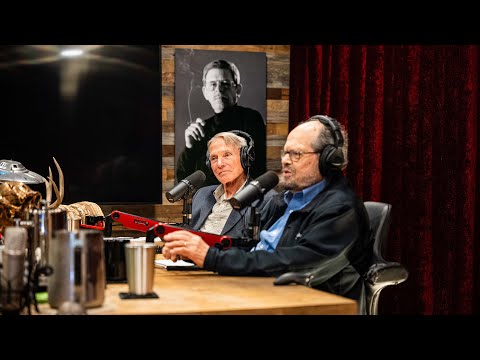
Joe Rogan Experience #2397 - Richard Lindzen & William Happer
Narrator, Richard Lindzen & William Happer (guest), Joe Rogan (host), Richard Lindzen & William Happer (guest), Joe Rogan (host), Narrator, Narrator
In this episode of The Joe Rogan Experience, featuring Narrator and Richard Lindzen & William Happer, Joe Rogan Experience #2397 - Richard Lindzen & William Happer explores physicists Challenge Climate Crisis Narrative, Expose Politics, Money, Censorship Joe Rogan interviews climate physicist Richard Lindzen (MIT/Harvard) and physicist William Happer (Princeton, former DOE official) about why they believe the mainstream climate crisis narrative is scientifically weak and politically driven.
Physicists Challenge Climate Crisis Narrative, Expose Politics, Money, Censorship
Joe Rogan interviews climate physicist Richard Lindzen (MIT/Harvard) and physicist William Happer (Princeton, former DOE official) about why they believe the mainstream climate crisis narrative is scientifically weak and politically driven.
They argue CO₂’s warming effect is modest, climate models are deeply uncertain, and historical temperature and CO₂ records don’t support catastrophic projections, while media and institutions aggressively suppress dissenting views.
Both describe systemic incentives—trillions in green spending, university overhead, political power, and ideological conformity—that they say have distorted climate science, funding, and public communication.
They warn that policies like net-zero mandates, nuclear phaseouts, and restrictions on fossil fuels and agriculture are already harming poor countries, energy security, and scientific progress more than climate itself.
Key Takeaways
CO₂’s direct warming effect is limited and often overstated.
Lindzen notes basic radiative physics suggests a CO₂ doubling alone yields roughly ~0. ...
Get the full analysis with uListen AI
Climate and weather are highly complex, regional, and not well captured by a single global temperature.
They emphasize that most ‘climate change’ is regional, driven by ocean circulation, geography, and orbital factors; a global mean temperature change of a degree or less is small compared to natural variability and daily swings.
Get the full analysis with uListen AI
Climate science has been heavily politicized and used to justify vast spending.
Both describe how, from the 1970s onward, environmentalism shifted into the energy sector (trillions of dollars at stake), with politicians and agencies favoring research that supports alarming narratives tied to net-zero and green subsidies.
Get the full analysis with uListen AI
Institutional incentives and peer review can enforce ideological conformity.
They recount papers questioning climate alarm being blocked or punished (editors fired, gatekeeping emails), funding steered toward ‘approved’ results, and university administrators prioritizing overhead from climate grants over open inquiry.
Get the full analysis with uListen AI
Media and activists selectively amplify fear while ignoring countervailing data.
They argue that extreme weather is used visually to sell catastrophe despite weak statistical links to CO₂, while trends like stable hurricane activity, sea-level changes without clear acceleration, and Arctic ice variability are downplayed.
Get the full analysis with uListen AI
Climate policies can harm the poor and undermine energy security.
Examples include developing nations blocked from building modern coal or gas plants, high electricity prices in the UK and Europe, Germany blowing up coal and nuclear plants, and pressure to cull cattle or reforest productive ranchland.
Get the full analysis with uListen AI
History shows science can be captured by bad ideas when tied to power.
They liken today’s climate-consensus culture to past episodes like eugenics and witch trials, where elite institutions, journals, and leaders endorsed pseudoscience for ideological or political reasons until reality or catastrophe intervened.
Get the full analysis with uListen AI
Notable Quotes
“Science is not a source of authority; it's a methodology.”
— Richard Lindzen
“If you have a theory that doesn’t agree with observations, it’s wrong. In climate science, nothing happens when predictions fail—the funding just keeps pouring in.”
— William Happer
“Destroying the world is not an easy thing to do. It shouldn’t be the top of your list of worries.”
— Richard Lindzen
“We’ve set back the serious study of climate by 50 years with this manic focus on CO₂.”
— William Happer
“It’s amazing that politicians can put forward a concept that is purely imaginary and have the science community discuss it seriously.”
— Richard Lindzen
Questions Answered in This Episode
If CO₂ is not a dominant ‘control knob’ for climate, what combination of factors best explains historical warm and cold periods, and how confident can we be in those attributions?
Joe Rogan interviews climate physicist Richard Lindzen (MIT/Harvard) and physicist William Happer (Princeton, former DOE official) about why they believe the mainstream climate crisis narrative is scientifically weak and politically driven.
Get the full analysis with uListen AI
How should funding agencies and universities be restructured to reduce political and financial bias in climate research while still supporting large-scale science?
They argue CO₂’s warming effect is modest, climate models are deeply uncertain, and historical temperature and CO₂ records don’t support catastrophic projections, while media and institutions aggressively suppress dissenting views.
Get the full analysis with uListen AI
What metrics and timeframes would provide a more honest, public-facing picture of climate risk than a single global average temperature or isolated extreme-weather images?
Both describe systemic incentives—trillions in green spending, university overhead, political power, and ideological conformity—that they say have distorted climate science, funding, and public communication.
Get the full analysis with uListen AI
How can societies balance real environmental stewardship (clean air, water, biodiversity) with the need for affordable, reliable energy in developing and developed countries?
They warn that policies like net-zero mandates, nuclear phaseouts, and restrictions on fossil fuels and agriculture are already harming poor countries, energy security, and scientific progress more than climate itself.
Get the full analysis with uListen AI
What concrete safeguards could prevent future scientific fields from being captured by ideology in the way the guests argue has happened with climate science?
Get the full analysis with uListen AI
Transcript Preview
(drumbeats) Joe Rogan podcast. Check it out. The Joe Rogan Experience. Train by day, Joe Rogan podcast by night, all day. (instrumental music) Gentlemen, first of all, thank you very much for being here. I really appreciate it.
Our pleasure.
My pleasure. And if you don't mind, would you please just tell everybody who you are and state your, uh, your resume, like what you do.
Oh.
I mean, just a f- a brief-
Yeah.
... version of your-
Uh.
... credentials.
I'm Dick Lindzen and, um, my whole life has been in academia. Basically, I finished my doctorate at Harvard and I did spend a couple of years, uh, at the University of Washington and in Norway and in Boulder, Colorado. Then, uh, part of that was because at Harvard, uh, I was working in atmospheric sciences, but they had no one who dealt with observations. So, I went to Seattle for someone who did. And then I got my first academic position at Chicago and stayed there about three, four years. Moved on to Harvard. Spent about 10 years there and then to MIT for about the last 35 years until I retired in 2013. Um, I've always enjoyed it. I mean, uh, the field of atmospheric sciences, when I entered it, I mean, the joy of it was a lot of problems that were solvable. So, you could, uh, look at phenomena, uh, one of them that I worked on was the sum- so called quasi-biannual cycle. Turns out, the wind above the equator, about 16 kilometers, 20 kilometers, goes from east to west for a year, turns around, goes the other way for the next year and so on. And, you know, we worked out why that happened and there were other things like that, so it was a very enjoyable period, uh, until global warming.
And sir, would you, uh, tell everybody what your credentials are, what you do, where you're from?
(clicks tongue) I'm Will Happer and I'm a retired professor of physics at Princeton and, uh, like, uh, Dick, I'm a science nerd. (laughs) But I was actually born in India under the British Raj. My father was a army officer in Indian Army, Scottish, and my mother was American and, uh, that was before World War II. So, when I came to America, uh, as- as a small child, uh, my mother was working in Oak Ridge for the Manhattan Project, so-
Wow.
... I remember, you know, the war days at Oak Ridge and, uh, that's probably why I went into physics, uh, I thought, "This looks like interesting way to make a living and if I can do it, I'll do it." And, and I have. And I've, uh, done a number of things. I spent a lot of time at universities, at Columbia, at Princeton. I also, uh, served for a couple years in Washington as Director of Energy Research, uh, under President Bush Sr. And, uh, I've learned a lot about climate from Dick, my colleague here. (laughs) Uh, I first became suspicious when I was Director of Energy Research. I would invite people in to explain how they were spending the taxpayers' money and most people were delighted to come to Washington and have some bureaucrat be interested in what they were doing. And there was one exception, that was the, uh, (laughs) people working on climate and they would always be very resentful. "You know, we work for Senator Gore. We don't work for you." And so I would tell them, "Well, uh, okay, let him pay for your next year's research. I- I can find other people who will come and talk to me, who'll be (laughs) glad to take my money."
Install uListen to search the full transcript and get AI-powered insights
Get Full TranscriptGet more from every podcast
AI summaries, searchable transcripts, and fact-checking. Free forever.
Add to Chrome