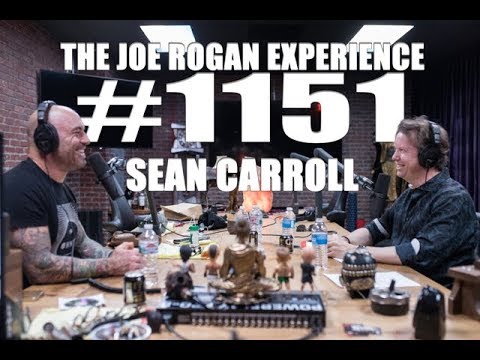
Joe Rogan Experience #1151 - Sean Carroll
Joe Rogan (host), Narrator, Sean Carroll (guest)
In this episode of The Joe Rogan Experience, featuring Joe Rogan and Narrator, Joe Rogan Experience #1151 - Sean Carroll explores sean Carroll, Joe Rogan Explore AI, Genetics, Death, and Meaning Joe Rogan and physicist Sean Carroll range widely across topics including Sean’s new podcast Mindscape, the culture of online discourse, politics, China’s social credit system, and the destabilizing effects of technology. They dive into universal basic income, automation, and genetic engineering with CRISPR, exploring designer babies, life extension, and the ethics of human enhancement. Carroll explains quantum mechanics, many‑worlds, and quantum computing in accessible terms, highlighting both what physics understands extremely well and what remains mysterious. Throughout, they return to deeper questions of free will, death, religion, and how humans will find meaning in a future reshaped by AI, biology, and brain–computer interfaces.
Sean Carroll, Joe Rogan Explore AI, Genetics, Death, and Meaning
Joe Rogan and physicist Sean Carroll range widely across topics including Sean’s new podcast Mindscape, the culture of online discourse, politics, China’s social credit system, and the destabilizing effects of technology. They dive into universal basic income, automation, and genetic engineering with CRISPR, exploring designer babies, life extension, and the ethics of human enhancement. Carroll explains quantum mechanics, many‑worlds, and quantum computing in accessible terms, highlighting both what physics understands extremely well and what remains mysterious. Throughout, they return to deeper questions of free will, death, religion, and how humans will find meaning in a future reshaped by AI, biology, and brain–computer interfaces.
Key Takeaways
Use podcasts and long-form conversations to break out of intellectual silos.
Carroll started Mindscape to talk not only to physicists but also to economists, historians, philosophers, and practitioners like chefs and poker players, arguing that serious ideas should cross disciplinary boundaries instead of being trapped in academic lanes.
Get the full analysis with uListen AI
Treat your public platform as serving your curiosity first, not the audience’s demands.
He insists he chooses topics and guests based on what he genuinely wants to understand, even if some fans say “stay in your lane,” because authenticity and sustained curiosity ultimately create better conversations and a healthier audience.
Get the full analysis with uListen AI
Prepare seriously for the social impact of AI, automation, and potential universal basic income.
They argue that millions of jobs could disappear quickly, and while UBI might unlock creativity for some and demotivate others, societies should be running real experiments and modeling consequences now instead of being blindsided.
Get the full analysis with uListen AI
Take genetic engineering and life-extension ethics seriously before the tech fully matures.
CRISPR and related tools will almost certainly enable embryo selection and gene edits for disease and, eventually, traits like height or intelligence; Carroll worries most about unequal access creating a biologically stratified society.
Get the full analysis with uListen AI
Brain–computer interfaces and enhanced bodies will blur the line between human and machine.
From advanced prosthetic hands that can play piano to Elon Musk’s proposed “neural lace,” they foresee a future where people can directly interface with computers, record everything they see, and even gain new sensory or cognitive capabilities.
Get the full analysis with uListen AI
Quantum mechanics works perfectly but is conceptually unresolved, and many‑worlds is a serious contender.
Carroll explains that the standard quantum recipe predicts experiments with stunning accuracy, yet physicists still disagree on what it *means*; his favored view is that the wavefunction is real and continually branches into multiple worlds rather than “collapsing.”
Get the full analysis with uListen AI
We can build meaning, morality, and a sane relationship with death without religion.
As an atheist, Carroll argues that purpose arises from our desires, relationships, and projects, not from a deity, and he supports “death‑positive” approaches and even psychedelics (like psilocybin) to help people face death more peacefully and honestly.
Get the full analysis with uListen AI
Notable Quotes
“I want to dissolve the boundary between science and the rest of our intellectual life.”
— Sean Carroll
“If you believe that robots will do most work someday, then we should be making it more and more possible for people to live without working.”
— Sean Carroll
“We’re opening up doors we never have before… and we don’t even have the capacity to ask the right questions about these things.”
— Sean Carroll
“Quantum mechanics is by far the most successful theory of physics ever invented—and we don’t understand it.”
— Sean Carroll
“We don’t need anything external to give us meaning. We just need to look at where we are already and try to make it better.”
— Sean Carroll
Questions Answered in This Episode
If CRISPR and embryo selection become cheap and routine, how should societies decide which genetic modifications, if any, ought to be legal or subsidized?
Joe Rogan and physicist Sean Carroll range widely across topics including Sean’s new podcast Mindscape, the culture of online discourse, politics, China’s social credit system, and the destabilizing effects of technology. ...
Get the full analysis with uListen AI
What concrete policies could help manage a transition where AI and automation rapidly displace millions of workers without igniting social unrest?
Get the full analysis with uListen AI
How would widespread brain–computer interfaces and always‑on recording change our concepts of privacy, memory, and even personal identity?
Get the full analysis with uListen AI
If the many‑worlds interpretation of quantum mechanics is right, does that change how we should think about risk, responsibility, or moral choices?
Get the full analysis with uListen AI
In a largely secular future where traditional religion fades, what institutions or practices could realistically replace the community, rituals, and death rituals religions currently provide?
Get the full analysis with uListen AI
Transcript Preview
(laughs)
All right.
Oh, wait a minute. Are we going live? Can-
Boom, and we're live. Mr. Carroll, how are you, sir?
Very good to be back.
Very good to have you back. So, uh, you have a podcast now.
I do. I've joined the ranks. You inspired me.
Well, you, uh, it's important.
(laughs)
We need people like you out there. Uh, you're, uh, you have, like, what, seven episodes so far?
Seven episodes up, got a few more in the can. Gonna try to drib 'em out once a week, uh, for the first six months or so, see how it goes. Yeah.
Are you enjoying the process?
I am. Mindscape, by the way, is the name, for those out there in podcast land. Yeah, I'm loving it. You know, the, the real, the thing that tilted me over toward doing it... 'Cause like, look, it's, I have a day job, right? I can't spend too much-
Yeah.
... time doing this stuff. Um, but what I realized, it was an excuse, uh, a license to talk to people who are not just physicists, right? 'Cause like-
Yes.
... I have intellectual interests that go way beyond just what I do for a living. And in academia, you're not allowed to take seriously anything other than your discipline, your job, right? I'm allowed to be talking about physics, but nothing else. But so now I can talk to historians and economists and philosophers and psychologists and it's great.
Well, you could've just gone to Evergreen State and then you could talk about anything.
(laughs)
I mean, you're teaching a professor, you could just, if you're a professor, you could teach them dance.
We have to break out-
Literally.
... of the system. We have to do it ourselves.
Yeah, man.
(laughs)
Gotta break outta that system. So your, uh, podcast, you decided that this would be a great venue for you to just, uh, expand on subjects and just get into anything that you'd like.
Well, you know, I, I have opinions about things, and I've never been one who's said you shouldn't talk about things unless you're a PhD-credentialed expert, right? I think everyone should be talking about everything, but you should know what your level of expertise is.
Yeah.
So if you're not an expert, you should listen to people, and you should then make your own decisions, but you should first gather the information. And so I don't feel quite like I can go... I, I have a blog, and I can write whatever I want on my blog, but I can't really expound on my theories of economics 'cause what do I know about economics?
Right.
But I can call up a, a very expert economist and chat with them on the podcast, and both I will learn something and hopefully the listeners will.
Install uListen to search the full transcript and get AI-powered insights
Get Full TranscriptGet more from every podcast
AI summaries, searchable transcripts, and fact-checking. Free forever.
Add to Chrome