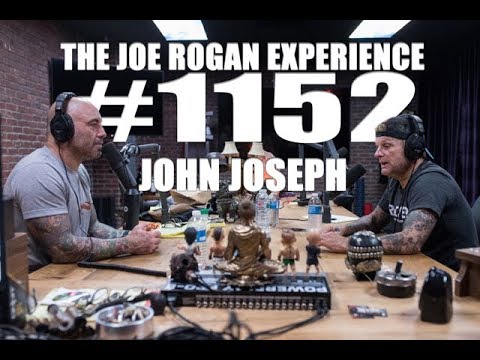
Joe Rogan Experience #1152 - John Joseph
John Joseph (guest), Joe Rogan (host), Narrator, Narrator, Narrator, Narrator, Narrator
In this episode of The Joe Rogan Experience, featuring John Joseph and Joe Rogan, Joe Rogan Experience #1152 - John Joseph explores from Street Violence to Vegan Ironman: John Joseph’s Transformative Journey Joe Rogan and John Joseph explore how identity politics around food—vegan vs. carnivore—mirror other toxic tribal divisions like politics and religion. Joseph explains why he rejects the label “vegan,” framing his life instead around Hare Krishna spirituality, PMA (Positive Mental Attitude), and service to others. He recounts his traumatic upbringing, time in foster care, incarceration, drug addiction, punk/hardcore history, and how yoga, plant-based eating, and writing helped him heal and become an endurance athlete and mentor. The conversation broadens into criticisms of social media outrage culture, Big Ag, pharmaceuticals, the prison-industrial complex, and the failures of modern politics, while emphasizing personal responsibility, compassion, and honest dialogue.
From Street Violence to Vegan Ironman: John Joseph’s Transformative Journey
Joe Rogan and John Joseph explore how identity politics around food—vegan vs. carnivore—mirror other toxic tribal divisions like politics and religion. Joseph explains why he rejects the label “vegan,” framing his life instead around Hare Krishna spirituality, PMA (Positive Mental Attitude), and service to others. He recounts his traumatic upbringing, time in foster care, incarceration, drug addiction, punk/hardcore history, and how yoga, plant-based eating, and writing helped him heal and become an endurance athlete and mentor. The conversation broadens into criticisms of social media outrage culture, Big Ag, pharmaceuticals, the prison-industrial complex, and the failures of modern politics, while emphasizing personal responsibility, compassion, and honest dialogue.
Key Takeaways
Avoid building your identity around what you eat.
Joseph warns that calling yourself “vegan” or “carnivore” can become a rigid tribal identity that fuels division; focusing on values, actions, and overall lifestyle is healthier than centering your entire self-concept on diet.
Get the full analysis with uListen AI
Lead with empathy, not purity tests, if you want real change.
Attacking people (e. ...
Get the full analysis with uListen AI
Trauma doesn’t define you; what you do with it does.
Influenced by writing teacher Robert McKee, Joseph reframed his childhood abuse and chaotic past: the critical factor is not the trauma itself but the choices and service you pursue afterward, turning pain into purpose.
Get the full analysis with uListen AI
Whole-food, plant-based eating is different from just being ‘vegan.’
He distinguishes between processed vegan junk food and an organic, whole-food plant-based diet, arguing that the latter—along with movement and a spiritual/mental practice—is what aligns with long-lived “blue zone” populations.
Get the full analysis with uListen AI
Use your platform to uplift, not to troll.
Both speakers criticize social media’s reward structure for outrage and dunking on others, noting that negative posts and pile-ons damage both the target and the poster’s self-respect while doing little to solve problems.
Get the full analysis with uListen AI
Rehabilitation requires opportunity, not just punishment.
Discussing his ‘30 to Life’ documentary, Joseph shows that ex-cons respond when treated as humans—given fitness, plant-based food, creative outlets, and job skills—highlighting that education and support beat warehousing people in cages.
Get the full analysis with uListen AI
Be skeptical of corporate and political narratives about health and safety.
They point to examples like Roundup/glyphosate, GMOs, aspartame approval, Big Pharma marketing, and manipulated wars to argue that profit often overrides public well-being, so individuals must read beyond headlines and look at who funds the data.
Get the full analysis with uListen AI
Notable Quotes
“I don’t like to put any type of label on myself… I’m more of a Hare Krishna Bhakti yoga person than I am a vegan.”
— John Joseph
“You have to be able to fan the spark, not throw water on it.”
— John Joseph
“It’s not what happens to somebody, it’s what they do as a result of it.”
— Robert McKee (as quoted by John Joseph)
“Should never say, ‘Fuck people,’ ’cause people are… They’re just like you. They’re human beings and everybody’s on a different path.”
— Joe Rogan
“Example’s better than precept. It ain’t what the fuck you say, it’s what you do.”
— John Joseph
Questions Answered in This Episode
How can someone deeply committed to a cause (like veganism) advocate passionately without falling into toxic identity politics or purity policing?
Joe Rogan and John Joseph explore how identity politics around food—vegan vs. ...
Get the full analysis with uListen AI
What practical steps can people with traumatic pasts take to begin turning their experiences into a source of strength and service to others?
Get the full analysis with uListen AI
Where is the line between necessary skepticism of corporations/government and falling into unproductive or unfounded conspiracy thinking?
Get the full analysis with uListen AI
How could prison systems be redesigned to genuinely prioritize rehabilitation and reintegration, based on what Joseph has seen work with ex-cons?
Get the full analysis with uListen AI
In an age of social media outrage and tribalism, what concrete habits can individuals build to foster more honest, compassionate, and nuanced conversations?
Get the full analysis with uListen AI
Transcript Preview
Must be from New York.
Yeah. Well, you can definitely tell that. Four, three, two (claps hands) , and we're live Jon Joseph.
What's happening?
What's up, brother? How are you, man?
Yo. This is like-
I'm excited.
Yeah, man.
And, uh, I'm excited too for, uh, I think it could set a nice precedent because there's so much fucking toxic energy between vegans and non-vegans. Even if we're just joking around, people get so fucking angry, and it's not necessary.
Absolutely. I mean, where's the humor? Where's the comedy?
Yeah.
I mean, the other thing is I don't sit around call ... Like, I'm not defined by what the fuck I eat. Like, like this dude said, "How come you don't call yourself a vegan?" I'm like, "'Cause I do a lot more shit than just eat plant-based food." It's part of what I do.
But don't you call yourself a vegan? I mean, you are a vegan, right?
Uh, I practice that, uh, lifestyle for sure, but I don't call myself a vegan. Um, uh-
That's interesting.
... I would say, uh, uh, people say, uh, "You know, how do you l-" ... I, I don't like to put any type of material-
Labels.
... label on myself. And if somebody says, you know, to me and pushes the issue, I'm like, "I'm more of a Hare Krishna Bhakti yoga person than I am a vegan." You know, even though I don't wear animal products, I don't use animal products, I, I eat a plant-based diet 100%. Um, but, uh, to call myself that just puts me in some, you know, some shelf, "Oh, it's just another vegan." Or whatever the fuck. You know, it's just-
Well, you know, it seems to me, it's like people are always searching for an identity, and if they have an identity that, uh, "No. I'm a, I'm a carnivore. I'm on the carnivore diet."
Yeah.
Which is all the latest trend.
Right.
And then people get really hopped up on that and that's all they wanna do is talk carnivore diet. So the, the, the difference between what's happening right now with this carnivore diet and vegans seems very similar to me in that they're very into the identity of their food.
Right.
Not, not their food choices, but certainly into the fact that this is how they identify. They talk about it all the time.
Yeah.
And I just think there's f- there's pitfalls in that. There's like traps that people fall into where they lock their identity into a group.
Absolutely.
And this is what happens with vegans, it happens to hunters, it happens with, uh, R- Republicans, happens with Democrats. It just becomes a group thing. And then you automatically oppose people of the other group and you, you have like, you have conflict with them. You have hate with them.
Install uListen to search the full transcript and get AI-powered insights
Get Full TranscriptGet more from every podcast
AI summaries, searchable transcripts, and fact-checking. Free forever.
Add to Chrome