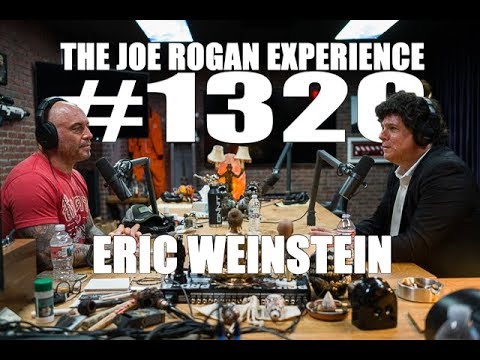
Joe Rogan Experience #1320 - Eric Weinstein
Joe Rogan (host), Eric Weinstein (guest), Guest (third voice, minor) (guest), Narrator, Narrator, Narrator, Guest (fourth voice, minor) (guest), Guest (fifth voice, minor) (guest), Narrator, Narrator, Narrator, Narrator
In this episode of The Joe Rogan Experience, featuring Joe Rogan and Eric Weinstein, Joe Rogan Experience #1320 - Eric Weinstein explores eric Weinstein and Joe Rogan explore portals, power, and peril This wide-ranging conversation moves from light banter about names and old comedy into a deep examination of modern life, technology, and attention. Weinstein and Rogan explore how constraints like Shabbat or rigorous routines can paradoxically create freedom in a world overwhelmed by digital communication. They dive into topics such as marine intelligence, the ethics of captivity, cannabis and sensory deprivation, and Weinstein’s “portal” metaphor for transformative ideas in science and culture. The episode culminates in Weinstein’s concerns about stalled theoretical physics, existential risk from our own technologies, and his announcement of a new podcast, *The Portal*, as a vehicle to explore these deeper questions.
Eric Weinstein and Joe Rogan explore portals, power, and peril
This wide-ranging conversation moves from light banter about names and old comedy into a deep examination of modern life, technology, and attention. Weinstein and Rogan explore how constraints like Shabbat or rigorous routines can paradoxically create freedom in a world overwhelmed by digital communication. They dive into topics such as marine intelligence, the ethics of captivity, cannabis and sensory deprivation, and Weinstein’s “portal” metaphor for transformative ideas in science and culture. The episode culminates in Weinstein’s concerns about stalled theoretical physics, existential risk from our own technologies, and his announcement of a new podcast, *The Portal*, as a vehicle to explore these deeper questions.
Key Takeaways
Deliberate constraints can create real freedom in an overconnected world.
Practices like Shabbat, disciplined routines, or hard rules about being offline carve out non-negotiable space for reflection, relationships, and deep work, counteracting the constant demand of texts, social media, and on-demand communication.
Get the full analysis with uListen AI
Our relationship with intelligent animals exposes both our ethical blind spots and potential.
Discussions about dolphins, orcas, sharks, and captivity show how little we understand other minds and how exploitative our systems can be, while also hinting that our coexistence with sophisticated nonhuman intelligence could teach us about cooperation and restraint.
Get the full analysis with uListen AI
Different delivery methods of the same drug can be entirely different experiences.
Weinstein and Rogan emphasize that edible cannabis, via the 11-hydroxy metabolite, is effectively a different, far more psychedelic substance than smoked THC—especially in sensory-deprivation tanks—underscoring the need for respect, context, and dose awareness.
Get the full analysis with uListen AI
Seemingly obscure math and biology can serve as ‘portals’ to deeper reality.
Objects like the octonions or the fully mapped C. ...
Get the full analysis with uListen AI
Culture-war activism can threaten the institutions we rely on to find truth.
Weinstein argues that when ideological agendas overrun scientific standards—e. ...
Get the full analysis with uListen AI
Online mobs and fringe groups are increasingly steering mainstream behavior.
The Andy Ngo/Portland Antifa case illustrates how violent fringes on left and right, tacitly tolerated or rationalized by a cowardly center, can normalize political violence and push ordinary people toward extremes.
Get the full analysis with uListen AI
Our technological power has outpaced our wisdom, demanding a new kind of seriousness.
With nuclear fusion, synthetic biology, and advanced computation, humanity now wields ‘godlike’ tools while retaining primate-level conflicts and biases; Weinstein believes we must either dramatically upgrade our wisdom or find ways—literal or metaphorical ‘portals’—to escape self-destruction.
Get the full analysis with uListen AI
Notable Quotes
““We are now gods, but for the wisdom.””
— Eric Weinstein
““Constraints… provide you some freedom by having restrictions, but it does.””
— Joe Rogan
““I became obsessed with exits—that there are other worlds and they’re real.””
— Eric Weinstein
““Get your fucking social engineering out of my laboratory.””
— Eric Weinstein
““Our best comedians have figured out how to be compassionate enough and kind enough, and touch the things that are animating us and making us uncomfortable.””
— Eric Weinstein
Questions Answered in This Episode
How convincing is Weinstein’s argument that we’re ‘gods without wisdom,’ and what concrete steps could realistically increase our collective wisdom fast enough?
This wide-ranging conversation moves from light banter about names and old comedy into a deep examination of modern life, technology, and attention. ...
Get the full analysis with uListen AI
Does the ‘portal’ metaphor help you reframe your own experiences with art, science, drugs, or travel as gateways to deeper understanding?
Get the full analysis with uListen AI
Where should we draw the line between legitimate social-justice reform and corrosive ideological interference in science and academia?
Get the full analysis with uListen AI
Are violent fringe groups like Antifa and their right-wing counterparts truly representative of political sides, or symptoms of deeper institutional failure?
Get the full analysis with uListen AI
If we fully mapped human ‘source code’—in physics or biology—how should that knowledge be governed to prevent catastrophic misuse?
Get the full analysis with uListen AI
Transcript Preview
... create, but without bullshit. It's very important when you recreate, you have no bullshit. So it's Eric Weinstein, not Weinstein.
Yeah, I think it was originally Weinstein.
Weinstein?
Shtein.
Oh, Weinstein. With-
Yeah.
... German.
Yeah, but, uh-
Ja.
It was, uh, we, we came from a, uh, town between Odesa and Kiev called Uman, and that's where the fam- the, the Weinstein family came from.
We talked about, uh, how many people mispronounce. The-
Yeah.
... Weinstein instead of Weinstein.
It's e- it's epidemic, and yet nobody ever says Albert Einstein.
Yes, that's-
Do they?
Yeah.
Strange, right?
That is a weird one. The Einstein is n- now, like, is there, is there a guy named Mike Ein- uh, like, "Oh, Mike Einstein." No, no, no. Einstein. Is there a guy like that?
You, you, do you remember the old, uh, what was it, Blazing Saddles, with, uh-
Sure, Mel Brooks.
Yeah, Mel Brooks and, uh, Harvey Korman's character-
Yeah.
... was Hedley Lamar, and everyone would call him Headie Lamar. And that was like the running joke in the picture.
(laughs) Oh, that's right. I fucking loved Mel Brooks movies.
Do you remember the Yiddish-speaking Indians? That, that had to be the best.
Oh, yeah, that's right. He had some great movies, man. Su- just fun fucking movies, man. Just silly, fun, outrageous movies.
Yeah, I mean, he was, he was transitional, right? I guess it was the Borscht Belt being updated for the modern era.
Yeah, into film. Yeah, but it was also, it was, you know, for the time, much more contemporary, but with that sort of Borscht Belt sort of shticky, sort of...
Right, in the writer's room, I guess from Sid Caesar's Show of Shows, was this legendary factory before Saturday Night Live for all of these kind of crazy talents behind the scenes. I think he came out of that with Carl Reiner.
Oh, that makes sense. He's... How old is Mel Brooks now?
I don't wanna ask the question because maybe something will happen.
I know, right? It's one of the... I think I saw recently that he turned 93, and I, I thought, "Shit, is he dead?" Like, Mel Bro-... you know-
You can't-
... because they were saying all these great things, Mel Brooks. I'm like, "Fuck, did we lose Mel Brooks?" But it's like one of those things where... is it... it's gonna happen. I mean, he's 93.
I know, but every time it does-
I know.
I mean, I guess, uh, who... Betty White is another one of these people.
Right.
Right? And so we need these very exotic links to our past, um, and they become more important as time goes on if they're still vital because, you know, we want desperately to be connected to something before, you know, our current era, given that I think a lot of us sort of don't believe in anything that happened before Google.
Install uListen to search the full transcript and get AI-powered insights
Get Full TranscriptGet more from every podcast
AI summaries, searchable transcripts, and fact-checking. Free forever.
Add to Chrome