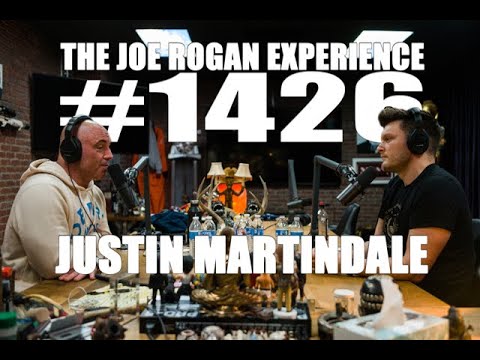
Joe Rogan Experience #1426 - Justin Martindale
Justin Martindale (guest), Joe Rogan (host), Narrator, Narrator, Narrator, Narrator, Narrator
In this episode of The Joe Rogan Experience, featuring Justin Martindale and Joe Rogan, Joe Rogan Experience #1426 - Justin Martindale explores weed, pandemics, psychedelics, fame, and gay culture with Justin Martindale Joe Rogan and comedian Justin Martindale bounce through an extremely loose, three-hour conversation that mixes drugs, health scares, religion, politics, comedy, and gay culture. They start with everyday vices—weed, steam rooms, glyphosate, polluted oceans—and escalate into coronavirus fears, Chinese drone surveillance, and chemical exposure from agriculture and city runoff.
Weed, pandemics, psychedelics, fame, and gay culture with Justin Martindale
Joe Rogan and comedian Justin Martindale bounce through an extremely loose, three-hour conversation that mixes drugs, health scares, religion, politics, comedy, and gay culture. They start with everyday vices—weed, steam rooms, glyphosate, polluted oceans—and escalate into coronavirus fears, Chinese drone surveillance, and chemical exposure from agriculture and city runoff.
The middle of the discussion focuses on systemic issues: toxic pesticides, homeless mental illness, America’s broken mental health system, drug policy, and how cities like Los Angeles fail their most vulnerable residents. They also dig into religion’s psychedelic origins, gay conversion therapy, identity in the gay community, and the hypocrisy of selective Bible-based morality.
Throughout, they weave in industry talk about stand-up comedy, The Comedy Store’s culture, the psychological impact of fame, social media toxicity, and the economics and rigging of U.S. politics. Martindale shares personal stories of drugs, depression, brushes with meth, career doubt, and how being passed by Mitzi Shore at The Comedy Store essentially saved and defined his career.
Key Takeaways
Legal or socially acceptable doesn’t mean harmless—question what you’re exposed to.
From glyphosate lawsuits to crop dusting chemicals, LA storm runoff, antidepressants in drinking water, and swimming post-rain, they repeatedly highlight that many 'normal' or legal practices (pesticides, Roundup, urban water systems) carry real long‑term health risks people rarely scrutinize.
Get the full analysis with uListen AI
Pandemics expose both technological power and authoritarian overreach.
Videos of Chinese trucks spraying disinfectant and drones scolding citizens without masks illustrate how states can rapidly deploy tech for public health—but also for surveillance, control, and propaganda, blurring the line between protection and dystopia.
Get the full analysis with uListen AI
Most visible homelessness is untreated severe mental illness, not just poverty.
Martindale’s story of a former coworker sliding into psychosis and street life, and Rogan’s reference to Reagan-era asylum closures, frame LA’s tent crisis as the result of defunded institutional care, lack of sustained treatment, and people too ill to self-manage housing or hygiene.
Get the full analysis with uListen AI
Drug safety is largely a prohibition problem, not just a morality problem.
Fentanyl-laced MDMA at raves, street cocaine cut with unknown powders, and 'ice' (meth) showing how one use can hook you all point to the danger of unregulated black markets. ...
Get the full analysis with uListen AI
Psychedelics may be central to both ancient religion and modern mental health.
They discuss theories that early Judeo-Christian experiences (burning bush, Eden’s 'apple,' mushroom frescoes) were rooted in psychedelic plants like acacia or Amanita muscaria. ...
Get the full analysis with uListen AI
Selective Bible literalism often masks prejudice, especially around LGBTQ issues.
They juxtapose anti-gay voters and 'pray the gay away' camps with other ignored biblical bans (shellfish, mixed fabrics), suggesting that many religious objections to gay marriage are cultural bias dressed up as theology rather than consistent scriptural practice.
Get the full analysis with uListen AI
Comedy clubs like The Comedy Store are creative ecosystems that can save careers.
Martindale explains how Mitzi Shore making him a paid regular gave him identity, community, and a reason not to quit or kill himself, while Rogan describes the club as both gym and family—where comics sharpen material, bond, and escape the isolating distortions of fame.
Get the full analysis with uListen AI
Notable Quotes
“People are just not supposed to live that stacked on top of each other like that. We're supposed to live in small villages in the woods with just enough food.”
— Joe Rogan
“Whenever something happens like this coronavirus thing, I get worried about all kinds of stuff. I start worrying about weird toxins and chemicals… does that make sense?”
— Joe Rogan
“Homeless people break my heart, but female homelessness really, really is sad for me… someone's daughter, someone's wife is just out there, vulnerable to the elements and predators.”
— Justin Martindale
“I just believed in myself. I had to be like, ‘I know who I am, I know what I've got,’… getting passed at The Store made me feel like I actually had a home.”
— Justin Martindale
“Most people that work in government… I don’t know if they have the capability of change on a large scale, or if they’re already so compromised that it would just be throwing money away.”
— Joe Rogan
Questions Answered in This Episode
How much of religious doctrine might change if psychedelic origins of early spiritual experiences were widely accepted and discussed openly?
Joe Rogan and comedian Justin Martindale bounce through an extremely loose, three-hour conversation that mixes drugs, health scares, religion, politics, comedy, and gay culture. ...
Get the full analysis with uListen AI
What would a realistic, humane mental-health system look like if cities like Los Angeles decided to truly address homelessness as primarily a medical issue instead of a nuisance?
The middle of the discussion focuses on systemic issues: toxic pesticides, homeless mental illness, America’s broken mental health system, drug policy, and how cities like Los Angeles fail their most vulnerable residents. ...
Get the full analysis with uListen AI
If drugs like cocaine and heroin were legalized and regulated, how should society balance reduced overdose deaths with the risk of increased access and normalization?
Throughout, they weave in industry talk about stand-up comedy, The Comedy Store’s culture, the psychological impact of fame, social media toxicity, and the economics and rigging of U. ...
Get the full analysis with uListen AI
In an age of social media and constant exposure, what can performers and public figures practically do to protect their mental health from anonymous online hostility?
Get the full analysis with uListen AI
How can comedy communities like The Comedy Store serve as models for other creative or professional spaces in terms of mentorship, resilience, and honest feedback?
Get the full analysis with uListen AI
Transcript Preview
I'm not supposed to smoke in my building, so...
They don't let you smoke weed in your buil-
Yeah.
What kind of fucking arcade building-
Because it's, because it's legal.
Oh.
Yeah.
That makes sense.
(laughs) We can't, we can't do things that are legal anymore.
But you can smoke cigarettes in your building, right?
No. No, no, no.
No?
No.
Oh, you have a smoke-free building?
Yeah.
Health-conscious.
Mm-hmm.
Ah. Well, I get that kind of if, if you say no cigarettes, you kinda have to say no weed, too.
But cigarette smoke stays...
Yeah.
Like, that gets in the walls and in the fabrics and all that stuff.
Mm.
Like, the weed just kinda...
For us.
Right.
(laughs)
But I think other people that don't smoke weed, they smell it. They're like, "Ew."
Yeah, and those people need to get outta California.
(laughs)
I mean, you s- you smell it everywhere you go now.
I know. Everywhere.
I'm so numb to it.
Everywhere.
It makes me laugh when I, when I can see a tourist, they're just like, "Oh, oh, oh," and I'm like, "This is-"
It's so funny.
Yeah.
It's so funny. My wife kinda gets that way, and she smokes weed. It's funny. But like, when we're with the kids, if we go somewhere, she's like, "Oh, lovely."
(laughs)
Like, she'll smell it. Like, women are so funny, like, when they have kids. All the sudden, they get, like, real protective of everything-
Yeah.
... and they wanna... That's where conservatives-
Mama bear.
... people... Yeah. Yep, yep.
Yep.
They wanna protect that den.
Mm-hmm.
Oh, great.
Yeah.
Lovely. Out in public.
(laughs)
Like, fully. I was doing it an hour ago. (laughs)
Yeah. It always makes me laugh, like, when it's in the morning, and you, like, and you're like, "Shit, it's like-"
Yeah.
"... 9:00 AM." (laughs) And someone's just smoking a blunt outside a brunch.
Well, yoga, there's this one dude that I go to yoga with, this old fella, and, uh, he has a van, and he parks his van, um, right next to the yoga place, and he gets fucking blasted.
(laughs)
Just hotbox.
Blasted. It's like a Cheech & Chong movie. He opens up that van-
(laughs)
... and climbs in the yoga cla-... You could see him just whacked out in class-
Yeah.
(laughs)
... sometimes, too.
Hotbox yoga.
Yeah.
(laughs)
You, you could see him in class just, like, he's in the middle of doing his yoga.
(laughs)
He's like freaking out, like, "Whoo." (laughs)
(laughs)
I saw a guy in the steam room at the gym doing that. He was just like... And I was like-
Install uListen to search the full transcript and get AI-powered insights
Get Full TranscriptGet more from every podcast
AI summaries, searchable transcripts, and fact-checking. Free forever.
Add to Chrome