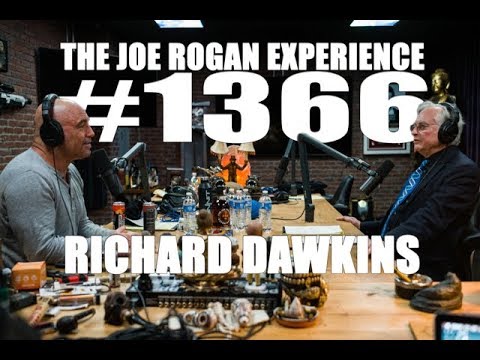
Joe Rogan Experience #1366 - Richard Dawkins
Joe Rogan (host), Richard Dawkins (guest), Narrator
In this episode of The Joe Rogan Experience, featuring Joe Rogan and Richard Dawkins, Joe Rogan Experience #1366 - Richard Dawkins explores richard Dawkins on Religion, Morality, and Outgrowing God with Rogan Joe Rogan and Richard Dawkins discuss Dawkins’ new book *Outgrowing God*, aimed at helping younger audiences critically examine religious belief and understand science, especially evolution.
Richard Dawkins on Religion, Morality, and Outgrowing God with Rogan
Joe Rogan and Richard Dawkins discuss Dawkins’ new book *Outgrowing God*, aimed at helping younger audiences critically examine religious belief and understand science, especially evolution.
They explore why religions arise and persist, the role of tribalism and comfort in belief systems, and how morality develops independently of holy books.
Dawkins contrasts evidence-based thinking with faith, criticizing homeopathy, Scientology, Mormonism, and fundamentalism while acknowledging the social and psychological appeal of religion.
They also delve into consciousness, death, psychedelics, and concrete examples of evolution, and Dawkins outlines efforts to spread secular, scientific thinking globally via education and translations.
Key Takeaways
Religious belief is largely an accident of birth and culture.
Dawkins emphasizes that most people adopt the faith of their parents and community, arguing this shows indoctrination and social inheritance rather than independent evaluation of truth claims.
Get the full analysis with uListen AI
Morality evolves socially and historically, not from holy books.
He notes that moral standards shift dramatically across centuries, often improving beyond what is endorsed in the Bible or Quran, implying ethics come from ongoing societal dialogue, not fixed scripture.
Get the full analysis with uListen AI
Complexity in nature does not require a divine designer.
Dawkins argues that natural selection—non-random survival of random variations—can generate immense biological complexity over deep time, making God an unnecessary and even worse ‘explanation’ because the designer would need explaining.
Get the full analysis with uListen AI
Tribalism strongly shapes beliefs, often more than evidence.
Drawing on Steven Pinker and Jonathan Haidt, Dawkins and Rogan highlight that people frequently believe what their group believes (politically or religiously), prioritizing identity and belonging over critical evaluation.
Get the full analysis with uListen AI
Placebo and ritual can be powerful even when logically empty.
They discuss how treatments like homeopathy persist because of placebo effects and personal narratives, and how structure and ritual in religion can comfort people regardless of the factual truth of the doctrines.
Get the full analysis with uListen AI
The internet is accelerating exposure to skepticism and atheism.
Dawkins cites massive free downloads of *The God Delusion* in Arabic and reports from Muslim-majority countries as evidence that online access is opening up previously closed societies to nonreligious ideas.
Get the full analysis with uListen AI
Simple, clear teaching of evolution is crucial for young audiences.
Because evolution is conceptually simple yet produces immense complexity, Dawkins focuses on concrete examples (like dog breeding and the peppered moths) and supports teacher training so that middle-school educators can confidently counter creationist pushback.
Get the full analysis with uListen AI
Notable Quotes
“A made-up story should not be comforting. I don't understand how a made-up story can be comforting.”
— Richard Dawkins
“They think that you've got to have a belief in some kind of higher power in order to be moral.”
— Richard Dawkins
“Everybody is an atheist about almost all the gods that humanity has ever believed in. Some of us just go one god further.”
— Richard Dawkins
“It's not about evidence; it’s about, ‘Is this part of my tribe?’”
— Richard Dawkins (paraphrasing themes from Steven Pinker and Jonathan Haidt)
“It's actually a very simple idea, but it plays out in very complex ways.”
— Richard Dawkins (on natural selection)
Questions Answered in This Episode
If morality is shaped by social evolution rather than scripture, how should societies decide which moral changes to embrace or resist?
Joe Rogan and Richard Dawkins discuss Dawkins’ new book *Outgrowing God*, aimed at helping younger audiences critically examine religious belief and understand science, especially evolution.
Get the full analysis with uListen AI
Can secular communities replicate the psychological and social benefits of religious congregations without drifting into cult-like dynamics?
They explore why religions arise and persist, the role of tribalism and comfort in belief systems, and how morality develops independently of holy books.
Get the full analysis with uListen AI
How can educators effectively teach evolution and critical thinking in environments where religious resistance is strong and organized?
Dawkins contrasts evidence-based thinking with faith, criticizing homeopathy, Scientology, Mormonism, and fundamentalism while acknowledging the social and psychological appeal of religion.
Get the full analysis with uListen AI
To what extent do psychedelics challenge or reinforce a strictly materialist view of consciousness and death?
They also delve into consciousness, death, psychedelics, and concrete examples of evolution, and Dawkins outlines efforts to spread secular, scientific thinking globally via education and translations.
Get the full analysis with uListen AI
What practical strategies could help the growing ‘non-religious’ demographic translate their numbers into constructive political and cultural influence without becoming just another tribe?
Get the full analysis with uListen AI
Transcript Preview
All right. Here we go. Mr. Dawkins, thank you very much for being here. I really appreciate it.
Thank you.
Uh, I'm a huge fan of your work and we have a new book out, Outgrowing God. When does it come out? Is it out now?
It is out now.
It is now.
Yes.
Like this week, right?
Uh, last week I think, yes.
I read The God Delusion in, in preparation for this. Could you pull that microphone right up to your face? Just get it about a fist away from your face. You don't have to move.
Okay.
Let the microphone move for you.
Okay.
Um, I'm a huge fan of your work and I, I always wanted to ask you, it... You, you go so hard against religion and you have for so long, has there ever been a time where you've gotten fatigued from this? Where you're like, "I just... Leave this to somebody else."?
Well, obviously not because I just produced another one.
(laughs)
Um, it, it's not so hard as you think. I mean, uh, you, you remember it as hard, but actually if you read it again, I think you'd find it was not as hard as you remember.
I didn't mean hard in, in a negative sense. I mean, you push. You're, you're-
Okay.
... you're so enthusiastic about your atheism.
I am enthusiastic.
Yes.
Uh, I'm also humorous. I mean, I, I-
Yes.
I like to think it's a funny book. Um, but a lot of people do think it's hard in the other sense, and, and they... Sometimes when they read it again, they realize actually, no, it's more humorous. It's not so h- not so edgy, not so hard-hitting as, as they think, as they originally thought it was.
Well, I think that's probably because you've had some interviews in the past where you have talked to some fiercely religious people and you've had some cantankerous interactions with them. I think maybe so they, they associate you with having this, uh, v- almost aggressively atheistic stance.
Yes. Well, p- perhaps you're thinking of Bill O'Reilly. I'm not sure.
(laughs)
Um, well, I mean, he's aggressive all right.
Yeah, in the-
A-
... in the other way. Yeah.
I did once had to tell him, "Will you please stop interrupting me and let me talk?" And, and, uh, so that might give the slight impression that I'm aggressive.
Now, what was that BBC documentary that you, you had done, where you'd, you had-
I've done several.
The, the one where you had gone and interviewed b- a bunch of different religious people.
Yes. That was not BBC, that was Channel 4, which is the-
Oh, okay.
... c- commercial, um, station. And, um, yes, I interviewed Ted Haggard.
Install uListen to search the full transcript and get AI-powered insights
Get Full TranscriptGet more from every podcast
AI summaries, searchable transcripts, and fact-checking. Free forever.
Add to Chrome