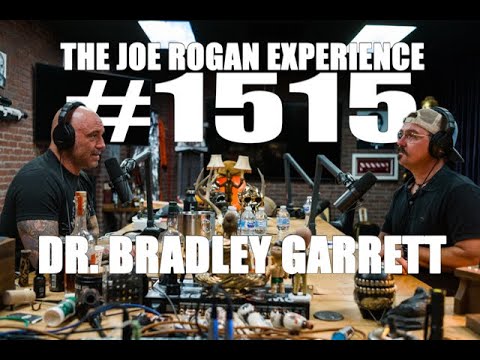
Joe Rogan Experience #1515 - Dr. Bradley Garrett
Joe Rogan (host), Dr. Bradley Garrett (guest), Narrator, Narrator
In this episode of The Joe Rogan Experience, featuring Joe Rogan and Dr. Bradley Garrett, Joe Rogan Experience #1515 - Dr. Bradley Garrett explores inside Doomsday Bunkers, Preppers’ Minds, and Hidden Worlds Underground Joe Rogan and Dr. Bradley Garrett discuss modern prepping culture, doomsday bunkers, and how global threats like pandemics, nuclear war, and solar flares shape people’s psychology. Garrett explains his immersive research with preppers around the world, from commercialized luxury bunkers in old missile silos to Mormon food storage systems and paramilitary-style compounds.
Inside Doomsday Bunkers, Preppers’ Minds, and Hidden Worlds Underground
Joe Rogan and Dr. Bradley Garrett discuss modern prepping culture, doomsday bunkers, and how global threats like pandemics, nuclear war, and solar flares shape people’s psychology. Garrett explains his immersive research with preppers around the world, from commercialized luxury bunkers in old missile silos to Mormon food storage systems and paramilitary-style compounds.
They explore how dread, distrust of institutions, and real systemic vulnerabilities (power grids, supply chains, pandemics) drive ordinary people to prep, often more rationally than stereotypes suggest. The conversation also covers alien craft claims, ancient civilizations, archeology, Native American history, and Garrett’s past as an urban explorer infiltrating underground infrastructures and abandoned spaces.
Throughout, they highlight how modern information overload, social media, and partisan culture wars amplify anxiety, tribalism, and conspiracy thinking, while governments quietly build their own bunkers and contingency plans.
The episode ultimately frames prepping less as fringe paranoia and more as a spectrum of practical risk management, psychological coping, and sometimes extreme, commercially exploited fear.
Key Takeaways
Prepping is often rational risk management, not simply fringe paranoia.
Many preppers Garrett studied are normal, non-anxious people trying to regain a sense of control over very real systemic risks—stockpiling modest food, securing water, or having backup shelter—rather than only building extravagant bunkers.
Get the full analysis with uListen AI
Our systems are fragile; a moderate increase in lethality or a grid failure would be catastrophic.
Garrett notes that if COVID had a ~10% fatality rate, supply chains could collapse because essential workers wouldn’t show up; similarly, a major solar flare/EMP could destroy transformers that take years to replace, crippling power, logistics, and healthcare.
Get the full analysis with uListen AI
Dread is diffuse and constant, driving tribal behavior and extreme responses.
Unlike specific anxiety, dread is a pervasive unease created by stacked existential threats (nukes, pandemics, climate, AI), and it pushes people into tight in-groups—preppers, rioters, hard-partisan camps—seeking security and simple narratives.
Get the full analysis with uListen AI
Governments have long prioritized their own continuity over public protection.
From Cold War bunkers for officials (vs. ...
Get the full analysis with uListen AI
Information overload and social media distort risk perception and fuel conflict.
Rogan and Garrett point out that global bad news is now instantly in everyone’s pocket, but our evolutionary wiring is tuned for local threats; this mismatch amplifies panic, performative outrage, and cancellation rather than nuanced, cooperative problem-solving.
Get the full analysis with uListen AI
Hidden infrastructures reveal how exposed and interconnected modern cities really are.
Garrett’s urban exploration of sewers, telecom tunnels, and abandoned subway stations showed that critical systems are both intricate and surprisingly accessible—challenging official narratives about security and exposing physical and cyber vulnerabilities.
Get the full analysis with uListen AI
Commercialization and ideology often hijack legitimate preparedness.
From televangelists selling “Bible buckets” and slop food to luxury bunker condos with artificial windows and private gun ranges, an entire fear-based industry exploits people’s worries while reinforcing conspiratorial and isolationist worldviews.
Get the full analysis with uListen AI
Notable Quotes
“In order to not stockpile, you have to have so much faith in capitalism.”
— Dr. Bradley Garrett
“A lot of the preppers I talked to are not actually very anxious or paranoid at all—because they have a plan.”
— Dr. Bradley Garrett
“We created COVID’s pathways. It’s international flights, international trade…the global capitalist system that took the virus everywhere at once.”
— Dr. Bradley Garrett
“We’re all saturated with dread. We’re experiencing a sort of collective psychotic break.”
— Dr. Bradley Garrett
“If there’s an asteroid impact, I want it to hit me in the fucking face.”
— Joe Rogan
Questions Answered in This Episode
Where should the line be drawn between sensible household preparedness and counterproductive, fear-driven prepping?
Joe Rogan and Dr. ...
Get the full analysis with uListen AI
Given our dependence on fragile infrastructure and foreign supply chains, what concrete steps should governments and citizens prioritize to reduce systemic risk?
They explore how dread, distrust of institutions, and real systemic vulnerabilities (power grids, supply chains, pandemics) drive ordinary people to prep, often more rationally than stereotypes suggest. ...
Get the full analysis with uListen AI
How can societies encourage honest discussion about existential threats (pandemics, climate, AI, nukes, aliens) without amplifying conspiracy thinking or paralyzing dread?
Throughout, they highlight how modern information overload, social media, and partisan culture wars amplify anxiety, tribalism, and conspiracy thinking, while governments quietly build their own bunkers and contingency plans.
Get the full analysis with uListen AI
Are private luxury bunkers and survival condos a realistic resilience strategy, or do they deepen inequality and erode social cohesion during crises?
The episode ultimately frames prepping less as fringe paranoia and more as a spectrum of practical risk management, psychological coping, and sometimes extreme, commercially exploited fear.
Get the full analysis with uListen AI
What changes in media, education, or online platforms might help people process constant global bad news without defaulting to tribalism and cancel culture?
Get the full analysis with uListen AI
Transcript Preview
And boom, (claps) because we're live. What's up, man? How are you?
Nice.
Cheers. Salud.
Ha- hey, cheers, brother.
Nice to meet you.
Good to meet you, too.
By the way, congrats on the mustache. The mustache-
(laughs) .
... lower piece combo, that's, uh, the anarchist guy, with, that guy that, uh, who's the mask?
Guy Fawkes.
Guy Fawkes, that's right.
Yeah, yeah.
Perfect, right?
Yeah. Yeah, I was kind, I was going more for a kind of a, a Doc Holliday. Val Kilmer as Doc Holliday.
Oh.
I'm, I'm your Huckleberry.
How good was he in that role?
He was fantastic.
Come on, man. Mm. Many people have played Doc Holliday, but he's the best. So, uh, are you a prepper yourself? 'Cause you do have one of them GPS watches on, so either you're like-
(laughs) .
... a hardcore hiker or you just don't wanna get lost.
So, you, you were waiting to see the paracord bracelet, right?
(laughs) Ah, but they always have that, right?
I know, right?
Does that ever come up?
That, uh, when do you ever unravel that thing, you know?
(laughs)
It's, it's... (laughs)
Yeah, that always seems to me like someone who, like, preps at, you know, they, you just try a little too hard if you've got a paracord bracelet.
Yeah. No, it's a kind of virtue signaling.
You never know, though. I guess it's better to have it and not to need it, right?
Yeah.
Than need it and not to have it.
I mean, and it's kind of funny, when I, uh, so I've been, I've been hanging out with preppers for about three years now, and, uh, inevitably you start drifting towards the culture, right, as you're talking to people. But every once in a while, I'll see someone in a grocery store or whatever, and I'm like, "Okay, they, you know, they got the bowie knife. They got the, like, you know, walkie-talkies strapped to 'em." I'm like, "Wow, you are really paranoid."
Walkie-talkie? Really?
Yeah. I know people who walk around with their radios on.
Well, you live-
Because they, because they wanna be ready for action at any moment.
You live in the mountains.
Yeah.
Wilderness-type area.
Yeah. I live in, I live in Big Bear.
Do you, did you live there before you got obsessed with-
No.
... prepping?
(laughs)
No. So did you move there to accustom yourself or to, uh, acclimate yourself to the culture? Like-
So here's the deal. I, one of the communities that I worked with while I was writing this book, Bunker, was a community in South Dakota where there's, there's 575, uh, sort of semi-subterranean concrete bunkers that, uh, were built during World War II, and they used to store, uh, weapons in there, right? So these are bunkers to protect ordinance.
Install uListen to search the full transcript and get AI-powered insights
Get Full TranscriptGet more from every podcast
AI summaries, searchable transcripts, and fact-checking. Free forever.
Add to Chrome