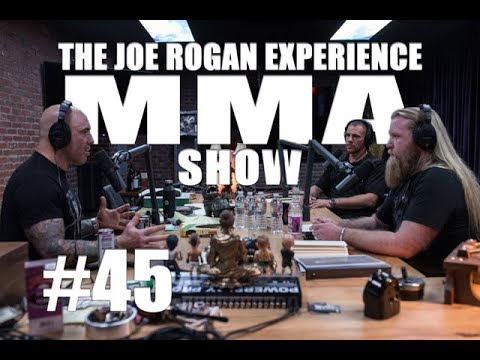
JRE MMA Show #45 with Justin Wren & Rafael Lovato Jr.
Joe Rogan (host), Rafael Lovato Jr. (guest), Justin Wren (guest), Justin Wren (guest), Guest (guest), Guest (guest), Guest (guest), Guest (guest)
In this episode of The Joe Rogan Experience, featuring Joe Rogan and Rafael Lovato Jr., JRE MMA Show #45 with Justin Wren & Rafael Lovato Jr. explores from Jiu-Jitsu Roots to Fighting Bullying: Lovato’s MMA Mission Rafael Lovato Jr. traces his journey from a Jeet Kune Do childhood under his martial-artist father, through becoming one of America’s most accomplished Brazilian jiu-jitsu black belts, to a late but successful transition into MMA and Bellator title contention.
From Jiu-Jitsu Roots to Fighting Bullying: Lovato’s MMA Mission
Rafael Lovato Jr. traces his journey from a Jeet Kune Do childhood under his martial-artist father, through becoming one of America’s most accomplished Brazilian jiu-jitsu black belts, to a late but successful transition into MMA and Bellator title contention.
He explains his technical evolution, the importance of the gi, his intense training in Brazil with the Chute Boxe lineage, and his modern approach to strength, conditioning, and movement to stay healthy and competitive at 35.
Justin Wren and Lovato also examine MMA culture—sparring philosophies, the Khabib–Conor brawl, and how promotion, trash talk, and commerce intersect with traditional martial-arts values like respect and discipline.
The conversation culminates in Wren’s Fight for the Forgotten initiative and their joint “Heroes in Waiting” anti-bullying and clean-water campaign, aimed at mobilizing martial arts schools to fund wells in Africa while teaching character and bullying prevention to kids.
Key Takeaways
Leverage a broad martial-arts base before specializing.
Lovato’s Jeet Kune Do upbringing (boxing, Muay Thai, Escrima, Wing Chun, Silat) gave him range awareness and adaptability, which later made his transition from pure BJJ into MMA more seamless.
Get the full analysis with uListen AI
Use the gi to refine no-gi and MMA grappling.
Lovato insists the gi forces precision due to friction and grips, exposing small technical errors that later make no-gi and MMA positions feel clearer, more controlled, and harder for opponents to slip out of.
Get the full analysis with uListen AI
Periodize intensity and listen to your body to prevent burnout.
He shifted from “kill yourself” strength work to daily, lower-volume, movement-based training (kettlebells, sleds, reverse hyper, crawling, hanging), avoiding chronic neck/back issues and overtraining before fights.
Get the full analysis with uListen AI
Match striking systems to MMA realities, not just pure striking.
Lovato’s Muay Thai coach in Brazil teaches an MMA-specific system (Evolução Thai) that integrates takedown offense/defense and small-glove defensive structures, tailored to a jiu-jitsu fighter’s needs and threats.
Get the full analysis with uListen AI
Hard sparring must be balanced with career longevity.
They acknowledge the legendary brutality of Chute Boxe sparring and note modern adjustments—more structure, selective pullback days—while contrasting it with fighters like Cowboy Cerrone and Tony Ferguson who largely removed hard sparring to extend their careers.
Get the full analysis with uListen AI
Promotion-driven chaos erodes martial-arts values if unchecked.
Rogan, Lovato, and Wren argue the UFC’s use of Conor’s bus attack in marketing helped normalize out-of-cage violence, making Khabib’s post-fight brawl almost inevitable and blurring the line between sport and spectacle.
Get the full analysis with uListen AI
Martial arts schools can be hubs for social impact, not just training.
Through Fight for the Forgotten’s Heroes in Waiting program, academies that raise $4,200 can both fund a deep well in Africa and receive a full anti-bullying and character curriculum, turning students into “heroes in waiting” who intervene when they see bullying.
Get the full analysis with uListen AI
Notable Quotes
“For me, the beauty of jiu-jitsu is with the gi.”
— Rafael Lovato Jr.
“Everything that I know of life, I’ve learned through martial arts.”
— Rafael Lovato Jr.
“A hero is someone who sees a need and takes action.”
— Justin Wren
“How many fighters ruin themselves before they get to the fight because they just overtrain?”
— Joe Rogan
“You’re not an innocent bystander. You’re a silent supporter if you see bullying and don’t stand up.”
— Justin Wren
Questions Answered in This Episode
How can MMA promotions balance the financial incentives of trash talk and spectacle with preserving traditional martial-arts values like respect and discipline?
Rafael Lovato Jr. ...
Get the full analysis with uListen AI
In practical terms, how should a serious amateur fighter decide between hard, Chute Boxe-style sparring and a lighter, more technical approach?
He explains his technical evolution, the importance of the gi, his intense training in Brazil with the Chute Boxe lineage, and his modern approach to strength, conditioning, and movement to stay healthy and competitive at 35.
Get the full analysis with uListen AI
For wrestlers transitioning into jiu-jitsu and MMA, what specific gi-based drills or progressions best overcome the discomfort of playing guard and being on their back?
Justin Wren and Lovato also examine MMA culture—sparring philosophies, the Khabib–Conor brawl, and how promotion, trash talk, and commerce intersect with traditional martial-arts values like respect and discipline.
Get the full analysis with uListen AI
How might an independent sanctioning body for MMA titles change matchmaking, rankings, and fighters’ earnings compared to the current promoter-controlled model?
The conversation culminates in Wren’s Fight for the Forgotten initiative and their joint “Heroes in Waiting” anti-bullying and clean-water campaign, aimed at mobilizing martial arts schools to fund wells in Africa while teaching character and bullying prevention to kids.
Get the full analysis with uListen AI
What are the most effective ways for martial arts academies to implement anti-bullying curricula so that kids actually intervene in real-life situations rather than just absorbing theory?
Get the full analysis with uListen AI
Transcript Preview
Five, four, three, two, one. Boom, and we're live with my friend, Justin Wren in the house, and one of the baddest motherfuckers on the planet-
(laughs)
... Rafael Lovato.
Absolutely.
Dude, I'm bummed that you're f- I'm happy that you're doing well, but I'm bummed you're fighting for Bellator.
Aw.
I really am, man. I wanna, I wanna commentate your fights. I, I know for a fact that Bellator right now is like, is, is high, it's a higher level than it's ever been before.
Right.
Mm-hmm.
I mean, you look at,they've got Mousasi, you, Rory MacDonald, uh, Lima, uh, you know-
Machida's about to fight.
... Paul Daley, Machida. I mean, it's fucking high level now, man. It's like Bellator is, uh, very close to comparable. Still, I would love to see you over in the UFC.
Yeah? Well, we'll see what happens. But right now, I'm, I'm really happy where I'm at.
How old are you now?
I'm 35.
And you d- didn't start MMA until you were, like, 31, 32?
Yes, 31. I was, four, four years ago.
Yeah.
2014 was my first fight.
Were you doing a lot of MMA training before that? Because y- y- when you're, you were ... For people that don't know, you're one of the most accomplished Brazilian jiu-jitsu black belts in the world, and when you were competing as, uh, Brazilian jiu-jitsu martial artist, were you training striking? Were you training other things as well?
Well, uh, you know, that's, uh, kind of my life story, I guess. Um, you know, um, uh, my father is a lifetime martial artist, and so I had a whole martial arts upgr- uh, upbringing well before I ever found out about Brazilian jiu-jitsu. My father was a Jeet Kune Do instructor, and so growing up, um, you know, the main thing that we were training in when I was a child was, uh, the Jeet Kune Do system, uh, which was basically mixed martial arts before mixed martial arts. You know, uh, Bruce Lee's philosophy was way ahead of his time. He believed in, um, you know, learning from all the arts and creating your own personal system of self-defense, um, that involved, you know, each range of combat. And so, you know, I grew up doing, uh, several different forms of martial arts, um, uh, boxing, Muay Thai, Escrima, Wing Chun, Penjak Silat. I mean, you name it, I've probably done it. And when my father discovered Brazilian jiu-jitsu, uh, I was an early teenager, like around 12 years old. He learned about Brazilian jiu-jitsu in one of the Jeet Kune Do instructor conferences that takes place in California. They brought in the Gracies. Um, they had, you know, they did, like, shoot fighting and different sort of, you know, martial arts incl- that included grappling, uh, but it was very, you know, rough and not n- near the, th- the technique that, that Brazilian jiu-jitsu has. Uh, so whenever he first started learning Brazilian jiu-jitsu, he fell in love with it. My dad's a s- a smaller guy. Uh, at that time, he was probably, like, 145, 150 pounds, and so it was perfect for him, and he fell in love with it, and he comes home and he starts telling me about Brazilian jiu-jitsu and teaching me what he learned. Um, and we lived in Oklahoma, and the instructor conference was in California. At that time, basically the only jiu-jitsu was in California, maybe a little bit in Florida, and then Renzo was in New York. So everything was as far as possible from us because we were right there in the middle of the country. And, you know, he fell in love with Brazilian jiu-jitsu and so he started making trips to California to learn Brazilian jiu-jitsu, and I was just a teenager. I'm a young kid, so, you know, I was already, uh, doing some boxing at the time. Uh, I was competing in amateur boxing, and I'm, I'm used to training with adults, and once I started learning Brazilian jiu-jitsu, you know, i- I fell in love with it right away because that gave me something that I could do where I could be competitive with the adults right away. You know? I was a long, lanky kid, um, and the guard just, you know, felt natural to me, and just being on the ground, I really loved it and I loved that the, the technique of Brazilian jiu-jitsu, how, how technical it was and, and the science of it. Um, so I fell in love with it right away, and I mean, uh, we, we sacrificed a lot to learn jiu-jitsu being in Oklahoma. Um, always traveled, uh, to learn. The first time I went to Brazil I was 16 years old.
Install uListen to search the full transcript and get AI-powered insights
Get Full TranscriptGet more from every podcast
AI summaries, searchable transcripts, and fact-checking. Free forever.
Add to Chrome