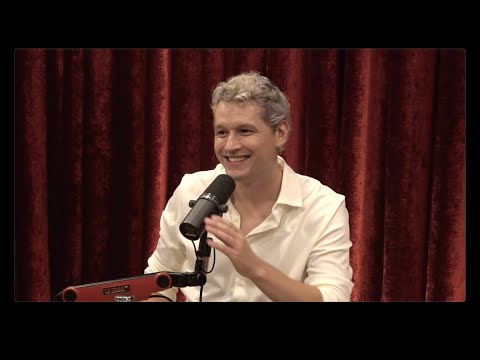
Joe Rogan Experience #2193 - Jack Symes
Jack Symes (guest), Joe Rogan (host), Kenneth Copeland (guest), Narrator, Megyn Kelly (guest), Donald Trump (guest), Lisa Guerrero (guest), Narrator, Narrator, Narrator
In this episode of The Joe Rogan Experience, featuring Jack Symes and Joe Rogan, Joe Rogan Experience #2193 - Jack Symes explores joe Rogan and Jack Symes Debate God, Multiverse, Meaning, Morality, Meat Joe Rogan and philosopher Jack Symes explore whether life has ultimate meaning, examining atheism, theism, pantheism, and how multiverse theories affect our view of good and evil. Symes argues that both traditional religion and New Atheism are philosophically incomplete: theists struggle with evolution and systemic suffering, while atheists lack robust accounts of meaning and morality.
Joe Rogan and Jack Symes Debate God, Multiverse, Meaning, Morality, Meat
Joe Rogan and philosopher Jack Symes explore whether life has ultimate meaning, examining atheism, theism, pantheism, and how multiverse theories affect our view of good and evil. Symes argues that both traditional religion and New Atheism are philosophically incomplete: theists struggle with evolution and systemic suffering, while atheists lack robust accounts of meaning and morality.
They dig into arguments for God (cosmological and fine‑tuning), the problem of evil—especially evolution by natural selection—and newer views like pantheism and panpsychism, where the universe itself is conscious or divine. Rogan repeatedly pushes a “the universe is God” intuition and emphasizes human epistemic limits and the arrogance of hard atheism.
A large section focuses on animal ethics: factory farming, hunting, veganism, moral psychology, and whether painless killing is enough or if depriving animals of future experiences is also wrong. They also discuss psychedelics and religious experience, noting both transformative benefits and under‑acknowledged long‑term harms.
The conversation ends on free speech, social media, and platforming controversial figures, before circling back to Symes’s call for honest agnosticism: suspend belief about God, confront the absurdity and apparent meaninglessness of the universe, and then construct meaning through moral action, relationships, and intellectual honesty.
Key Takeaways
Philosophy is needed to interpret science, not replace it.
Symes rejects scientism—the idea that science alone answers all big questions—arguing that philosophy clarifies concepts (e. ...
Get the full analysis with uListen AI
New Atheism critiques religion but fails to supply meaning and ethics.
Figures like Dawkins, Hitchens, and Dennett successfully attacked religious dogma, yet, Symes argues, they never built a satisfying positive framework for meaning, value, and purpose, which is partly why New Atheism has lost cultural traction and feels as dogmatic as the religions it criticized.
Get the full analysis with uListen AI
Classical arguments for God are strong—but so is the problem of evil.
Symes grants that the cosmological argument (everything that begins requires a cause) and fine‑tuning (our universe’s laws are improbably hospitable to life) offer serious support for some kind of theism, yet evolution by natural selection and vast, systemic suffering in nature make a perfectly good, omnipotent God hard to defend.
Get the full analysis with uListen AI
Pantheism and panpsychism are emerging alternatives to traditional theism.
Instead of a perfect, external deity, some philosophers (including Symes’s colleague Philip Goff, and Rogan intuitively) consider views where the universe itself is divine or fundamentally conscious; this reframes God as an evolving process rather than a static, perfect being but raises deep technical questions about how one cosmic mind becomes many individual minds.
Get the full analysis with uListen AI
Our treatment of animals is morally inconsistent, especially under factory farming.
Most people say animal suffering matters yet still support systems where ~99% of chickens, turkeys, and most pigs live in factory farms; Symes stresses that even if one believes eating meat is sometimes necessary, they must confront how many animal lives and how much suffering they are willing to trade for their diet and convenience.
Get the full analysis with uListen AI
Hunting can be ethically better than factory farming—but remains morally complex.
Rogan defends skilled hunting as providing a quick, comparatively humane death within the natural predator–prey cycle, and as reconnecting humans to nature, while Symes counters that even painless killing deprives conscious animals of future experiences, so it still raises serious moral questions beyond suffering alone.
Get the full analysis with uListen AI
Psychedelics and religious experiences are powerful tools with real risks.
Both note that psychedelic and religious experiences can radically shift values, reduce ego, and engender compassion, but Symes emphasizes data showing a non‑trivial minority suffer long‑term anxiety, psychosis‑like symptoms, or “negative religious experiences,” arguing public narratives are often too one‑sidedly positive.
Get the full analysis with uListen AI
Agnosticism plus active meaning‑making may be the most honest stance.
Given strong arguments both for and against traditional God concepts and our limited perspective, Symes advocates suspending belief (agnosticism), recognizing the “absurd” gap between our craving for ultimate meaning and a silent universe, and then constructing worthwhileness through moral action, relationships, and intellectual humility rather than dogma.
Get the full analysis with uListen AI
Notable Quotes
“The fundamental question of philosophy is whether life is or is not worth living.”
— Jack Symes (quoting Albert Camus, then adopting it as his own guiding question)
“I think it’s ridiculous to dismiss philosophy because you are a proponent of science.”
— Joe Rogan
“If God exists, then God’s a psychopath, right? If that’s what… God didn’t have to do that.”
— Jack Symes, on evolution by natural selection as a system designed by a perfectly good God
“I think the universe might be God. And I don’t think it was born. I think it’s probably always been here.”
— Joe Rogan
“I am of the opinion that I am not my ideas… I don’t want to be that buffoon that’s connected to the first shit that comes out of my mouth.”
— Joe Rogan
Questions Answered in This Episode
If both classical theism and hard atheism are philosophically fragile, what would a robust, non‑dogmatic framework for meaning and morality actually look like in practice?
Joe Rogan and philosopher Jack Symes explore whether life has ultimate meaning, examining atheism, theism, pantheism, and how multiverse theories affect our view of good and evil. ...
Get the full analysis with uListen AI
How should individuals weigh the moral cost of animal suffering and death—both in factory farming and hunting—against their perceived health needs, cultural traditions, and personal fulfillment?
They dig into arguments for God (cosmological and fine‑tuning), the problem of evil—especially evolution by natural selection—and newer views like pantheism and panpsychism, where the universe itself is conscious or divine. ...
Get the full analysis with uListen AI
Does the multiverse, if real, make our moral efforts locally meaningful but cosmically insignificant, or does it change nothing about what we ought to do here and now?
A large section focuses on animal ethics: factory farming, hunting, veganism, moral psychology, and whether painless killing is enough or if depriving animals of future experiences is also wrong. ...
Get the full analysis with uListen AI
Are psychedelic and intense religious experiences reliable sources of insight about consciousness and reality, or are they better understood as powerful but fundamentally ambiguous psychological events?
The conversation ends on free speech, social media, and platforming controversial figures, before circling back to Symes’s call for honest agnosticism: suspend belief about God, confront the absurdity and apparent meaninglessness of the universe, and then construct meaning through moral action, relationships, and intellectual honesty.
Get the full analysis with uListen AI
What responsibilities do influential media hosts and platforms have when giving airtime to polarizing or inflammatory figures—should they prioritize free expression, harm reduction, or some principled balance of both?
Get the full analysis with uListen AI
Transcript Preview
(drumbeats) Joe Rogan podcast, check it out. The Joe Rogan Experience.
Train by day, Joe Rogan podcast by night, all day. (instrumental music) What's up, Joe? How are you, man?
How's it going, Joe? Yeah, I'm very well.
Nice to meet you.
Thank you for having me. It's good to be here.
So I got the r- request to be on when, when it said multiverse and new atheism.
Yeah.
I'm like, what a combination that is. Let's talk.
Nice.
(laughs)
Yeah, so I think, like, it's interesting to think why philosophers need to think about the multiverse, right? Uh, it tends to be, like, a theory thrown about by physicists and, and stuff. But I think there's a... At the moment, we don't wanna be talking about philosophy as a society. We're, like, stuck in this idea of scientism, the view that science can solve all of these problems and questions. So you've probably heard people like Lawrence Krauss or Dawkins, um, Stephen Hawking, uh, Brian Cox, they all say something along the lines of, like, "Philosophy is dead." So just before we get into the multiverse, it's probably best to say, like, what philosophy is and sort of-
Yeah, let- please.
... what the point of, of-
Yeah.
... talking about the multiverse is. So this is something I ask every philosopher I speak to, like, what they take philosophy to be 'cause it's really interesting to see how all the ideas they discuss fall into their wider projects. And one of the ideas that I love is this one by, uh, the late great British philosopher, Mary Midgley. She likens philosophy to a kind of plumbing, right? So, like, we have these conversations in our societies, and, like, these conversations are flowing around. And likewise, we have these pipes l- running underneath our houses, keeping the water flowing. But occasionally, it gets clogged, and so the philosopher needs to pull up the floorboards, see what the clog is, and help the conversation move along again. So these are things like what it is to be a woman, or what it is to have free speech, or what it means to say that a gene is selfish. So that's, I see, like the primary job of the philosopher, something we're all doing every day, like, trying to understand the concepts we're using. But then also there's this bigger aspect to philosophy, which is, like, how it all hangs together in the broadest possible sense of the term. Like, let's put all of the pieces of the puzzle together from physics, biology, and, and the arts, and let's try and get a big picture of the world. And if we're missing a piece of the puzzle, let's have our best guess about what that piece could be. So I take that to be the project. And so the questions that come out of that, the questions that philosophy asks are things like, why is there something, a universe, rather than nothing, no universe? Like, why are, are the laws of nature fine-tuned for the existence of life? Where does consciousness come from? Like, when I make a moral statement like, "The Holocaust is bad," is it the same as me saying that Jonah Hill's movies are bad? Like, are they the same kind of statement? Is that the same bad I'm using?
Install uListen to search the full transcript and get AI-powered insights
Get Full TranscriptGet more from every podcast
AI summaries, searchable transcripts, and fact-checking. Free forever.
Add to Chrome