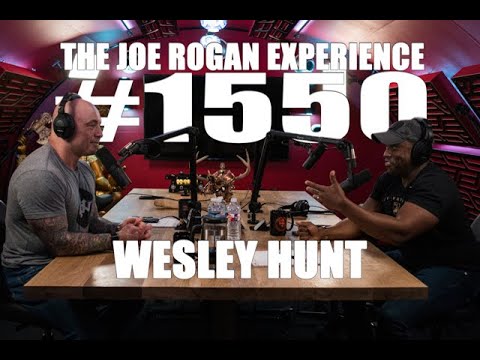
Joe Rogan Experience #1550 - Wesley Hunt
Narrator, Joe Rogan (host), Wesley Hunt (guest), Narrator
In this episode of The Joe Rogan Experience, featuring Narrator and Joe Rogan, Joe Rogan Experience #1550 - Wesley Hunt explores veteran Candidate Wesley Hunt Tackles Policing, Energy, Freedom, Division, Service Joe Rogan interviews congressional candidate and Army veteran Wesley Hunt about his military family, why he’s running for office in Houston, and how his background shapes his views on race, policing, and service. They dive into current controversies over police brutality, “defund the police,” COVID-19 responses, and the mental and physical health of Americans. Hunt lays out a pro–law enforcement but reform-minded stance, critiques the Green New Deal while defending fossil fuels and nuclear as part of an “all of the above” energy strategy, and warns about government overreach and social media censorship. Throughout, he argues for more veterans in Congress, more open debate, and a renewed focus on shared American values and gradual, pragmatic progress.
Veteran Candidate Wesley Hunt Tackles Policing, Energy, Freedom, Division, Service
Joe Rogan interviews congressional candidate and Army veteran Wesley Hunt about his military family, why he’s running for office in Houston, and how his background shapes his views on race, policing, and service. They dive into current controversies over police brutality, “defund the police,” COVID-19 responses, and the mental and physical health of Americans. Hunt lays out a pro–law enforcement but reform-minded stance, critiques the Green New Deal while defending fossil fuels and nuclear as part of an “all of the above” energy strategy, and warns about government overreach and social media censorship. Throughout, he argues for more veterans in Congress, more open debate, and a renewed focus on shared American values and gradual, pragmatic progress.
Key Takeaways
Service and perspective from veterans are badly needed in politics.
Hunt argues that with historically low numbers of veterans in Congress, decisions about war, security, and national direction lack the lived experience of people who have risked their lives and lost friends in combat—experience that creates sobriety and humility in policymaking.
Get the full analysis with uListen AI
“Defund the police” is counterproductive; reform, training, and accountability are essential.
Both men contend that abolishing or defunding departments harms vulnerable communities the most, and that the real need is better training, more resources, and mechanisms to quickly remove bad officers while affirming and supporting the many good ones.
Get the full analysis with uListen AI
COVID-19 policy must balance protection of the vulnerable with preserving livelihoods and freedoms.
They criticize blanket lockdowns, school closures, and gym shutdowns when rapid testing, targeted protection for high-risk groups, and emphasis on metabolic health, exercise, and mental resilience could reduce harm without long-term social and economic devastation.
Get the full analysis with uListen AI
Energy transition must be realistic, global, and innovation-driven, not purely punitive.
Hunt accepts human-driven climate impact but says the Green New Deal ignores global emitters and the centrality of hydrocarbons to modern life; he advocates an “all of the above” mix including fossil fuels, renewables, and potentially nuclear, working with energy companies to innovate rather than demonize them.
Get the full analysis with uListen AI
Censorship by tech platforms undermines free speech and deepens polarization.
Rogan and Hunt argue that Twitter and Facebook’s bans and selective fact-checking of political content (e. ...
Get the full analysis with uListen AI
Addressing racial injustice requires mutual responsibility, empathy, and honest historical context.
Hunt leans on his family history from slavery to West Point to highlight immense progress while acknowledging ongoing disparities; he says both systemic factors (like the welfare state) and internal cultural issues must be confronted together rather than used as weapons in a blame game.
Get the full analysis with uListen AI
National division is amplified by social media but can be reduced through in-person engagement and shared missions.
They note that life feels less divided face-to-face than online; Hunt believes veterans—who have pledged to defend all Americans—are uniquely suited to build cross-party relationships and re-anchor politics in shared service rather than tribal identity.
Get the full analysis with uListen AI
Notable Quotes
““Leadership is not about when it’s convenient for you. It’s about when your country needs you.””
— Wesley Hunt
““You don’t throw the whole fucking system out. Anybody who’s ever been in a situation where you need the cops and they show up, that is a great sign of relief.””
— Joe Rogan
““This is not a California problem, it’s a global issue. You can literally destroy the oil and gas industry here in the U.S. at no gain to the globe.””
— Wesley Hunt
““We’re always about progression. What I don’t like is people who refuse to even mention our past slavery. I actually want to talk about it because when you talk about it, we can fix it.””
— Wesley Hunt
““If it wasn’t for ‘toxic masculinity,’ we’d all be speaking German, so shut the fuck up.””
— Joe Rogan
Questions Answered in This Episode
How realistic is Hunt’s “all of the above” energy strategy in the context of current climate targets and international climate agreements?
Joe Rogan interviews congressional candidate and Army veteran Wesley Hunt about his military family, why he’s running for office in Houston, and how his background shapes his views on race, policing, and service. ...
Get the full analysis with uListen AI
What concrete mechanisms could be implemented to rapidly identify and remove bad police officers while protecting good ones and maintaining due process?
Get the full analysis with uListen AI
If social media were treated like a public utility under First Amendment–style rules, who would set and enforce the limits on harmful or dangerous content?
Get the full analysis with uListen AI
How can communities like Chicago’s South Side build genuine trust between residents and law enforcement after decades of violence and mutual suspicion?
Get the full analysis with uListen AI
What specific policies or reforms would best increase the number and influence of veterans in Congress without turning military service into a de facto prerequisite for leadership?
Get the full analysis with uListen AI
Transcript Preview
(drumbeats) Joe Rogan podcast, check it out. The Joe Rogan Experience.
Train by day, Joe Rogan podcast by night, all day. (instrumental music plays) Mr. Hunt, welcome aboard.
Happy to be here.
Thanks for having- uh, thanks for being here. I really appreciate it. Friend of Dan Crenshaw's.
That's right.
He's a friend of mine.
That's right.
All of them. So, um, Congress.
Yeah.
Running for Congress.
Yeah.
This is what I want my congressmen to look like, jacked veterans.
(laughs)
I mean, that's... Wouldn't it be- the world be a better place?
I agree. I think so.
I mean, it really would be.
Yeah.
Um, so tell me what this has been like running for Congress. Was... Is this the first office you've run for?
This is the first time, thank God.
What- what started this? I know you're friends with Dan, who's also a congressman. What started this, this journey?
Yes. Great question, and thank you so much for having me on.
My pleasure.
This is- this is awesome. Really appreciate you. And what started this was really just my family and how can we continue service in just in a different capacity. Uh, I come from a military family, so, uh, my dad did 23 years in the Army, retired as a lieutenant colonel. Uh, my sister went to West Point in my family first, so she's 10 years older than me, did 23 years active duty. She was a military intelligence officer, uh, deployed to Iraq twice and s- did a few tours, abroad as well. Uh, I went to West Point in my family second. Uh, we're- we're 10 years apart, my sister and I, and then graduated West Point class of 2004. Uh, flew Apaches, uh, in Iraq for eight- for- for- was actually active duty eight years, deployed to Iraq, did 55 combat air missions in Baghdad, and then did two tours of duty in Saudi Arabia as a diplomatic liaison officer. My brother, who is 10 months and eight days my junior, so we're Irish twins, uh, he also went to West Point, and he did five years in the Navy and went to Harvard Business School for his graduate degree and now lives in Houston with his family. There's about 60 years worth of military service just in my immediate family.
Wow. Respect.
Thank you, sir.
That's a lot.
Thank you.
That's serious... (laughs) That's a serious-
Thank you.
... serious military family.
It is. My mom's the best of us, so she stood at home for two months in 2006 while I was flying combat air missions in Baghdad, my sister was doing intel in the Green Zone, and my brother was in the Arabian Gulf on a destroyer for two months at the same time. So even though she didn't serve in the military per se, she served those who served by lending her family. So when people ask me why am I running for Congress, I always lead with that, because that's the kind of service and sacrifice it takes for us to live in this free country.
Install uListen to search the full transcript and get AI-powered insights
Get Full TranscriptGet more from every podcast
AI summaries, searchable transcripts, and fact-checking. Free forever.
Add to Chrome