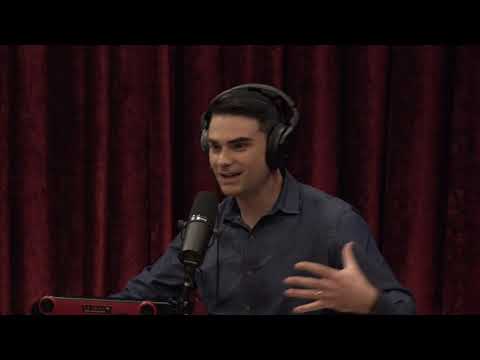
Joe Rogan Experience #1732 - Ben Shapiro
Joe Rogan (host), Ben Shapiro (guest)
In this episode of The Joe Rogan Experience, featuring Joe Rogan and Ben Shapiro, Joe Rogan Experience #1732 - Ben Shapiro explores rogan and Shapiro dissect COVID, crime, media bias, and masculinity Joe Rogan and Ben Shapiro spend several hours unpacking their shared disillusionment with blue-state governance, COVID policy, media behavior, and cultural trends in America. They contrast life in California and New York with Florida and Texas, arguing that high-crime, lockdown-heavy cities have driven residents and voters rightward. Much of the conversation critiques pandemic risk intolerance, vaccine mandates, censorship on big tech platforms, and what they see as a culture that rejects personal responsibility, discipline, and traditional family structures. They also dig into meritocracy versus equality, college credentialism, the Israel–Palestine narrative, and the potential societal dangers of the metaverse and technological overdependence.
Rogan and Shapiro dissect COVID, crime, media bias, and masculinity
Joe Rogan and Ben Shapiro spend several hours unpacking their shared disillusionment with blue-state governance, COVID policy, media behavior, and cultural trends in America. They contrast life in California and New York with Florida and Texas, arguing that high-crime, lockdown-heavy cities have driven residents and voters rightward. Much of the conversation critiques pandemic risk intolerance, vaccine mandates, censorship on big tech platforms, and what they see as a culture that rejects personal responsibility, discipline, and traditional family structures. They also dig into meritocracy versus equality, college credentialism, the Israel–Palestine narrative, and the potential societal dangers of the metaverse and technological overdependence.
Key Takeaways
Population flight from big blue cities is reshaping political maps.
Rogan and Shapiro argue that crime, homelessness, high taxes, and strict COVID restrictions in cities like LA, San Francisco, New York, and Chicago are pushing people toward states like Florida and Texas, which in turn makes those states more solidly Republican.
Get the full analysis with uListen AI
COVID exposed a deep divide between risk-averse and risk-tolerant worldviews.
They frame pandemic conflict less as left vs right and more as people who accept inevitable risk vs those who expect authorities to eliminate risk by controlling others’ behavior, driving mandates, lockdowns, and social tension.
Get the full analysis with uListen AI
Media framing and big tech moderation strongly shape public understanding of COVID and politics.
They highlight examples like the lab-leak hypothesis, Rogan’s ivermectin use, and social media fact-checking to argue that legacy media and platforms suppress disfavored narratives while later quietly adopting some of them, eroding trust.
Get the full analysis with uListen AI
Focusing solely on vaccines while ignoring health fundamentals is a policy failure.
They criticize authorities for not forcefully emphasizing obesity reduction, exercise, and vitamin D, claiming that these well-established risk factors for severe COVID have been downplayed in favor of a single-solution, pharma-centric narrative.
Get the full analysis with uListen AI
A culture that devalues discipline, duty, and family formation undermines young men especially.
Both contend that messages against responsibility and “toxic masculinity” leave young men aimless, while figures like Shapiro, Rogan, and Jordan Peterson gain influence by emphasizing marriage, work, discipline, and risk-taking as paths to meaning.
Get the full analysis with uListen AI
Meritocracy in markets can coexist with moral and communal values, but we confuse them.
Shapiro distinguishes between rewarding skills and innovation with money (which generates useful products and jobs) and judging moral worth; they argue we over-index on financial metrics while neglecting honor, community contribution, and character.
Get the full analysis with uListen AI
Growing virtual immersion and the metaverse may weaken societal resilience.
They worry that if large numbers of people live primarily online, they’ll be unprepared for real-world shocks (like power-grid failures) and that other civilizations (e. ...
Get the full analysis with uListen AI
Notable Quotes
““There’s also a fucking effort inequality problem in this country.””
— Joe Rogan
““Once everybody’s had the opportunity to protect themselves, we’re done.””
— Ben Shapiro
““If you pay people to stay home, they will stay home.””
— Ben Shapiro
““Discipline equals freedom.””
— Joe Rogan
““Eliminating problems doesn’t make people happier.””
— Ben Shapiro
Questions Answered in This Episode
How fair or accurate are Rogan and Shapiro’s characterizations of COVID risk, vaccines, and treatments when weighed against current scientific consensus?
Joe Rogan and Ben Shapiro spend several hours unpacking their shared disillusionment with blue-state governance, COVID policy, media behavior, and cultural trends in America. ...
Get the full analysis with uListen AI
To what extent is the urban exodus from blue states driven by policy failures vs broader economic and lifestyle trends unrelated to politics?
Get the full analysis with uListen AI
Where is the line between necessary content moderation and censorship that meaningfully distorts public debate on platforms like YouTube, Facebook, and Spotify?
Get the full analysis with uListen AI
Can a society meaningfully promote both economic meritocracy and robust communal/moral values without one eroding the other? If so, how?
Get the full analysis with uListen AI
How might the normalization of virtual worlds and the metaverse transform concepts of identity, responsibility, and citizenship over the next few decades?
Get the full analysis with uListen AI
Transcript Preview
(drumming music) Joe Rogan podcast, check it out. The Joe Rogan Experience. Train by day, Joe Rogan podcast by night, all day. (rock music) Hello, Ben Shapiro.
Well, hello, Joe Rogan.
Good to see you, buddy.
It's good to see you outside LA.
I know. I'm a free man now and as are you.
Oh, yeah.
We've escaped the criminal communist state of C- California.
We both look about 25% happier.
Uh, I'm definitely happier. It's way easier to live here. It's, like, l- less traffic and, uh, just forget about all the d- draconian COVID restrictions and dealing with, uh, an inept, bullshit government-
Yep.
... which is what it is.
You save yourself some money too.
It's that, but it's, people are nicer.
Yes.
It's like-
Yes.
... you're living in a r- a d- they're r- regular folks. Like, California is so polluted by show business, it's hard to really reconcile it. It's hard to really understand how bad it is until you leave, and then you go, "Oh, okay. That's not normal. This is normal." Like, just regular people.
It's crazy. So I grew up in LA, right? I mean, I, I was in LA all the way up until last year basically, and the only three years I wasn't in LA I was in Boston for law school. So I- I've only been in, like, big blue cities my entire life. And when you grow up in LA it's like there's no other place... It's like growing up in New York. There's no-
Yeah.
... other place that exists in the country. And then you leave and you're like, "Whoa, the rest of this country is kind of fantastic." And people are. They're way nicer, just way nicer. Like, in LA there's a thing you do where you walk down the street, if you're not driving, you walk down the street, you spot somebody who you don't know, you c- you kinda lock eyes with them. The first thing you do is you look away, right? You don't, you don't, like, you don't catch eyes with somebody and have a conversation with them just in the normal course of business in LA or New York. You move outside LA or New York, you're walking down the street, you lock eyes with somebody, you're like, "Hey, how are you?"
Yeah, they say hi. (laughs)
It's crazy. It's like a crazy thing. (laughs)
Well, there's a thing that happens when you just get too many human beings living together where people become a nuisance, you know? It's just, there's the, well, the population density of Los Angeles is replicated in rat population density studies that they've done. Have you ever seen those?
No, I haven't seen these.
They're really fascinating 'cause they, what they do is they've taken rats, and they take them, and they have a certain number of these rats together, and they behave fairly normally. And then as they increase the population of rats, you start seeing what you see in large cities. You start seeing rats, like, huddled in the corner nodding and shit. You see, like-
Install uListen to search the full transcript and get AI-powered insights
Get Full TranscriptGet more from every podcast
AI summaries, searchable transcripts, and fact-checking. Free forever.
Add to Chrome