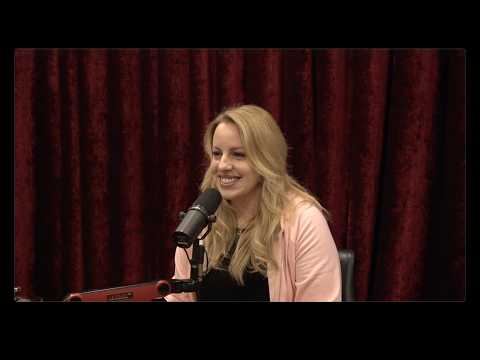
Joe Rogan Experience #2460 - Rachel Wilson
Joe Rogan (host), Rachel Wilson (guest), Joe Rogan (host), Joe Rogan (host), Joe Rogan (host), Joe Rogan (host), Joe Rogan (host)
In this episode of The Joe Rogan Experience, featuring Joe Rogan and Rachel Wilson, Joe Rogan Experience #2460 - Rachel Wilson explores occult feminism claims: women’s liberation driven by elites, ideology, and propaganda Rachel Wilson recounts her personal path from a politically split childhood to motherhood, then explains why she investigated feminism’s history and wrote Occult Feminism: The Secret History of Women’s Liberation.
Occult feminism claims: women’s liberation driven by elites, ideology, and propaganda
Rachel Wilson recounts her personal path from a politically split childhood to motherhood, then explains why she investigated feminism’s history and wrote Occult Feminism: The Secret History of Women’s Liberation.
She argues the standard narrative—women broadly demanded suffrage and workplace equality to escape oppression—was not the reality; she claims many women opposed suffrage and that later academic programs reframed history to market feminism.
Wilson contends feminism served broader political-economic goals (expanded labor force, tax base, state influence via schooling) and aligned with elite philanthropy and Cold War-era propaganda, citing examples like CIA support for Gloria Steinem and institutional funding for gender studies.
The conversation expands into claims about feminism’s links to spiritualism/occult currents, sexual liberation, eugenics/anti-natalism (Margaret Sanger), and modern downstream effects: two-income dependence, family instability, declining birth rates, and worsening female mental health outcomes.
Key Takeaways
Wilson frames feminism as the largest social revolution of the last century.
She argues feminism rapidly flipped long-standing family, work, and gender norms worldwide and now shapes everything from workplace dynamics to schooling and legislation.
Get the full analysis with uListen AI
She claims women’s suffrage was not broadly desired by women at the time.
Wilson alleges anti-suffrage groups outnumbered suffragists, cites a Massachusetts referendum figure (4% support among women who voted), and argues leaders then sidelined direct female input on suffrage.
Get the full analysis with uListen AI
Workforce expansion is presented as a structural cause of wage stagnation and dual-income necessity.
Wilson claims the 1970s–1980s shift—moving women into college and paid work—nearly doubled labor supply and contributed to a “two-income trap,” making single-income families harder to sustain.
Get the full analysis with uListen AI
Household labor is depicted as “repackaged” into taxable corporate labor.
She argues many jobs women hold replicate domestic/community tasks (childcare, care work, clerical/HR), but moved under corporations, adding commuting costs and increasing tax exposure while reducing parental control.
Get the full analysis with uListen AI
She argues women’s studies/gender studies “rewrote” feminist history for PR purposes.
Wilson cites claims of foundation funding (Ford/Rockefeller/Carnegie) and a textbook-analysis narrative that omitted inconvenient details (male backers, socialist ties, anti-suffrage arguments).
Get the full analysis with uListen AI
Anti-natalism and eugenics are portrayed as central to key feminist institutions.
Wilson characterizes Margaret Sanger and Planned Parenthood’s origins as eugenics-driven, alleges fabricated stories/letters to justify abortion advocacy, and ties population-control ideology to elite networks.
Get the full analysis with uListen AI
She links feminist currents to occult/spiritualist ideologies and sexual liberation movements.
Wilson claims early and later feminists drew from spiritualism, theosophy, Luciferian symbolism, and “sex magic” subcultures (e. ...
Get the full analysis with uListen AI
Notable Quotes
““Feminism is far and away… the biggest social revolution in all of human history, and it happened in one century.””
— Rachel Wilson
““Women did not want Women’s Liberation… it was only a small minority… and they far outnumbered by joining the anti-suffrage groups.””
— Rachel Wilson
““In the span of about 20 years, we almost doubled the labor force… and men’s wages have never recovered.””
— Rachel Wilson
““I don’t believe that society should give women the opportunity… to stay home and be mothers, because if we do, they’re all gonna pick that.””
— Rachel Wilson (quoting Simone de Beauvoir)
““Occult… means hidden… there’s a whole history here that’s been completely intentionally hidden.””
— Rachel Wilson
Questions Answered in This Episode
What primary documents (debates, pamphlets, organizational membership rolls) most strongly support the claim that anti-suffrage women outnumbered suffragists, and where can viewers verify them?
Rachel Wilson recounts her personal path from a politically split childhood to motherhood, then explains why she investigated feminism’s history and wrote Occult Feminism: The Secret History of Women’s Liberation.
Get the full analysis with uListen AI
How does Wilson separate correlation from causation in the “women entering the workforce → wage stagnation/two-income trap” argument, given other 1970s macroeconomic changes?
She argues the standard narrative—women broadly demanded suffrage and workplace equality to escape oppression—was not the reality; she claims many women opposed suffrage and that later academic programs reframed history to market feminism.
Get the full analysis with uListen AI
Which specific “protections” (breadwinner laws, debt liability, property/consent rules) were most commonly lost after suffrage, and through what statutes/court changes did that occur?
Wilson contends feminism served broader political-economic goals (expanded labor force, tax base, state influence via schooling) and aligned with elite philanthropy and Cold War-era propaganda, citing examples like CIA support for Gloria Steinem and institutional funding for gender studies.
Get the full analysis with uListen AI
What is the most credible public documentation for CIA involvement in funding Ms. Magazine and Steinem’s activities, and what parts are disputed by historians?
The conversation expands into claims about feminism’s links to spiritualism/occult currents, sexual liberation, eugenics/anti-natalism (Margaret Sanger), and modern downstream effects: two-income dependence, family instability, declining birth rates, and worsening female mental health outcomes.
Get the full analysis with uListen AI
If women’s higher education correlates with falling birth rates globally, what policy mix (housing, tax credits, childcare, cultural norms) best reverses it without restricting education?
Get the full analysis with uListen AI
Transcript Preview
[upbeat music] Joe Rogan Podcast, check it out! The Joe Rogan Experience. Train by day, Joe Rogan Podcast by night. All day. [upbeat music]
Hello, Rachel. What's happening?
Hello, Joe.
Very nice to see you again.
Good to see you, too.
Um, so when your husband Andrew came in here, he told me about your book, and then I talked to you, and you seemed very interesting, and you gave me, like, a little brief synopsis of it. And so then I listened to it on audio tape, and it's fucking crazy.
[laughing]
And it is the Occult Feminism: The Secret History of Women's Liberation. Um, you know, I didn't really have much of an opinion on feminism. I... My, my opinion was, you know, unfortunately, you run into some feminists that just seem to not like men, for whatever reason. And, you know, there's a lot of people in this world that aren't happy with their position or station in life, but I didn't really think too much into how this all got started until I listened to your book, and I'm like, "This is kind of bonkers." So before we get into your book, like, how did you decide to write about this? Like, what, what was your little journey?
Oh.
Or big journey.
Yeah, it's kind of a big journey. So, uh, when I was growing up, I was, like, a... In all the advanced kid classes, and from the time I was in, like, kindergarten, it was just pounded into my head, like, "You're going to college, you're going to have a career. And, you know, you're smart, and you have to do something with that." It was, like-
Right
... the only option that was put before me, and so I followed that path, like, all the way through school. And by the time I got done with 12 years of regular school, I realized a couple things. One is, uh, school is not where you go to learn things. Uh, school isn't nec- public school is not so great for smart people, for the most part, and that I really didn't like... Like, another four years of school just sounded like hell to me, and I really just wanted to get married and have kids. That's kind of what I always wanted to do, much to the horror of my Marxist feminist mother, um [chuckles] -
Oh, you were-
... who did not like that
... indoctrinated at an early age.
Well, she tried-
[chuckles]
... but I was the why kid. I was the kid that's just like: "Why? Why?"
Yeah.
"But why?" Um, and I had, like, a Rush Limbaugh dad.
Wow!
Yeah. They got divorced. Shocker. [chuckles] Who could have seen it coming?
[chuckles]
Um, so they got divorced when I was, like, nine, and I had... So I grew up in, like, two worlds. I had, like, Republican business owner, Rush Limbaugh dad, and I had Marxist feminist, crazy mom.
Install uListen to search the full transcript and get AI-powered insights
Get Full TranscriptGet more from every podcast
AI summaries, searchable transcripts, and fact-checking. Free forever.
Add to Chrome