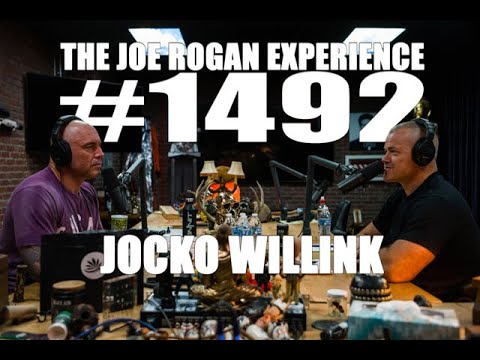
Joe Rogan Experience #1492 - Jocko Willink
Joe Rogan (host), Jocko Willink (guest)
In this episode of The Joe Rogan Experience, featuring Joe Rogan and Jocko Willink, Joe Rogan Experience #1492 - Jocko Willink explores jocko Willink and Joe Rogan Deconstruct Policing, Media, and Discipline Joe Rogan and Jocko Willink use 2020’s chaos—COVID, George Floyd, riots, and political polarization—as a springboard to examine how emotional media, weak leadership, and poor communication are tearing institutions and communities apart.
Jocko Willink and Joe Rogan Deconstruct Policing, Media, and Discipline
Joe Rogan and Jocko Willink use 2020’s chaos—COVID, George Floyd, riots, and political polarization—as a springboard to examine how emotional media, weak leadership, and poor communication are tearing institutions and communities apart.
They argue that social and mainstream media now operate to inflame outrage rather than inform, which destroys trust, impairs decision-making, and deepens partisan divides.
Jocko lays out a concrete blueprint for reforming policing through intense, ongoing training, better psychological vetting, community relationship-building, and honest public education about how to interact with officers.
They also stress personal discipline—fitness, jiu-jitsu, hard work, and embracing hardship—as the antidote to societal fragility, while lamenting the lack of serious, unifying leadership in politics and public life.
Key Takeaways
Media ecosystems are optimized for outrage, not clarity.
Both social and mainstream media select and frame stories to maximize emotional reactions and clicks, often omitting crucial context (e. ...
Get the full analysis with uListen AI
Policing problems are primarily training and leadership problems.
Jocko argues that most departments give officers only a few hours of combatives training per year; he recommends at least 20% of time devoted to scenario-based training, de-escalation, and regular psychological assessment, plus higher physical and mental standards.
Get the full analysis with uListen AI
“Defund the police” without a replacement plan is dangerous.
They distinguish between reallocating some resources and literally dismantling departments, warning that reducing budgets typically cuts training first and discourages good candidates—likely leaving more undertrained, lower-quality officers in the job.
Get the full analysis with uListen AI
Building police–community trust requires sustained, hands-on engagement.
Drawing on counterinsurgency lessons from Iraq, Jocko says officers must get out of the car, meet families, offer ride-alongs, and recruit local youth, because genuine relationships turn civilians into allies against actual “bad actors.”
Get the full analysis with uListen AI
Leadership demands humility: admit uncertainty, listen, and share ownership.
Jocko stresses that real leaders say “I don’t know,” openly adjust course when new data emerges (e. ...
Get the full analysis with uListen AI
Discipline and hardship inoculate individuals against chaos.
They present jiu-jitsu, hard physical training, hunting, and deliberately doing difficult things as ways to build confidence, reduce fear, shrink the ego, and avoid both bullying and victimhood—attributes they see as missing in much of modern society.
Get the full analysis with uListen AI
Economic and manufacturing resilience are national security issues.
Using Origin USA and Detroit as examples, they argue offshoring for marginal profit hollowed out the middle class and skills base; COVID then exposed the danger of depending on foreign supply chains for essentials like medicine and PPE.
Get the full analysis with uListen AI
Notable Quotes
“No one makes good decisions when they're emotional.”
— Jocko Willink
“If we want to help the police through these situations, we need to invest more money into them.”
— Jocko Willink
“There’s no clear path to sanity if we don’t talk to each other.”
— Joe Rogan
“A leader on the front line is always right.”
— Jocko Willink (citing General Patton and his own approach)
“If you don’t like to fight, you more than anyone else should learn jiu-jitsu.”
— Jocko Willink
Questions Answered in This Episode
How realistic is Jocko’s proposal that police officers should train 20% of their time, and what concrete policy changes would be required to make that standard nationwide?
Joe Rogan and Jocko Willink use 2020’s chaos—COVID, George Floyd, riots, and political polarization—as a springboard to examine how emotional media, weak leadership, and poor communication are tearing institutions and communities apart.
Get the full analysis with uListen AI
What specific mechanisms could be put in place to force media outlets—both social and mainstream—to present fuller context rather than outrage-optimized headlines?
They argue that social and mainstream media now operate to inflame outrage rather than inform, which destroys trust, impairs decision-making, and deepens partisan divides.
Get the full analysis with uListen AI
In practice, what would a balanced reform agenda look like that addresses both police misconduct and the broader violent crime affecting many communities?
Jocko lays out a concrete blueprint for reforming policing through intense, ongoing training, better psychological vetting, community relationship-building, and honest public education about how to interact with officers.
Get the full analysis with uListen AI
How can individuals cultivate the kind of discipline and mental resilience Jocko describes if they don’t have military or martial arts backgrounds?
They also stress personal discipline—fitness, jiu-jitsu, hard work, and embracing hardship—as the antidote to societal fragility, while lamenting the lack of serious, unifying leadership in politics and public life.
Get the full analysis with uListen AI
Given the deep partisan divides they describe, what structural changes (e.g., election reform, term limits, independent candidates) might realistically encourage the kind of unifying leadership they say is missing?
Get the full analysis with uListen AI
Transcript Preview
If anybody's got the answers, it's Jocko.
(laughs)
Got any answers?
Oh, uh, I'm not quite so sure about that.
(laughs)
I'm not sure how this movie ends.
(laughs)
(laughs)
This is the dumbest fucking movie ever. Do you know Magic the Gathering is now racist?
(laughs) I don't even know what Magic the Gathering is.
It's some dorky-
What is it?
... game that, that nerds play.
Oh.
Sorry, nerds.
How is it, how is it racist?
Um, I don't know. I was just reading ... I only saw the title of the article that they're, they're trying to cancel Magic the Gathering. I'm like, "Oh, Christ."
(laughs)
(exhales) I thought that's what you guys liked. I thought they liked Magic the Gathering.
I, I have no idea.
Everything's, everything's, everything's problematic. Everyone's getting canceled. It's amazing how many people did blackface.
Yeah.
(laughs)
It's very strange. It's very strange. (laughs) It's, it's very strange. I mean, it was on, but it was on primetime TV, right?
Yeah, yeah, a bunch of times. Yeah.
I mean, like, in the modern world-
Oh, yeah, yeah, yeah.
... primetime TV.
Jimmy Fallon was doing ... Well, he's doing a Chris Rock impression, which, by the way, you used to be able to do. When I was in high school, my friends were Mr. T for Halloween. Nobody gave a fuck. Nobody was like, "Jimmy, what's wrong with you?"
(laughs)
Everybody was like, "Oh, you're Mr. T for Halloween." It was never, like, a problem.
Yeah.
It's very ... It's a very strange thing. You know? Like, you can do whiteface no problem. Here it is. What is this? Magic the Gathering- Invoke Prejudice card. Mm. So, that's a ... It's an enchantment card which restricts the caster's opponents only using summons that match the skin color of their opposing Creatures. Huh?
(laughs)
(laughs)
This is ... You, you brought me on to talk about this? I should leave now.
(laughs)
About, about Magic the Gathering.
No.
And this is why I'm here, man. We're in a bad way. (laughs)
It just shows how fucked up everything is.
Yeah. There's a lot of thin skin out there right now-
A, apparently-
... apparently.
I just don't ... I mean, uh, it seems like a perfect storm. Like, if you wanted to engineer the downfall of society-
(laughs)
... you would do it in several steps. You would have a reality show president who ... where everybody's mad at him, and- and then all the liberals get their feathers in a ruffle and everybody gets real super uptight. And, and then there's this big divide between the left and the right that's kind of f- you know, manufactured. And then you'd have this disease.
Install uListen to search the full transcript and get AI-powered insights
Get Full TranscriptGet more from every podcast
AI summaries, searchable transcripts, and fact-checking. Free forever.
Add to Chrome