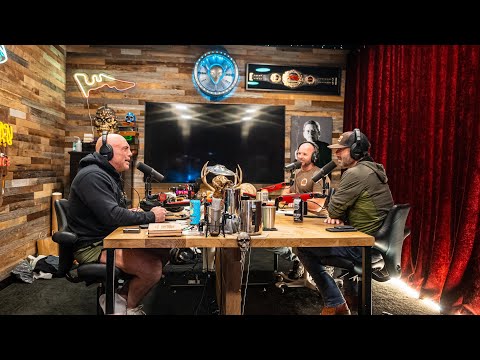
Joe Rogan Experience #2426 - Cameron Hanes & Adam Greentree
Narrator, Narrator, Adam Greentree (guest), Joe Rogan (host), Cameron Hanes (guest), Adam Greentree (guest), Narrator, Cameron Hanes (guest), Narrator, Narrator
In this episode of The Joe Rogan Experience, featuring Narrator and Narrator, Joe Rogan Experience #2426 - Cameron Hanes & Adam Greentree explores predators, Policy, And Purpose: Bowhunters Decode Nature And Modern Life Joe Rogan, Cameron Hanes, and Adam Greentree spend the episode immersed in hunting stories that reveal the brutal reality of predators, from mountain lions and brown bears to sharks and wolves, contrasting it with modern humans’ insulated urban lives.
Predators, Policy, And Purpose: Bowhunters Decode Nature And Modern Life
Joe Rogan, Cameron Hanes, and Adam Greentree spend the episode immersed in hunting stories that reveal the brutal reality of predators, from mountain lions and brown bears to sharks and wolves, contrasting it with modern humans’ insulated urban lives.
They argue that predator management through regulated hunting is essential for ecological balance and human safety, criticizing emotionally driven anti-hunting policies in places like California, British Columbia, and Japan.
The conversation expands into how high-level bowhunting demands physical conditioning, mental toughness, and ethical decision-making, with detailed discussions of gear evolution, shot selection, and the importance of learning from each hunt.
They close by connecting wilderness, suffering, and fitness to mental health and life purpose, highlighting transformations like Jelly Roll’s and emphasizing that voluntary struggle and time in nature are antidotes to modern anxiety and disconnection.
Key Takeaways
Predator populations must be actively managed, not left to ‘nature.’
The guests argue that unmanaged predators like mountain lions and brown bears increasingly attack livestock, pets, and people, citing Japan’s bear crisis and California’s depredation kills as evidence that hunting quotas and regulated harvests are safer and more rational than reactive government culls.
Get the full analysis with uListen AI
Urban voters often shape wildlife policy they don’t understand.
They criticize how city-based majorities in places like California and British Columbia vote emotionally to protect charismatic predators, while rural residents absorb the real risks—livestock losses, pet predation, and attacks on hunters, farmers, and even school groups.
Get the full analysis with uListen AI
Ethical hunting relies on precision, not just opportunity.
From selecting old males over females, to choosing angles that avoid wounding, to rejecting technologies like thermal optics for fair chase, they emphasize that responsible hunters obsess over accuracy, shot placement, and restraint rather than maximizing kills.
Get the full analysis with uListen AI
Modern gear helps, but bowhunting remains brutally difficult.
Even with advanced cams, rangefinders, lightweight clothing, and image‑stabilized optics, success rates stay low and animals remain elusive—meaning fitness, woodcraft, and judgment still matter more than technology.
Get the full analysis with uListen AI
Voluntary suffering is a powerful antidote to modern malaise.
They link structured hardship—hard hunts, tough workouts, long pack‑outs—to reduced anxiety and greater contentment, contrasting it with the constant low‑grade misery of a comfort‑obsessed, sedentary life filled with distractions but no real challenge.
Get the full analysis with uListen AI
Time in wild places restores mental health and perspective.
All three describe feeling more alive, present, and grateful in mountains and wilderness than in cities, arguing that humans are wired for environments where effort directly connects to survival, not abstract office work and social media drama.
Get the full analysis with uListen AI
Transformation is possible at any age if you get on the path.
Using Jelly Roll’s shift from 500‑plus pounds and addiction to running, bowhunting, and better health as a central example, they stress that improvement comes from small, consistent steps and momentum, not perfection or early specialization.
Get the full analysis with uListen AI
Notable Quotes
“We live on a murderous planet. It’s a constant war.”
— Joe Rogan
“I love mountain lions. I think they’re amazing—but we still have to kill them.”
— Cameron Hanes
“Most society doesn’t know anything about the wild these days. We’re domesticated.”
— Adam Greentree
“The fake life is what we think of as the real life—and it’s not what humans were designed for.”
— Joe Rogan
“I enjoy being part of the success of others. Sharing our lifestyle with new hunters drives me.”
— Cameron Hanes
Questions Answered in This Episode
Where should the ethical line be drawn between helpful hunting technology and tools that make killing too easy?
Joe Rogan, Cameron Hanes, and Adam Greentree spend the episode immersed in hunting stories that reveal the brutal reality of predators, from mountain lions and brown bears to sharks and wolves, contrasting it with modern humans’ insulated urban lives.
Get the full analysis with uListen AI
How can wildlife policy better balance urban voters’ values with the lived reality of rural communities facing predator risks?
They argue that predator management through regulated hunting is essential for ecological balance and human safety, criticizing emotionally driven anti-hunting policies in places like California, British Columbia, and Japan.
Get the full analysis with uListen AI
In what practical ways could non-hunters gain a more realistic understanding of nature’s brutality without actually hunting?
The conversation expands into how high-level bowhunting demands physical conditioning, mental toughness, and ethical decision-making, with detailed discussions of gear evolution, shot selection, and the importance of learning from each hunt.
Get the full analysis with uListen AI
How much of modern anxiety and depression might be rooted in our disconnection from purposeful physical struggle and the natural world?
They close by connecting wilderness, suffering, and fitness to mental health and life purpose, highlighting transformations like Jelly Roll’s and emphasizing that voluntary struggle and time in nature are antidotes to modern anxiety and disconnection.
Get the full analysis with uListen AI
What personal ‘path’ of voluntary hardship—hunting, sport, craft, or otherwise—could someone choose to gain the kind of fulfillment these hunters describe?
Get the full analysis with uListen AI
Transcript Preview
(drumming music) Joe Rogan podcast, check it out. The Joe Rogan Experience.
Train by day, Joe Rogan podcast by night, all day. (rock music) Hey.
We're live?
We're live.
Hey.
Gentlemen, what's happening?
(laughs) What is going on?
Good to see ya. Good to see you guys again.
Bow hunting brothers.
You know, we were just talking about the mountain lion that we have in the lobby, and how insane that thing is. So Adam, you shot that mountain lion when?
I think it was about six or seven years ago now.
And you ate it, and I ate some of it. You sent some to me. It's really good, believe it or not, ladies and gentlemen.
You wouldn't think so, but it's incredible. I-
Everybody says it's like ... They, they, the way they describe it is like a sup- I think Rinella said this, a superior pork.
Yeah. Yeah. It's like ... I, I think of it as a cross between venison and chicken. And then ... And I only did a quick on the barbecue, and I'm not a great cook, but it was that tender and that tasty.
But the, the story behind the mountain lion's nuts. Like, that was a, like a murderous mountain lion-
Mm.
... that-
It was ... I felt a bit funny about it to start with, because like the dogs do all the hunting, right? The dogs smell it, dogs find it, they put it up in a tree, but the further I looked into it, I'm like, well, you need the tree 'cause you wanna sex it, and you wanna age it, you know? You wanna make sure it's a lion that's, you know, old, and it has to be a male to shoot it in Colorado, at least at the time you had to, anyway. So, it was actually the perfect way to hunt, but then seeing how destructive that individual lion was, at least, um, I was telling Cam about this when we got here, that it must've grabbed the cow, like a beef cow. It must've grabbed it on the neck. Um, and the cow couldn't move, you know, but it was still fully alive internally, and vocally it was still alive, and when we got there, the mountain lion was like eating it from its rear end-
(exhales)
And it'd been there for at least an hour or two, because there was quite a lot of meat that had been eaten out from the cow's ass.
Oh.
And, um- Kicking its hooves. Yeah, and it just ... But it ... The cow couldn't get up, so it was f- it was literally eating it while it was still alive-
(exhales)
And as the dogs were running down there, you could hear this cow off in the distance just like screaming, like mooing flat out.
Install uListen to search the full transcript and get AI-powered insights
Get Full TranscriptGet more from every podcast
AI summaries, searchable transcripts, and fact-checking. Free forever.
Add to Chrome