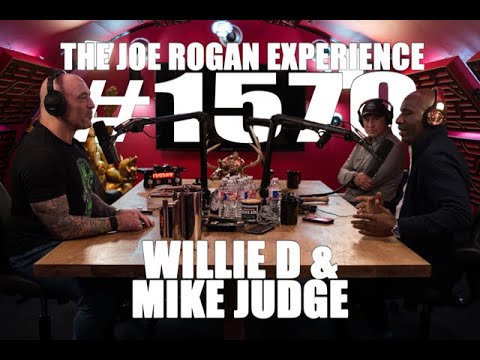
Joe Rogan Experience #1570 - Willie D & Mike Judge
Mike Judge (guest), Joe Rogan (host), Willie D (guest), Guest (guest), Guest (guest), Guest (guest), Guest (guest)
In this episode of The Joe Rogan Experience, featuring Mike Judge and Joe Rogan, Joe Rogan Experience #1570 - Willie D & Mike Judge explores willie D exposes hip-hop manipulation, hustle mindset, and real courage Joe Rogan sits down with Willie D (Geto Boys) and briefly Mike Judge to discuss the origins of the Geto Boys, early hip‑hop, censorship battles, and the formation of Bushwick Bill’s iconic role and album cover. Willie D walks through pivotal life moments—from near-miss violent crimes and boxing careers to industry politics and social media battles—that shaped his philosophy on self-belief, responsibility, and manhood. They dig into systemic forces steering hip-hop toward destructive themes, including an upcoming documentary about executive collusion to kill conscious rap, and how social media algorithms and media structures incentivize outrage and division. Throughout, Willie D frames his story as both cautionary tale and blueprint for resilience, emphasizing learning from failure, facing fear, and refusing to dilute his message.
Willie D exposes hip-hop manipulation, hustle mindset, and real courage
Joe Rogan sits down with Willie D (Geto Boys) and briefly Mike Judge to discuss the origins of the Geto Boys, early hip‑hop, censorship battles, and the formation of Bushwick Bill’s iconic role and album cover. Willie D walks through pivotal life moments—from near-miss violent crimes and boxing careers to industry politics and social media battles—that shaped his philosophy on self-belief, responsibility, and manhood. They dig into systemic forces steering hip-hop toward destructive themes, including an upcoming documentary about executive collusion to kill conscious rap, and how social media algorithms and media structures incentivize outrage and division. Throughout, Willie D frames his story as both cautionary tale and blueprint for resilience, emphasizing learning from failure, facing fear, and refusing to dilute his message.
Key Takeaways
Turn painful environments into fuel, not a permanent identity.
Willie D describes growing up with “insufficient everything” and deciding early that he would not repeat the cycle; that decision, backed by daily disciplined effort (even just five minutes a day toward rap), became the foundation for changing his life trajectory.
Get the full analysis with uListen AI
Failure and fear are required parts of growth, not signs to quit.
From getting badly beaten in sparring to heartbreak and business setbacks, both he and Rogan stress that discomfort, losses, and doubt are inevitable; what matters is continuing anyway and viewing those experiences as teachers rather than endpoints.
Get the full analysis with uListen AI
Conflict resolution should be taught like math or reading.
Willie D admits that in his “cowboy western days” he solved problems with violence—jumping off stages to knock out hecklers, strong‑arming promoters—and argues America’s lack of conflict‑resolution skills drives unnecessary violence and legal trouble.
Get the full analysis with uListen AI
Guard your long‑term goals against short‑term relationships and pressure.
He recounts ending a relationship when a girlfriend demanded more time than his craft because he had vowed not to let anyone, including family or partners, derail his mission to become a successful rapper—a contrast to peers who quit under partner pressure and later regretted it.
Get the full analysis with uListen AI
Media and industry incentives often reward division and degradation.
They discuss how labels, radio, and now social media algorithms push inflammatory or destructive content (from gangsta clichés to outrage politics) because it’s profitable, while more constructive or nuanced messages get sidelined.
Get the full analysis with uListen AI
Authenticity beats manufactured personas in the new media landscape.
Rogan urges Willie D to podcast precisely because audiences connect with unfiltered voices; both criticize legacy TV/radio formats where executives shape topics (e. ...
Get the full analysis with uListen AI
There may be deliberate efforts to suppress conscious Black voices in hip-hop.
Willie D previews his ‘Hip Hop To Death’ documentary alleging a documented executive-level meeting to phase out positive, socially conscious rap in favor of nihilistic, mumble and violence-focused content—especially for Black artists—arguing it serves broader control agendas.
Get the full analysis with uListen AI
Notable Quotes
“My past don’t define me. It refine me.”
— Willie D
“Experience is not the best teacher. Other people’s experience is the best teacher.”
— Willie D
“I love who love me, but I hate who hate me.”
— Willie D
“The people don’t run the country. A bunch of old folks in Congress run the country.”
— Willie D
“This is the craziest moment in all of time for communication… a person can just talk into a microphone and instantaneously reach millions.”
— Joe Rogan
Questions Answered in This Episode
If the ‘Hip Hop To Death’ documentary’s claims about executive collusion are accurate, what mechanisms could artists and audiences use now to reclaim the culture of hip-hop?
Joe Rogan sits down with Willie D (Geto Boys) and briefly Mike Judge to discuss the origins of the Geto Boys, early hip‑hop, censorship battles, and the formation of Bushwick Bill’s iconic role and album cover. ...
Get the full analysis with uListen AI
How do you balance ‘never letting anyone derail your dream’ with maintaining healthy, reciprocal relationships and family responsibilities?
Get the full analysis with uListen AI
Where is the line between confidently confronting trolls or bullies and simply feeding an outrage ecosystem that thrives on conflict?
Get the full analysis with uListen AI
What would a serious, nationwide conflict-resolution curriculum in schools actually look like, and how might it change communities like the ones Willie D grew up in?
Get the full analysis with uListen AI
Given the power of algorithms to amplify anger and division, should platforms be regulated like utilities, self-reformed, or competed against with new, values-driven alternatives?
Get the full analysis with uListen AI
Transcript Preview
(drum music) Joe Rogan podcast, check it out. The Joe Rogan Experience.
Train by day, Joe Rogan podcast by night, all day. (rock music) Willy D and Mike Judge, together at last.
(laughs)
(laughs)
Good to see you, man.
Absolutely.
You're the first guy in the studio to bring his own headphones, the first guy ever in 1,500 shows.
I- is that right?
Yeah.
Oh, man. Well, you know that where there's a will, there's a way. (laughs)
(laughs)
Well, they fit too. They're- they're-
Yeah.
... they're- they're unique.
Right.
And, uh, Mike, you just happen to be rolling with Willy, so you're here today as well.
Yes, thanks for having me.
My pleasure, man. Um, I wanted to get m- get ahold of you and find the good spots in Austin anyway, man. You've been here for a long time, right?
Yeah, since '94. And I'd come down here a lot before that. Lived in Dallas.
What's going on with Beavis and Butt-Head?
Uh, it's, uh, it's coming back. Yeah.
It- it really is?
Yeah. In fact-
Wow.
... that's why I'm gonna have to split in a little while for some Zoom meetings. But, uh, yeah, no, it really is. Yeah, we're doing a ... I think, uh, I think it's gonna be good. I'm excited about that.
Dude, I was a gigantic fan of Beavis and Butt-Head. Right around the time I started smoking pot-
(laughs)
... was when I really got into Beavis and Butt-Head at the same time.
Yeah, that- a lot of ... We had a lot of stoners that liked it. Also, a lot of people talking about it, like hat- watching it after you come home from a bar, that sort of thing.
Yeah, it was one of the silliest shows ever.
(laughs)
It was ridiculous.
Now everyone will be drinking at home and getting stoned. Well, you always get stoned at home, so...
(clears throat) And Willy-
You'll be stoned everywhere, right?
I've been a fan of the Geto Boys-
(laughs)
... since the very beginning.
Yes.
Yeah.
So when I- when I first met you in Houston ... I rarely geek out, but w- when I met you, I mean, I've ... Dude, when I used to deliver newspapers, I used to listen to Geto Boys while I was delivering newspapers.
I didn't know you d- delivered newspapers.
Yeah.
We got something in common. Man, we got something that's in common.
You did that too?
Well, I delivered newspapers, and I also sold door-to-door subscriptions-
Oh.
... for the Houston Chronicle.
No kidding. Yeah.
Yeah.
I did, uh, the Boston Globe and the Boston Herald. When did you guys start? When did Geto Boys start?
Install uListen to search the full transcript and get AI-powered insights
Get Full TranscriptGet more from every podcast
AI summaries, searchable transcripts, and fact-checking. Free forever.
Add to Chrome