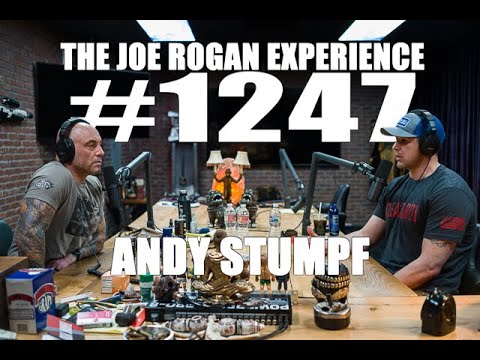
Joe Rogan Experience #1247 - Andy Stumpf
Joe Rogan (host), Andy Stumpf (guest), Jamie Vernon (guest)
In this episode of The Joe Rogan Experience, featuring Joe Rogan and Andy Stumpf, Joe Rogan Experience #1247 - Andy Stumpf explores ex–Navy SEAL Andy Stumpf Deconstructs War, Risk, Trauma, and Culture Joe Rogan and former Navy SEAL Andy Stumpf discuss how combat, brotherhood, and prolonged exposure to life-or-death situations permanently change a person’s sense of purpose and perspective. Stumpf details being shot in Iraq, the cascading physical and neurological consequences, and how poorly medicine still understands traumatic brain injury, especially for veterans and fighters. They dive into extreme risk-taking—wingsuit BASE jumping, skydiving, climbing—and why Stumpf chased high-consequence activities to recreate the mental clarity of combat, before shifting that drive into jiu-jitsu. The conversation widens into outrage culture, social media, political polarization, school shootings, U.S. foreign policy, and why Stumpf believes war should be a last resort even as a strong, forward-leaning military presence remains necessary.
Ex–Navy SEAL Andy Stumpf Deconstructs War, Risk, Trauma, and Culture
Joe Rogan and former Navy SEAL Andy Stumpf discuss how combat, brotherhood, and prolonged exposure to life-or-death situations permanently change a person’s sense of purpose and perspective. Stumpf details being shot in Iraq, the cascading physical and neurological consequences, and how poorly medicine still understands traumatic brain injury, especially for veterans and fighters. They dive into extreme risk-taking—wingsuit BASE jumping, skydiving, climbing—and why Stumpf chased high-consequence activities to recreate the mental clarity of combat, before shifting that drive into jiu-jitsu. The conversation widens into outrage culture, social media, political polarization, school shootings, U.S. foreign policy, and why Stumpf believes war should be a last resort even as a strong, forward-leaning military presence remains necessary.
Key Takeaways
Life-or-death environments permanently recalibrate what feels important.
Stumpf explains that repeated exposure to combat strips away trivial concerns and engrains a deep sense of purpose and perspective, making everyday civilian disputes and “outrage culture” feel surreal and often meaningless by comparison.
Get the full analysis with uListen AI
Traumatic brain injury is widespread and poorly understood, especially in combat arms and contact sports.
He notes that blast exposure, hard parachute openings, and repeated sub-concussive impacts can cause lasting cognitive, hormonal, and behavioral changes without obvious knockouts—and that military medicine often treats TBI and PTSD as separate despite heavily overlapping symptoms.
Get the full analysis with uListen AI
Physical wounds can be easier to see than the cascading life impact they create.
Stumpf’s gunshot left metal fragments near his sciatic nerve, chronic neuropathic pain, numbness, and inability to get MRIs, forcing guesswork in his care and ultimately contributing to medical retirement and a major personal identity crisis.
Get the full analysis with uListen AI
Extreme risk-seeking often masks a drive to recreate lost mental states, not just chase adrenaline.
He frames wingsuit BASE jumping and other high-risk activities as attempts to regain the hyper-focused, noise-free clarity he had before combat missions—not simply thrill-seeking—eventually recognizing the toll and pausing BASE after a close friend died.
Get the full analysis with uListen AI
Structured struggle like jiu-jitsu can be profoundly therapeutic for veterans.
Both men describe how live grappling forces full presence, humbles the ego, and provides a safe arena for simulated life-or-death struggle, giving veterans a healthy outlet that can replace more destructive pursuits or the dangerous craving for real combat.
Get the full analysis with uListen AI
Media and movies wildly distort what war and tactical work actually look like.
Stumpf criticizes Hollywood for endless ammo, fireball grenades, and reckless room-clearing, contrasting that with the reality of 95% planning/training, frequent “dry holes,” and painstaking, often boring logistics and PowerPoint before any kinetic action.
Get the full analysis with uListen AI
Solving violence requires addressing motivation and mental health, not just the hardware.
On school shootings and gun violence, Stumpf argues the U. ...
Get the full analysis with uListen AI
Notable Quotes
“I probably have closer relationships with some of the people I served with than my biological family—and maybe even my wife and kids.”
— Andy Stumpf
“The only thing I really learned as a SEAL was how to enhance my ability to learn other things.”
— Andy Stumpf
“Most people who die skydiving die under perfectly functioning equipment—they kill themselves with bad decisions.”
— Andy Stumpf
“War should be a measure of last resort. The military is really good at cutting the head off the snake, but not at building and holding infrastructure.”
— Andy Stumpf
“We don’t have a gun crisis; we have a mental health crisis disguised as a gun problem.”
— Joe Rogan (restating his long-held position)
Questions Answered in This Episode
How can military and civilian medical systems better distinguish and treat the overlapping effects of TBI and PTSD in veterans?
Joe Rogan and former Navy SEAL Andy Stumpf discuss how combat, brotherhood, and prolonged exposure to life-or-death situations permanently change a person’s sense of purpose and perspective. ...
Get the full analysis with uListen AI
What are healthier ways for people who miss high-stakes environments—combat, elite sports, extreme risk—to find that same sense of purpose and clarity?
Get the full analysis with uListen AI
Given the documented manipulation on social media by foreign actors, what practical steps can individuals take to avoid being emotionally weaponized online?
Get the full analysis with uListen AI
What would a realistic, long-term U.S. strategy look like that both prevents safe havens for extremist groups and avoids endless occupation and war?
Get the full analysis with uListen AI
How could schools and communities address the motivational roots of mass shootings—alienation, hopelessness, mental illness—rather than only debating gun access?
Get the full analysis with uListen AI
Transcript Preview
Four, three, two ... Hello, Andy.
(laughs) What's up, Joe?
What's going on, buddy?
(laughs) Not much, man.
We're here drinking CBD water. I've never had CBD water. GT's Kombucha sent us some CBD water.
My first sip was a few seconds ago and, uh, I didn't read that it said cucumber basil, so I was shocked by the taste, but I like it.
Yeah, that's a weird combo, right?
Yeah.
Cucumber ... And it- it's called Dream Catcher, which makes me think of, like, (clicks tongue) white trash lady living in a trailer park with one of them things hanging over her bed. Right?
Pa- partially broken on the inside.
Mullet.
(laughs)
Weird cats. (laughs) If you have a dream catcher, most likely you have cats, right?
I think you have to have one.
It's part of the program. Yeah. Yeah.
It's a package deal.
It's like, you know what I saw, um, yesterday that, that is really rare? I saw a dude who was dressed up like a Native American who was not in fact a Native American. That's a risky move in this day and age.
(clicks tongue) Yeah, I'm not gonna go there. Uh, I wouldn't-
When we were kids-
(laughs)
... you could be an Indian, like if you could play cowboys and Indians, you could be an Indian and they'd be like, "Oh, okay."
"Yeah, no problem."
"He's, he's, he's the Indian, this guy's the cowboy."
(laughs)
Normal shit. Today they will fucking come for you.
That day is gone.
It's d- day's over.
Yeah.
What happened?
I'm not smart enough to answer that question, but-
But you are.
... a significant margin. (laughs)
But some things have taken place. I mean, d- and dur- during the time that you were serving-
Yeah.
... from 2001 to 2019, where we're at today, I mean there has been a significant change in outrage culture in this country-
Yep.
... in, in entitlement, like, with- with things that people think that they can get offended by and not offended by, things that are important and not important. It's a w- we're in the strangest time.
(clicks tongue) The beauty of that is most of the time I was serving, so I paid zero attention to any of it.
Right.
The disaster part of that is when you come off the off-ramp, you know, out of service-
Yeah.
... and you go, "W- what happened?"
Yeah.
"What happened to the environment that I left?" But, uh, I mean, I went from Santa Cruz, California where I grew up, where it could well be the origin of outrage culture and social justice warriors, to the military, to back out of the military. So I had very, uh, very different, uh, optics when it comes to perspective, where I started and then what I was seeing when I came out.
Install uListen to search the full transcript and get AI-powered insights
Get Full TranscriptGet more from every podcast
AI summaries, searchable transcripts, and fact-checking. Free forever.
Add to Chrome