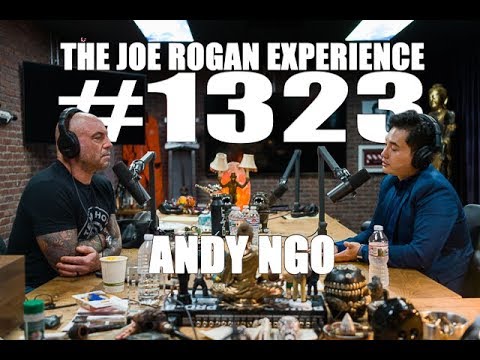
Joe Rogan Experience #1323 - Andy Ngo
Joe Rogan (host), Andy Ngo (guest), Narrator
In this episode of The Joe Rogan Experience, featuring Joe Rogan and Andy Ngo, Joe Rogan Experience #1323 - Andy Ngo explores journalist Andy Ngo Details Antifa Assault And Portland’s Policing Crisis Andy Ngo recounts being violently assaulted by Antifa activists in Portland, resulting in a brain hemorrhage, and describes a broader pattern of left-wing political violence in the city. He and Joe Rogan discuss Portland’s political monoculture, the mayor’s dual role as police commissioner, and allegations that police are effectively ordered to stand down at Antifa-related unrest.
Journalist Andy Ngo Details Antifa Assault And Portland’s Policing Crisis
Andy Ngo recounts being violently assaulted by Antifa activists in Portland, resulting in a brain hemorrhage, and describes a broader pattern of left-wing political violence in the city. He and Joe Rogan discuss Portland’s political monoculture, the mayor’s dual role as police commissioner, and allegations that police are effectively ordered to stand down at Antifa-related unrest.
Ngo explains his work covering far-left militancy and fake hate-crime panics, which he believes made him a specific target for Antifa harassment, doxing, and ultimately physical attacks. They critique mainstream media figures and left-leaning journalists who, in their view, minimize or justify Antifa violence under the banner of ‘anti-fascism.’
The conversation explores Antifa’s ideology, organization, and normalization by sympathetic academics and politicians, contrasting its professed anti-fascist stance with its use of masked mobs, doxing, and street violence. Ngo advocates for legal accountability, federal involvement, and basic reforms like anti-mask laws, warning that unchecked escalation could lead to deaths and broader civil unrest.
Key Takeaways
Targeted journalists in volatile environments face real physical risk, not just online harassment.
Ngo’s experience shows that covering extremist groups on the ground—especially when criticizing their narratives—can lead to direct, severe violence, including lasting brain injury.
Get the full analysis with uListen AI
Institutional inaction can normalize and embolden street-level political violence.
Repeated decisions by Portland leadership and police to avoid intervening in Antifa clashes appear to have created an environment where masked mobs feel they can assault opponents with impunity.
Get the full analysis with uListen AI
Dehumanizing labels make violence against opponents easier to rationalize.
By branding a wide range of people as ‘Nazis,’ ‘fascists,’ or ‘far-right,’ Antifa sympathizers and some commentators implicitly or explicitly justify assaults on those they disagree with, including nonviolent journalists.
Get the full analysis with uListen AI
Anonymous masking and crowd dynamics significantly escalate the danger of protests.
Widespread mask-wearing and uniform black attire make identification difficult, blur individual responsibility, and foster mob behavior, which Rogan and Ngo argue leads to sucker-punch tactics and group beatings.
Get the full analysis with uListen AI
Media framing shapes public tolerance for political violence.
Ngo and Rogan argue that some mainstream and progressive journalists downplay or excuse Antifa actions because they oppose the same political enemies, which widens the Overton window for ‘acceptable’ violence.
Get the full analysis with uListen AI
Understanding an extremist movement requires looking beyond its branding.
Despite the appealing ‘anti-fascist’ label, Ngo stresses that Antifa’s literature and practice advocate anarchist or revolutionary aims, opposition to liberal democracy itself, and the ethical use of preemptive violence.
Get the full analysis with uListen AI
Legal and policy choices—like anti-mask laws or lawsuits—can change incentives.
Ngo suggests federal scrutiny, lawsuits against city authorities, and laws restricting masks during crimes as concrete levers to deter future mob attacks and force local institutions to enforce existing laws.
Get the full analysis with uListen AI
Notable Quotes
“What happened to me should happen to nobody, much less a journalist.”
— Andy Ngo
“Violence is not a bug of what they do. It’s a feature.”
— Andy Ngo
“When you put people in masks and then you have a bunch of people yelling and escalating… that’s what you’re seeing with Antifa.”
— Joe Rogan
“If you understood violence, it’s the last thing you would ever be calling for.”
— Joe Rogan
“Portland is a harbinger and a warning to what can happen in other cities when you have a government turning a blind eye to far-left militancy.”
— Andy Ngo
Questions Answered in This Episode
How should law enforcement balance protecting free assembly with preventing masked mob violence at protests?
Andy Ngo recounts being violently assaulted by Antifa activists in Portland, resulting in a brain hemorrhage, and describes a broader pattern of left-wing political violence in the city. ...
Get the full analysis with uListen AI
To what extent are media outlets ethically responsible for downplaying or justifying violence when it’s committed by groups they see as ideologically aligned?
Ngo explains his work covering far-left militancy and fake hate-crime panics, which he believes made him a specific target for Antifa harassment, doxing, and ultimately physical attacks. ...
Get the full analysis with uListen AI
Is it possible to oppose genuine fascism or white supremacy effectively without sliding into illiberal or violent tactics ourselves?
The conversation explores Antifa’s ideology, organization, and normalization by sympathetic academics and politicians, contrasting its professed anti-fascist stance with its use of masked mobs, doxing, and street violence. ...
Get the full analysis with uListen AI
What concrete reforms—legal, policing, or cultural—would most effectively reduce the kind of political street violence described here?
Get the full analysis with uListen AI
How can the public better distinguish between legitimate anti-extremist activism and movements that use ‘anti-fascism’ as a cover for revolutionary or authoritarian goals?
Get the full analysis with uListen AI
Transcript Preview
(clears throat) Okay. (claps) Hello, Andy.
Hi, Mr. Rogan. Thanks for having me on.
My pleasure. How you doing, man? You're all healed up?
The bruising and swelling has gone down, as you can see, but the more serious injury was to the brain.
You have a serious injury to your brain?
Yeah, brain hemorrhage.
What happ- From what?
The mob beating, so they were-
From getting hit in the head, you got a brain hemorrhage?
Multiple times.
Really?
Contusions. Yes. They were bashing me on the back of my head and to my eyes. Um...
But w- so how do you know you had brain hemorrhaging, and how are you able to just walk around?
Well, I was taken to... I started losing my balance after the beating.
Mm-hmm.
There was no police. I made it, uh, to the courthouse, sat down on the ground. Ambulance was called. I had to walk back to the ambulance because the streets were... or walk back to the police precinct in the direction of the mob. The medics that were associated with the Portland police let me know that they, um... that I needed to walk in that direction. It was quite shocking 'cause it was, um... I had just been a victim of this mob beating, and then now they're telling me to walk back in the direction of, uh, the Sun Trail Precinct where the beating had happened.
Did they not know that you had been beaten up? Well, let's, let's, let's, let's, let's set this up for people-
Okay.
... who are, are new to this and don't understand what happened. Um, I've been aware of you because of... You had written for Quillette, right? And, uh, you had become one of these, for whatever reason, controversial online journalists. And, uh, you covered Antifa quite a bit, and you covered a lot of, uh, the radical left. You were in Portland. And, uh, what was the exact rally that was going on? What was it called? Does... Did it have a name?
Uh, it was something like Protect Portland. So it was organized by Rose City Antifa and its allies. And by its allies, I rem- I'm referring to the local chapter of the Democratic Socialists America came out to support them in numbers.
And what are they protecting Portland from?
They allege, uh, fascists.
Fascists.
Mm-hmm.
But just in general? I mean, is there, like, a particular thing they're worried about?
There were two right-wing events happening that day that they were counter-demonstrating against. There was a... on one si- um, part... one part of downtown, the Proud Boys were holding a flag-waving event. That was completely n- uh, peaceful. There was no actually-
Flag-waving? American flag-waving?
Correct.
Okay.
Um, and a lot of Portland has found that provocative and, uh, a manifestation of, uh, fascistic violence. And in another part of downtown, there was a men's rights activist who was holding, um, a rally, uh, uh... sh- it was titled for dome- for victims of domestic terrorism. It was an anti-Antifa event.
Install uListen to search the full transcript and get AI-powered insights
Get Full TranscriptGet more from every podcast
AI summaries, searchable transcripts, and fact-checking. Free forever.
Add to Chrome