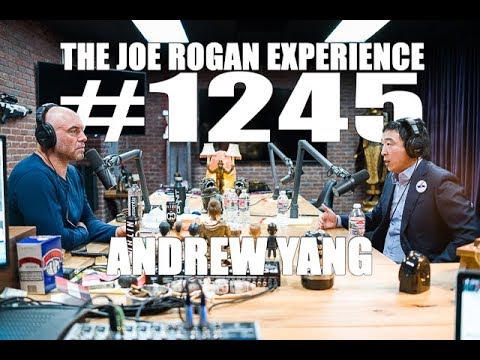
Joe Rogan Experience #1245 - Andrew Yang
Andrew Yang (guest), Joe Rogan (host)
In this episode of The Joe Rogan Experience, featuring Andrew Yang and Joe Rogan, Joe Rogan Experience #1245 - Andrew Yang explores andrew Yang warns of automation crisis, pushes universal basic income Andrew Yang joins Joe Rogan to argue that rapid automation and AI are already hollowing out America’s most common jobs, especially for non‑college‑educated workers, fueling despair, addiction, and political instability.
Andrew Yang warns of automation crisis, pushes universal basic income
Andrew Yang joins Joe Rogan to argue that rapid automation and AI are already hollowing out America’s most common jobs, especially for non‑college‑educated workers, fueling despair, addiction, and political instability.
He proposes a Universal Basic Income (rebranded as the “Freedom Dividend”) of $1,000 per month for every US adult, funded by a value‑added tax on large tech-driven companies and by redirecting existing welfare spending.
Yang contends that retraining alone will not solve mass job loss given poor historical results and the nature of upcoming automation, especially in trucking, retail, call centers, and clerical work.
Beyond UBI, he advocates Medicare for All, rethinking education and student debt, legalizing marijuana, and reshaping economic metrics beyond GDP to focus on health, well‑being, and social cohesion.
Key Takeaways
Automation is already eroding core working‑class jobs, not just a future threat.
Yang cites millions of manufacturing jobs lost and coming disruption to 3. ...
Get the full analysis with uListen AI
Traditional retraining programs have largely failed displaced workers.
Government retraining for laid‑off manufacturing workers showed real‑world success rates between 0–15%, and many mid‑career workers are unlikely to transition into limited numbers of STEM jobs, making “learn to code” both unrealistic and insulting for most.
Get the full analysis with uListen AI
Universal Basic Income can provide a buffer and stimulate local economies.
A $1,000 per month Freedom Dividend would mostly be spent on essentials by cash‑strapped Americans, circulating through communities, creating jobs, reducing costs tied to crime and poor health, and partially paying for itself through increased tax revenues.
Get the full analysis with uListen AI
Funding UBI is mathematically feasible with tax reform and reallocation.
Yang estimates a true net cost of about $1. ...
Get the full analysis with uListen AI
Economic precarity degrades cognition, increases bigotry, and fuels social decay.
Studies he cites show that financial stress can reduce effective IQ by about 13 points, pushing people toward impulsive, resentful thinking—linked to rising suicides, overdoses, and receptiveness to scapegoating and extremist politics.
Get the full analysis with uListen AI
Society must redefine work, purpose, and success beyond paid employment.
Yang argues that men in particular handle joblessness poorly, and that UBI must be paired with a broader cultural reset—valuing caregiving, community work, craftsmanship, and other non‑GDP activities while measuring national success via health and well‑being.
Get the full analysis with uListen AI
Policy shifts should include healthcare reform, student debt relief, and vocational tracks.
He backs Medicare for All to unburden employers and entrepreneurs, proposes structured student‑debt payoff plans and cost controls on universities, and wants far more investment in trades and apprenticeships that are harder to automate than white‑collar cognitive work.
Get the full analysis with uListen AI
Notable Quotes
“We’re in the third inning of the greatest economic and technological transformation in the history of our country.”
— Andrew Yang
“The five most common jobs in the United States are already being eaten by technology.”
— Andrew Yang
“The opposite of Donald Trump is an Asian guy who likes math.”
— Andrew Yang
“Very few entrepreneurs start businesses out of scarcity… You make what you measure.”
— Andrew Yang
“If you accept that basic income is inevitable, there’s no point in trying to time it. Going too late is society‑ending.”
— Andrew Yang
Questions Answered in This Episode
How might Universal Basic Income change people’s sense of identity and purpose when traditional jobs disappear?
Andrew Yang joins Joe Rogan to argue that rapid automation and AI are already hollowing out America’s most common jobs, especially for non‑college‑educated workers, fueling despair, addiction, and political instability.
Get the full analysis with uListen AI
What specific new forms of work or community contribution could societies cultivate to replace lost meaning from employment?
He proposes a Universal Basic Income (rebranded as the “Freedom Dividend”) of $1,000 per month for every US adult, funded by a value‑added tax on large tech-driven companies and by redirecting existing welfare spending.
Get the full analysis with uListen AI
How can policymakers realistically support mid‑career workers in their 40s and 50s who are displaced by automation and unlikely to relocate or re‑educate extensively?
Yang contends that retraining alone will not solve mass job loss given poor historical results and the nature of upcoming automation, especially in trucking, retail, call centers, and clerical work.
Get the full analysis with uListen AI
What safeguards would be needed to ensure a value‑added tax and UBI don’t simply inflate prices or further entrench corporate power?
Beyond UBI, he advocates Medicare for All, rethinking education and student debt, legalizing marijuana, and reshaping economic metrics beyond GDP to focus on health, well‑being, and social cohesion.
Get the full analysis with uListen AI
If GDP is no longer the main benchmark, which alternative indicators of national success should be prioritized and how would those reshape political decision‑making?
Get the full analysis with uListen AI
Transcript Preview
To me-
Five, four... We'll talk about it.
Yeah.
Three, two... (laughs) Yes! And we're live. Hello.
Hey, Joe.
Welcome. Thank you.
Oh, it's great to be here. Thanks for having me.
My pleasure. Um, Sam Harris sends his regards.
Yeah. Sam's a beautiful man.
He is. I love that guy. Uh, and he's one of the reasons why you're here. Um, so universal basic income. This is what this is all about.
Yes.
Joe-
Yeah, that's what my campaign for president is all about.
That's a... an interesting, like, uh, focus of a campaign. And, and... very unusual. And, I mean, four years ago, you'd never even thought that that would have a chance at all, but this is a subject that has been gaining momentum and it g- it made a... I made a big shift 'cause, uh, I had my friend, Eddie Huang, on once, and he was the first person to bring it up. And, uh, my initial knee-jerk reaction was, "Get the fuck outta here." Like, universal basic income? Just gonna give people money. They're just gonna be lazy. Nothing's ever gonna get done. That's a terrible idea. And then I started paying attention to the rise of AI and automation and how many jobs are gonna get taken-
Yes, yes.
... away from p-... And then, once you see the actual numbers, it's pretty staggering.
Yeah, and that's how I got there, Joe. Like, I spent the last seven years running an organization that I'd started called Venture for America, and we helped create about 3,000 jobs in Detroit, Cleveland, St. Louis, Birmingham, New Orleans, other cities around the country. And I saw that we're pouring water into a bathtub that has a giant hole ripped in the bottom, and that for every 5, 10, 50 jobs that my entrepreneurs were gonna create, we're gonna lose 5, 10, 50,000 jobs.
It's not something that people intuitively suspect could be a real issue either. It's, it's one of the o-... the ones where you kinda have to, like, go ha-... shake people. Like, "Hey, look at this. This is coming. There's a cliff. We're going towards this cliff."
It's, it's darker still in that... So, uh, when I was digging into the numbers, I found that it's not this cliff that we're heading towards. It's actually more of a curve that we're on. Uh, what I've been telling people is that we're in the third inning now, where one of the main reasons why Donald Trump won in 2016 is that we automated away four million manufacturing jobs that were based in Michigan, Pennsylvania, Ohio, Wisconsin, Missouri, Iowa, all the swing states he needed to win in the center of the country. And a lot of that was just manufacturing work, and if you go to a factory, you'll see, it's just giant robot arms as far as the eye can see.
Install uListen to search the full transcript and get AI-powered insights
Get Full TranscriptGet more from every podcast
AI summaries, searchable transcripts, and fact-checking. Free forever.
Add to Chrome