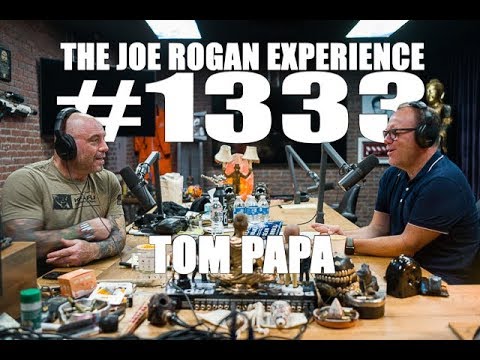
Joe Rogan Experience #1333 - Tom Papa
Joe Rogan (host), Tom Papa (guest), Jamie Vernon (guest), Jamie Vernon (guest), Narrator, Narrator, Narrator
In this episode of The Joe Rogan Experience, featuring Joe Rogan and Tom Papa, Joe Rogan Experience #1333 - Tom Papa explores joe Rogan and Tom Papa Dive Into Parenting, Comedy, Violence, Mortality, Parasites Joe Rogan and Tom Papa have a long, loose, and funny conversation that weaves from parenting and stand-up comedy craft into martial arts, hunting, wild animals, violence, and the darker sides of human behavior.
Joe Rogan and Tom Papa Dive Into Parenting, Comedy, Violence, Mortality, Parasites
Joe Rogan and Tom Papa have a long, loose, and funny conversation that weaves from parenting and stand-up comedy craft into martial arts, hunting, wild animals, violence, and the darker sides of human behavior.
They discuss how childhood experiences and discipline shape comedians, the addictive nature of stand-up, and technical aspects of performing in big venues and writing effective jokes.
The episode frequently pivots to physicality—martial arts, dancing, working out, injuries, yoga, meditation, sensory deprivation tanks—and how these practices manage aggression, anxiety, and overall well‑being.
Later, they move into heavier territory: overpopulation of wildlife, bears and moose encounters, the Epstein conspiracy, sexual norms, porn, parasites, Lyme disease, and how little guidance men and society often have for dealing with violence and mortality.
Key Takeaways
Clear communication and consistent boundaries are crucial in parenting.
Both Rogan and Papa contrast the old ‘because I said so’ style of parenting with modern approaches that explain the reasons behind rules, arguing kids need firm limits plus explanations to internalize values rather than just obey.
Get the full analysis with uListen AI
Stand‑up is both an art and an addiction that demands constant risk.
They describe comics as ‘laugh junkies’ who are happiest when new lines work, but tormented by failed tags; continual experimentation on stage is necessary to keep the act alive and personally satisfying.
Get the full analysis with uListen AI
You can channel aggression and anxiety through physical practice.
Rogan talks about hitting the heavy bag, running hills, yoga, and martial arts as ways to ‘empty out’ aggression and become nicer, raising the question of whether humans need periodic explosive physical exertion to stay emotionally balanced.
Get the full analysis with uListen AI
Meditation and sensory deprivation can materially change how you feel and react.
Papa explains how twice‑daily TM lowers his heart rate and makes him calmer and more resilient, while Rogan describes how float tanks remove external stimuli and give perspective, reinforcing that these are trainable mental skills, not vague concepts.
Get the full analysis with uListen AI
Wildlife must be actively managed when humans live nearby.
Their discussions of overpopulated bears and deer in New Jersey, coyotes eating pets in LA, and disease‑carrying ticks and mosquitoes highlight that romanticizing nature without management can lead to real danger for both humans and animals.
Get the full analysis with uListen AI
Media narratives and labels often distort complex people and events.
Using Jordan Peterson, Pepe the Frog, and Jeffrey Epstein as examples, they argue that public discourse frequently reduces nuanced issues to caricatures (e. ...
Get the full analysis with uListen AI
Interpersonal etiquette and community ties quietly sustain mental health.
They lament that modern society devalues manners, rituals, and small daily interactions—like knowing your grocer or pharmacist—even though these create belonging, help us process death and hardship, and provide a ‘guidebook’ for living.
Get the full analysis with uListen AI
Notable Quotes
“We’re all, for sure, laugh junkies. I think we are so lucky that regular people don’t know what it feels like to get a big laugh—or they would do it.”
— Tom Papa
“The thing about hitting things is that it leaves no violence in you. I wanna pound it all out. Nothing pounds it all out like hitting the bag.”
— Joe Rogan
“Meditation adds another four hours to your day. It doesn’t just relax you; over time, it makes you more chill. Things don’t bother me the way they used to.”
— Tom Papa
“We should think of how we interface with life as a skill. Not just playing piano or golf—how you treat people, how you respond to problems. You can actually get better at that.”
— Joe Rogan
“Most people are really fine. Most people are cool. Most people are nice. But that’s why terrorism works—because the spectacular stuff scares us so much that we forget how many millions of people are out having a good time and doing the right thing every night.”
— Tom Papa
Questions Answered in This Episode
How much of a comedian’s success is rooted in talent versus the psychological ‘addiction’ to getting laughs and constantly taking risks on stage?
Joe Rogan and Tom Papa have a long, loose, and funny conversation that weaves from parenting and stand-up comedy craft into martial arts, hunting, wild animals, violence, and the darker sides of human behavior.
Get the full analysis with uListen AI
Are practices like intense exercise, martial arts, yoga, meditation, and float tanks interchangeable tools for managing aggression and anxiety, or do they fundamentally affect people in different ways?
They discuss how childhood experiences and discipline shape comedians, the addictive nature of stand-up, and technical aspects of performing in big venues and writing effective jokes.
Get the full analysis with uListen AI
Where’s the ethical line between necessary wildlife management and human overreach when dealing with predators like bears, or prey like deer, that increasingly share our suburbs?
The episode frequently pivots to physicality—martial arts, dancing, working out, injuries, yoga, meditation, sensory deprivation tanks—and how these practices manage aggression, anxiety, and overall well‑being.
Get the full analysis with uListen AI
How do we balance genuine concern about exploitation in porn and sex work with respecting adult agency, and why do we instinctively treat male and female performers so differently?
Later, they move into heavier territory: overpopulation of wildlife, bears and moose encounters, the Epstein conspiracy, sexual norms, porn, parasites, Lyme disease, and how little guidance men and society often have for dealing with violence and mortality.
Get the full analysis with uListen AI
If everyday etiquette, religious rituals, and community customs act as informal ‘guidebooks’ for life, what replaces them in a more secular, online, and individualistic society—and is that replacement working?
Get the full analysis with uListen AI
Transcript Preview
(squelching noises) You definitely shouldn't make those noises to start off a podcast, Tom Papa. That (squelching noise) . What are you doing? You're freaking people out.
It's-
Do you know, what is it called?
It's been-
ASMR? Do you know what that is? Is that-
Yeah, like when you, like go-
People like certain sounds.
Yeah.
They find them soothing. (squelching noises) I don't think that's one of them.
N- This is what I use to drive my kids crazy. I say, "It's mac and ch- it's a spoon in mac and cheese." (squelching noises) (laughs)
Yeah. They're like, "Oh my God. I thought my dad was funny professionally."
They're like, "Stop it." (laughs)
"This is ridiculous." They probably think they're gonna starve to death.
(laughs)
Like, this is crazy.
My younger-
This isn't gonna work.
My younger one, who's, like, comedian funny, this is her thing. (laughs) This is... She, so she doesn't care about parents or what we're doing or... She's just out for herself.
(laughs)
Whenever I make a joke in the (laughs) , around the house (laughs) , she, uh, that I think is funny, she just goes, "Ha, jokes." (laughs)
How old is she? (laughs)
14.
That's hilarious.
Yeah.
Do you think she'll be a comic?
Uh, she, yeah. She could be.
Really? Wow. But don't-
She definitely could be.
But do you have a healthy household?
It is healthy.
That doesn't seem like a good recipe for comedy.
Uh...
Right?
Yeah. Well, you know, it takes all kinds.
It does take all kinds.
You know?
But have you met anybody that came from a good childhood that's really funny?
Me.
You?
Yeah.
Really?
I'm pretty funny.
You c- You're very funny. But you came from, uh, no problems at all?
I think every kid-
Did you move around a lot?
Uh, I moved once one town over, and it traumatized me.
Hmm.
In third grade.
How old were you then? Third grade?
Yeah. I still can't... I'm still not over it.
Really?
But I think that everybody has-
(laughs)
(laughs) I think, I think as a child, uh, even if it's not real heavy stuff, it feels heavy to you.
Hmm. Of sure, of sure.
You know what I mean? Like, my father was super strict and, like-
Yeah.
... you know, spanked us and stuff. And I, I was like this nervous...
Oh, yeah.
You know what I mean? And it's always-
Scared kids.
So I think you can grow up pretty normal and be pretty funny, you know?
It's like a, there's a, a line with kids. It's like you don't wanna be mad at them, but you can't let them get away with too much.
Install uListen to search the full transcript and get AI-powered insights
Get Full TranscriptGet more from every podcast
AI summaries, searchable transcripts, and fact-checking. Free forever.
Add to Chrome