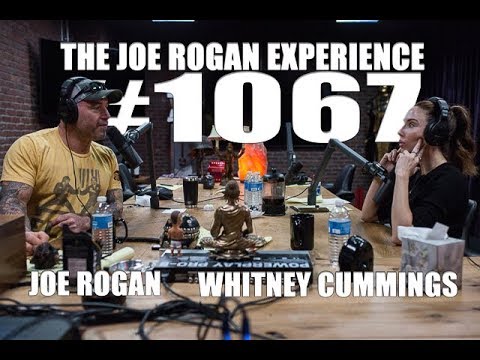
Joe Rogan Experience #1067 - Whitney Cummings
Joe Rogan (host), Whitney Cummings (guest), Narrator, Narrator, Narrator, Narrator, Narrator, Narrator, Narrator, Narrator, Narrator
In this episode of The Joe Rogan Experience, featuring Joe Rogan and Whitney Cummings, Joe Rogan Experience #1067 - Whitney Cummings explores whitney Cummings, Bill Cosby, #MeToo, Trump, Sex, and Power Collide Joe Rogan and Whitney Cummings move from Bill Cosby’s reappearance on stage into a wide-ranging discussion of rape culture, the #MeToo and Women’s March backlash, and how celebrity and power warp accountability. They explore how trauma, biology, and social conditioning affect women’s responses to harassment, coercive sex, and relationships, including Whitney’s own history of assault and therapy. The conversation branches into Trump’s fitness and possible drug use, media polarization, pedophilia, sex robots, and how technology and culture are reshaping gender dynamics. Throughout, they wrestle with tribalism—men vs. women, left vs. right—and argue for seeing people as flawed individuals rather than as monolithic groups.
Whitney Cummings, Bill Cosby, #MeToo, Trump, Sex, and Power Collide
Joe Rogan and Whitney Cummings move from Bill Cosby’s reappearance on stage into a wide-ranging discussion of rape culture, the #MeToo and Women’s March backlash, and how celebrity and power warp accountability. They explore how trauma, biology, and social conditioning affect women’s responses to harassment, coercive sex, and relationships, including Whitney’s own history of assault and therapy. The conversation branches into Trump’s fitness and possible drug use, media polarization, pedophilia, sex robots, and how technology and culture are reshaping gender dynamics. Throughout, they wrestle with tribalism—men vs. women, left vs. right—and argue for seeing people as flawed individuals rather than as monolithic groups.
Key Takeaways
Celebrity status can override even massive evidence of wrongdoing.
They argue Cosby’s ability to perform again—despite dozens of consistent rape accusations—shows how fame, nostalgia, and ‘star power’ can eclipse moral judgment and create pockets of permissive audiences and venues.
Get the full analysis with uListen AI
The ‘freeze’ response explains why many victims don’t fight or clearly say no.
Whitney describes trauma-induced freezing as a third survival response (alongside fight and flight) that can leave women physically compliant but psychologically dissociated, complicating simplistic ‘why didn’t she just leave or say no? ...
Get the full analysis with uListen AI
Years of ‘small’ boundary violations accumulate into deep anger and movement energy.
From ass-grabs at work to transactional sex under pressure, they frame #MeToo and the Women’s March as the snap of a long-overstretched pendulum—decades of normalized harassment finally surfacing at once.
Get the full analysis with uListen AI
Men’s and women’s experiences of sex and desire are biologically and socially mismatched.
They contrast male ‘sperm factory’ urgency and porn-influenced expectations with women’s socialization to please, avoid conflict, and feel shame—leading to many young women having sex they don’t truly want.
Get the full analysis with uListen AI
Tribal thinking (men vs. women, left vs. right) undermines nuanced problem-solving.
Rogan insists that treating all men as predators or all women as infallible victims is as dangerous as partisan politics; both emphasize that plenty of men and women are decent, and some in every group are opportunistic or dishonest.
Get the full analysis with uListen AI
Trauma treatment can rewire responses, but it’s slow, painful, and stigmatized.
Whitney explains EMDR, 12-step work, and the promise of MDMA therapy for PTSD, while noting how humiliating it feels to publicly disclose assault, contrary to the idea that victims enjoy ‘victim status’.
Get the full analysis with uListen AI
Technology and changing norms are rapidly outpacing our ethical and emotional tools.
From social media callouts and dating scripts to sex robots and political chaos, they suggest culture is shifting faster than our psychology, creating confusion about consent, power, and what behavior is acceptable.
Get the full analysis with uListen AI
Notable Quotes
“When rapists are on stage performing and there’s not a complete melee of disapproval, that’s really scary to me.”
— Whitney Cummings
“Anybody that says, ‘Why didn’t you just…’ has never been involved in any sort of real altercation when they’re in danger.”
— Joe Rogan
“I didn’t come to terms with the fact that I was sexually assaulted till I was 32… I minimized mine.”
— Whitney Cummings
“We have a real problem with language policing… The word ‘retarded’ means to slow the growth of something. The bad thing is mocking someone with a disability.”
— Joe Rogan
“I’m not pro-men. I’m not pro-women either. I’m pro-human.”
— Joe Rogan
Questions Answered in This Episode
How should comedy clubs and venues ethically handle performers with credible histories of sexual assault?
Joe Rogan and Whitney Cummings move from Bill Cosby’s reappearance on stage into a wide-ranging discussion of rape culture, the #MeToo and Women’s March backlash, and how celebrity and power warp accountability. ...
Get the full analysis with uListen AI
Where should we draw the line between bad sex, coercive sex, and assault—and who gets to define those boundaries?
Get the full analysis with uListen AI
How can workplaces balance necessary protection against harassment with avoiding a fearful, hyper-litigious culture that backfires on women?
Get the full analysis with uListen AI
What practical steps can ordinary men take to be more attuned to non-verbal cues and trauma responses without becoming paralyzed by fear?
Get the full analysis with uListen AI
As technology advances (porn, social media, sex robots), how can society protect real intimacy and empathy instead of further dehumanizing sex and relationships?
Get the full analysis with uListen AI
Transcript Preview
I think what you said is dead-on, that you gotta go straight ... He's gotta go straight African American 'cause white people are just not ... Hey, and we're live. (door shuts)
Uh.
This is, this is what I think. We need to recognize the return of Dr. Cosby and, uh, send a shout-out to him and all the folks at the barbershops.
I can't do this. No, I can't do this.
You were ... (laughs)
I'm triggered. I'm triggered!
(laughs) You were saying, uh, before the show, like, what do you do if you're at a comedy club and Bill Cosby walks ... 'Cause apparently Bill Cosby's doing stand-up again. And like, what do you do?
Why isn't he in jail?
(laughs)
I'm not even trying ... Like, I'm not trying to be funny.
No.
Why isn't this guy in jail?
You're right. Well, because the first, first trial was ... Was it a mistrial?
Yeah. Yeah.
I can't do this.
Yeah. It was a mistrial. Um, they couldn't agree, which is hilarious. Like, I mean, how many people have to say, "That guy fucking drugged me and raped me"? How many people ... Like, is there some sort of ... Could you imagine, there's like 80 people-
Yeah.
... that are telling the same story-
Yeah.
... of you drugging them and raping them. And people are like, "Mm, I don't know."
So, and look, and here's what I'll say, like-
Get this sucker up to your-
You know, I'm sorry.
That's all right.
I just, I don't want anything Black and phallic-
You're getting a little crazy. (laughs)
... near me right now. We're talking about Bill Cosby. This is, (laughs) this is-
Oh.
Too soon for this. I guess I just, uh, you know, and it's interesting that this happened after this weekend was the Women's March. And I know like a lot of people wanna roll their eyes. And I was getting a lot of shit on Instagram for like, "The Women's March, you guys have to ..." This is exactly the kinda thing that I'm terrified of, is that this guy is now not in jail and he's just like back to doing stand-up.
Yeah.
Because I don't know if we got desensitized or if we just forgot about him, or we just got sick of talking about it. Like, how ... I just don't understand how people in that club-
Nobody saw it coming. I, I think, uh, he's ... First of all, he has an enormous ego and he's a psychopath.
Correct.
And I think that he is ... He's just ... He has enough fans, and enough people in his community still love him where he can go places, in small places, and they accept him. And then he's m- he's, uh, he's advertising it.
Install uListen to search the full transcript and get AI-powered insights
Get Full TranscriptGet more from every podcast
AI summaries, searchable transcripts, and fact-checking. Free forever.
Add to Chrome