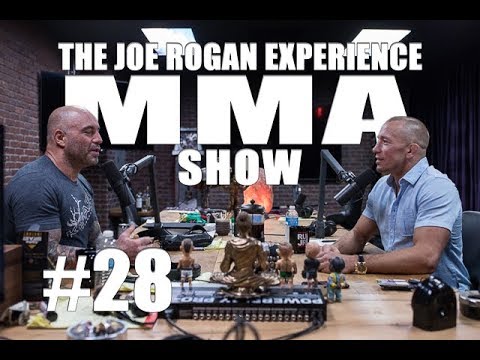
JRE MMA Show #28 with Georges St-Pierre
Georges St-Pierre (guest), Joe Rogan (host), Narrator, Narrator
In this episode of The Joe Rogan Experience, featuring Georges St-Pierre and Joe Rogan, JRE MMA Show #28 with Georges St-Pierre explores georges St-Pierre on health, comeback, mind games, and legacy Georges St-Pierre joins Joe Rogan to unpack his return against Michael Bisping, the health crisis that followed, and why he vacated the middleweight title. He details how ulcerative colitis, over-eating to bulk up, and chronic stress nearly derailed him—and how intermittent fasting, time-restricted eating, and pool-based training turned his health around. GSP breaks down his tactical approach to fighting, his obsession with preparation, and why he actually hates fight day even though he loves the martial arts lifestyle. They also dive into PEDs, free will, consciousness, aliens, and GSP’s surprising passion for paleontology.
Georges St-Pierre on health, comeback, mind games, and legacy
Georges St-Pierre joins Joe Rogan to unpack his return against Michael Bisping, the health crisis that followed, and why he vacated the middleweight title. He details how ulcerative colitis, over-eating to bulk up, and chronic stress nearly derailed him—and how intermittent fasting, time-restricted eating, and pool-based training turned his health around. GSP breaks down his tactical approach to fighting, his obsession with preparation, and why he actually hates fight day even though he loves the martial arts lifestyle. They also dive into PEDs, free will, consciousness, aliens, and GSP’s surprising passion for paleontology.
Key Takeaways
For performance, don't force your body far from its natural weight.
GSP’s attempt to bulk up unnaturally to fight Bisping—eating every two hours and forcing food despite no appetite—triggered severe digestive issues and ulcerative colitis, and he now believes he would have performed better at his natural walking weight.
Get the full analysis with uListen AI
Intermittent fasting and time‑restricted eating can improve health and body composition.
Working with Dr. ...
Get the full analysis with uListen AI
Train the way you want to fight: physical, technical, and tactical layers must align.
GSP structures camp as a pyramid—physical conditioning at the base, technical skills in the middle, and tactics at the top—and credits coaches like Firas Zahabi, John Danaher, and Freddie Roach for being rare trainers who can influence all three, especially the tactical layer that separates contenders from champions.
Get the full analysis with uListen AI
Build confidence deliberately; it’s not a feeling, it’s a decision plus preparation.
He treats fighting as “autopilot” built through endless repetition and uses mental routines—like psyching himself up in the mirror before walking out—to override fear and ensure his training translates directly under pressure, rather than hoping to “step up” on fight night.
Get the full analysis with uListen AI
Health comes before belts; don’t be afraid to walk away when conditions are wrong.
GSP relinquished the middleweight title once his colitis diagnosis was clear, refusing to stall the division or fight again at a weight that harmed his body, emphasizing he’s financially secure and must prioritize long‑term health over organizational expectations or public pressure.
Get the full analysis with uListen AI
Be extremely cautious and realistic about PEDs and future 'superhuman' sport.
He believes modern PEDs increasingly target the nervous system (reaction time, confidence, reset time), that testing can still be gamed, and that gene doping may eventually turn elite sport into a competition of engineered “cyborgs” rather than natural athletes.
Get the full analysis with uListen AI
Detach your identity from fighting and keep a broader life perspective.
Despite being considered one of the greatest ever, GSP insists fighting is what he does, not who he is; he combats anxiety by reminding himself that most of the world doesn’t care about his fights and that his real life is his family, friends, and passions like paleontology.
Get the full analysis with uListen AI
Notable Quotes
“I hate fighting. I love winning—and I love the lifestyle—but I hate fight day.”
— Georges St-Pierre
“Satisfaction is the death blow. If you’re satisfied as champion, you should retire.”
— Georges St-Pierre (quoting CT Fletcher and agreeing)
“Being the strongest man in the world is an illusion. Styles make fights, and the belt is just a symbol.”
— Georges St-Pierre
“Confidence is not a state of mind; it’s a choice. You can build it in your head.”
— Georges St-Pierre
“You don’t play fighting. You can die in this sport, so I must be selfish and do what’s best for me.”
— Georges St-Pierre
Questions Answered in This Episode
How should modern fighters balance chasing size advantages with respecting their natural weight for optimal health and performance?
Georges St-Pierre joins Joe Rogan to unpack his return against Michael Bisping, the health crisis that followed, and why he vacated the middleweight title. ...
Get the full analysis with uListen AI
Could intermittent fasting and time‑restricted eating safely be integrated into high‑level fight camps, and for which types of athletes might it backfire?
Get the full analysis with uListen AI
What practical methods can coaches use to systematically train the “tactical layer” the way GSP and his team describe, rather than just conditioning and technique?
Get the full analysis with uListen AI
As gene editing and advanced PEDs emerge, is there any realistic way to preserve a meaningful 'natural' category of elite sport?
Get the full analysis with uListen AI
How can high performers in any field adopt GSP’s perspective of separating identity from results to reduce anxiety and burnout?
Get the full analysis with uListen AI
Transcript Preview
Going to the contender after, Freddie Roach.
Oh, really?
Yeah.
Nice. Live? Boom, we're live. You wanna wear headphones or no?
Yeah. It's better like this, right?
Do you wear... Y- uh, your cauliflower ears, they keep you from wearing earbuds.
Uh...
You know, those little things that go in your ear?
But it... Do I need to it? No, I don't need it.
No. You don't need it. You don't have to.
Yeah, so I don't- I don't-
You don't have to. Just keep this close to your face and we're good.
All right.
There we go. What's up, man? How are you?
Fantastic.
You look good.
I feel good. I feel, uh, if it would not be for my, uh, like, ulcer that I had, I would be... I- I feel better than- than when I was 25.
What did- what did you have? You had colitis?
Yeah, colitis. Yeah.
What- what is that? How did... What causes that?
We don't really know what it caused it, but, uh, the best- the best, uh, theory is that, uh, before my last fight with Michael Bisping, I tried to put on weight, extra weight. So I followed a- a diet pro- program that I was eating every... almost every two hours. And, um, I think your system is like a car, you know, if you do a lot of mileage, it overuse it and then... So that's what happened with the stress and everything. During my training camp, I had big problem, you know, I couldn't sleep, I had crazy cramps, you know, sometimes I had-
Oh.
... I had blood even like that... when I went to the bathroom, at one point, I had to go do some tests because I was worried that it was something more s-... like, I mean, colitis is very serious, but that it was like cancer or something 'cause it had blood. So I did some tests, it came out negative and I said to myself, I said, "This fight been delayed..." Not delayed, but postponed so many times that if I do something, if I say that publicly what is going on, I'm gonna lose the opportunity to fight for the title, uh-
Yeah.
... at 185. So I- I keep it shut and I told myself, I said, "Whatever it is, I'll deal with it after the fight." So I did the fight, everything went well. Then after I went to do, uh, it's called a colonoscopy. They put a camera inside of you.
Yeah.
And I did... I got diagnosed with ulcer colitis. That's probably the mix of the stress and also the- the fact that I was...
Constantly eating.
I was eating, and not only eating, Joe, I was trying to put on some weight. It was very hard. Sometimes I was... I remember many times I was having breakfast, but I was regurgia- regurgitating my breakfast.
Install uListen to search the full transcript and get AI-powered insights
Get Full TranscriptGet more from every podcast
AI summaries, searchable transcripts, and fact-checking. Free forever.
Add to Chrome