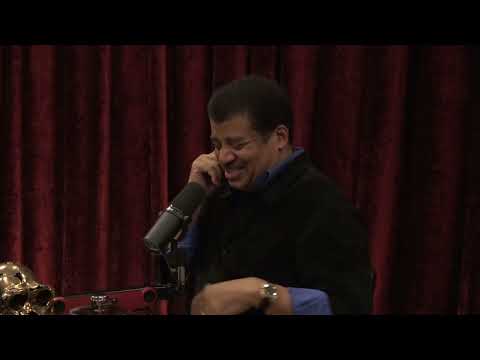
Joe Rogan Experience #1904 - Neil deGrasse Tyson
Narrator, Neil deGrasse Tyson (guest), Joe Rogan (host)
In this episode of The Joe Rogan Experience, featuring Narrator and Neil deGrasse Tyson, Joe Rogan Experience #1904 - Neil deGrasse Tyson explores neil deGrasse Tyson Explains Webb, Multiverse, Minds, and Humanity’s Future Neil deGrasse Tyson joins Joe Rogan to unpack the James Webb Space Telescope, explaining its engineering marvels, infrared focus, and how it extends and deepens what Hubble could see rather than overturning past science. From there, they range into cosmology—Big Bang, multiverse, black holes, and scientific method—emphasizing how new theories embed, not erase, earlier confirmed knowledge.
Neil deGrasse Tyson Explains Webb, Multiverse, Minds, and Humanity’s Future
Neil deGrasse Tyson joins Joe Rogan to unpack the James Webb Space Telescope, explaining its engineering marvels, infrared focus, and how it extends and deepens what Hubble could see rather than overturning past science. From there, they range into cosmology—Big Bang, multiverse, black holes, and scientific method—emphasizing how new theories embed, not erase, earlier confirmed knowledge.
The conversation then pivots to human perception, drugs, consciousness, and the reliability of eyewitness testimony, as Tyson contrasts subjective inner experiences with objective, testable reality. They explore risk, probability, and how poor statistical intuition fuels casinos, lotteries, conspiracy thinking, and policy mistakes.
In the latter half, Tyson dives into ethics and identity: meat vs. plants, animal and plant sentience, diversity in bodies and minds, autism and genius, race, gender, and genetic engineering. He argues that human variation—physical, neurological, and cultural—is a core strength of civilization and warns against homogenizing the species through genomic control.
They close by discussing AI, self‑driving cars, Neuralink‑style brain interfaces, and whether technology will augment or endanger us, with Tyson predicting AI as tool rather than overlord and stressing the need for a cosmic perspective to steward both our civilization and our own evolution.
Key Takeaways
Webb is not Hubble 2.0; it opens an entirely new window.
Webb’s segmented, foldable mirror and deep‑cold infrared design (about 8–10x Hubble’s light‑collecting area and tuned to redshifted light) let it see the earliest galaxies and peer through dust to star and planet formation—regions Hubble was never optimized to access.
Get the full analysis with uListen AI
Confirmed science rarely gets “overturned”; it gets embedded in deeper frameworks.
Tyson explains that Newton’s laws still work perfectly at low speeds and weak gravity but sit inside Einstein’s relativity, which extends to extreme conditions; similarly, the Big Bang and cosmic background won’t disappear, but may be reinterpreted as one event in a larger multiverse.
Get the full analysis with uListen AI
Subjective experiences are real to you but only useful to science if testable.
On psychedelics, near‑death experiences, and mystical trips, Tyson draws a strict line: unless experiences yield externally verifiable predictions or evidence (e. ...
Get the full analysis with uListen AI
Humans are terrible at probability, and entire industries exploit it.
From roulette players thinking numbers are “due” to state lotteries funding schools while schools fail to teach statistics, Tyson argues that misunderstanding randomness and risk skews everything from gambling behavior to how we respond to car deaths vs. ...
Get the full analysis with uListen AI
“Disabilities” often enable unique capabilities that advance civilization.
Through examples like armless archer Matt Stutzman, one‑handed jiu‑jitsu legend Jean‑Jacques Machado, no‑hand pitcher Jim Abbott, autistic scientist Temple Grandin, and face‑blind neurologist Oliver Sacks, Tyson argues that variation in bodies and minds creates new problem‑solving modes we’d lose if we genetically “normalized” everyone.
Get the full analysis with uListen AI
Race and gender categories are crude bins laid over rich spectra.
Tyson notes that Africa contains more human genetic diversity than anywhere else, making “Black” a scientifically absurd monolith; likewise, much of “male/female” is performative (clothes, muscles, grooming), and forcing strict binaries via law undermines personal freedom in a country that promises the pursuit of happiness.
Get the full analysis with uListen AI
We will likely embrace AI tools but resist wiring computers into our brains.
Tyson sees AI as embedded in systems—cars, medicine, appliances—rather than an AGI overlord, and predicts social resistance to surgical brain–machine interfaces, while acknowledging others (like Musk) fear and/or pursue deeper integration; he emphasizes that ethics will lag behind technical capability.
Get the full analysis with uListen AI
Notable Quotes
“The Big Bang’s not going to go away. All the data support this. What changes is we may discover it’s just a small part of a much larger whole.”
— Neil deGrasse Tyson
“If what you experienced is not part of an objective reality that we can all recognize, then it’s completely in your head—and if it’s completely in your head, it’s less useful to other people.”
— Neil deGrasse Tyson
“We are victims of our own brain wiring. If it were natural to think statistically about the world, statistics would’ve been the first branch of math we discovered. It wasn’t.”
— Neil deGrasse Tyson
“The moment you homogenize and ‘normalize’ who and what humans should be, you cut off so much of what has enriched civilization simply because people were different.”
— Neil deGrasse Tyson
“Be ashamed to die until you have won some victory for humanity.”
— Neil deGrasse Tyson, quoting Horace Mann
Questions Answered in This Episode
If Webb mostly deepens existing knowledge rather than overturning it, how should the public recalibrate its expectations of what “revolutionary” science looks like?
Neil deGrasse Tyson joins Joe Rogan to unpack the James Webb Space Telescope, explaining its engineering marvels, infrared focus, and how it extends and deepens what Hubble could see rather than overturning past science. ...
Get the full analysis with uListen AI
Where should we draw the ethical line between using genetics to cure disease and using it to design or “optimize” future humans?
The conversation then pivots to human perception, drugs, consciousness, and the reliability of eyewitness testimony, as Tyson contrasts subjective inner experiences with objective, testable reality. ...
Get the full analysis with uListen AI
How much weight should we give to inner, transformative experiences (psychedelics, near‑death events) if they don’t currently produce testable, shared evidence?
In the latter half, Tyson dives into ethics and identity: meat vs. ...
Get the full analysis with uListen AI
Given our poor intuition about probability, should basic statistics and risk literacy be mandatory through K–12, and how might that change public policy and personal decision‑making?
They close by discussing AI, self‑driving cars, Neuralink‑style brain interfaces, and whether technology will augment or endanger us, with Tyson predicting AI as tool rather than overlord and stressing the need for a cosmic perspective to steward both our civilization and our own evolution.
Get the full analysis with uListen AI
Is Tyson underestimating the social and economic pressure that could push people toward brain–computer interfaces if they truly confer large cognitive or career advantages?
Get the full analysis with uListen AI
Transcript Preview
(drum music) Joe Rogan podcast, check it out. The Joe Rogan Experience. Train by day, Joe Rogan podcast by night, all day. (energetic music)
I don't wanna... Every one of my sentences to sound like Barry White.
Is that what it sounds like-
I- i- in-
... in your ears?
... headphones, they do. It's like, "Oh hey, baby."
(laughs)
(laughs) I, I just can't. Whereas without the headphones I, I'm just regular.
All right, ready?
I'm ready.
Good to see you.
Hey.
What's happening?
Joe.
I'm excited to talk to you. I'm excited to talk to you about a bunch of things, but, uh, I've been paying attention to all the, uh, web telescope stuff.
Oh my gosh.
Fascinating.
It's all that.
Could you please explain the difference in the ability of... The capabilities of this telescope versus what we've had previously?
Yeah. So first of all, it's all that, and the excitement was in part because so much could have gone wrong with this thing, and the fact that nothing went wrong, we were ecstatic.
Could you explain the... How complicated it is-
Yeah.
... to get something-
Here-
... like that.
... yeah. Here's... So one of the great challenges that we face is how do you put a telescope in orbit that's bigger than the rocket that's gonna launch it? Is that even possible? And the Hubble Telescope, do you know what set the size of that 94-inch diameter mirror? That's the biggest mirror you could fit in the payload of the space shuttle. (laughs)
Oh.
That's what set the size of that telescope. Big as it was, we would've made it bigger if the space shuttle were bigger. Now, I don't know if you've seen the Hubble Telescope. There's a replica of it at the Air and Space Museum in, in-
Let's take a... Let's look a photo of it.
Uh, and it'll just... Uh, it's there hanging from the ceiling. But if you wanna know how... It's about the size of a Greyhound bus. So the space shuttle deployed a Greyhound bus into orbit, which is the Hubble Space Telescope. And the, the value of the Hubble was that you could update it, w- by s... With servicing missions, and it was serviced many times. And as a result, it lived within our culture for three decades. There are people who came of age only ever knowing the majesty of the universe as delivered to you by the Hubble Telescope. 30 years worth of this. Think about it.
Mm-hmm.
Most other telescopes they put into orbit, and they have a five-year mission, and then they come down. So they don't have a chance to get, to get inside you, to become something that you, that you... Uh, oh, you got a nice, uh, visual there. So that's the Hubble Telescope on the left, which every year, every year I post a tweet (laughs) at the end of the Stanley Cup, and I say, "The Stanley Cup and the Hubble Telescope had the same designer." (laughs)
Install uListen to search the full transcript and get AI-powered insights
Get Full TranscriptGet more from every podcast
AI summaries, searchable transcripts, and fact-checking. Free forever.
Add to Chrome