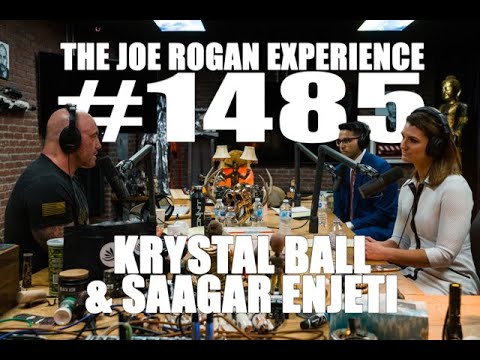
Joe Rogan Experience #1485 - Krystal & Saagar
Joe Rogan (host), Saagar Enjeti (guest), Krystal Ball (guest), Narrator, Narrator
In this episode of The Joe Rogan Experience, featuring Joe Rogan and Saagar Enjeti, Joe Rogan Experience #1485 - Krystal & Saagar explores krystal and Saagar Expose Media Grift, Elite Power, and Protest Chaos Joe Rogan hosts Krystal Ball and Saagar Enjeti to dissect how legacy media, party establishments, and corporate interests shape U.S. politics and public perception. They explain why they created their heterodox left‑right show, Rising, to represent economically populist views largely excluded from cable news. The conversation ranges from scripted partisan talking points and corporate capture of both parties to COVID economic policy failures, social media’s toxicity, and the 2020 protest/riot response. Throughout, they debate law‑and‑order vs. de‑escalation, corruption, and how class and race are used to divide the public and protect elite power.
Krystal and Saagar Expose Media Grift, Elite Power, and Protest Chaos
Joe Rogan hosts Krystal Ball and Saagar Enjeti to dissect how legacy media, party establishments, and corporate interests shape U.S. politics and public perception. They explain why they created their heterodox left‑right show, Rising, to represent economically populist views largely excluded from cable news. The conversation ranges from scripted partisan talking points and corporate capture of both parties to COVID economic policy failures, social media’s toxicity, and the 2020 protest/riot response. Throughout, they debate law‑and‑order vs. de‑escalation, corruption, and how class and race are used to divide the public and protect elite power.
Key Takeaways
Legacy media runs on party-scripted talking points, not independent analysis.
Krystal and Saagar describe receiving daily ‘message of the day’ emails with identical talking points that later appear verbatim across cable networks, rewarding on‑script repetition with access, contracts, and career safety.
Get the full analysis with uListen AI
The real unrepresented bloc is economically left and culturally moderate/right.
They argue most Americans are more populist on economics (healthcare, wages, trade) but less culturally progressive than media elites, yet cable debates are dominated by socially liberal, economically pro‑corporate voices.
Get the full analysis with uListen AI
Career incentives in D.C. structurally punish dissent and reward failure—if it’s ‘approved’ failure.
You can back disasters like the Iraq War or financial deregulation and keep failing upward so long as you stay within establishment consensus; stepping outside that line risks cancellation, lost jobs, and loss of platform.
Get the full analysis with uListen AI
The COVID bailout prioritized asset prices over workers and small businesses.
They criticize Congress and the White House for capping small‑business relief while quickly delivering trillions in corporate support and Federal Reserve backstops, instead of adopting payroll guarantees that keep workers attached to jobs and health insurance.
Get the full analysis with uListen AI
Social media and cable outrage structurally encourage division over substance.
Twitter’s reduction of complex people and issues into 280‑character condemnations, plus virtue-signaling and dunk culture, make it easier to label and isolate ‘bad’ people than to engage or understand why millions voted for Trump or Sanders.
Get the full analysis with uListen AI
Riots and looting are both symptom and accelerant of institutional failure.
Krystal emphasizes systemic injustice, lost faith in law and democracy, and economic nihilism as the context for unrest, while Saagar stresses that failing to quickly restore order—especially in places like Minneapolis and New York—hurts working‑class communities most and fuels support for military deployment.
Get the full analysis with uListen AI
Identity politics is easily co‑opted to shield corporate power from scrutiny.
They note that brands loudly backing symbolic causes or diversity campaigns rarely challenge the economic order that made them powerful; focusing everything through race alone often diverts attention from class, corruption, and policy choices that harm workers of all races.
Get the full analysis with uListen AI
Notable Quotes
“What if we hated each other less and the elites more?”
— Saagar Enjeti (quoting Krystal Ball’s description of their show’s ethos)
“There’s a whole system set up where you can be dramatically wrong—if you’re wrong in the approved ways.”
— Krystal Ball
“You created a space where nobody knew people wanted to listen to a guy talk about chimps for three hours—and millions did.”
— Saagar Enjeti, to Joe Rogan
“If you’re a public figure, you have no control over who likes you.”
— Joe Rogan
“We have to make it the cynical choice to do the right thing for working‑class people.”
— Saagar Enjeti
Questions Answered in This Episode
How realistic is their proposed payroll guarantee model in the U.S. political system, and what coalitions would be needed to pass it?
Joe Rogan hosts Krystal Ball and Saagar Enjeti to dissect how legacy media, party establishments, and corporate interests shape U. ...
Get the full analysis with uListen AI
To what extent does focusing on class versus race help or hinder addressing systemic racism in policing and the economy?
Get the full analysis with uListen AI
Can media institutions that rely on outrage, partisan loyalty, and corporate advertising meaningfully reform themselves, or must alternatives like Rising fully replace them?
Get the full analysis with uListen AI
Where should the line be drawn between restoring law and order during unrest and protecting the First Amendment rights of protest and assembly?
Get the full analysis with uListen AI
How can individuals practically reduce their exposure to toxic social media dynamics without becoming uninformed or disengaged from public life?
Get the full analysis with uListen AI
Transcript Preview
Here we go. We're rolling. What's up? Good to see you guys.
Good to see you, Joe.
Good, good to see you too. Thanks for having us.
It's always weird to meet somebody when you watch a lot of their YouTube content-
(laughs)
... or TV con-, and then, then you're like, "You're real!"
(laughs)
And I can touch your hands.
(laughs)
That's how I feel about you, man. That's like ... (laughs)
Let's ... You know, we all feel about each other that way.
Yeah, right. (laughs)
It is a strange dynamic.
You get the ... I, I love you guys.
Oh, thank you.
I mean, big fan. Thank you.
Thank you. Well, same. We feel the same.
For sure.
You guys are honest.
(laughs)
I mean, we were, we were talking about that earlier, like it's so rare that someone is just calling it like it is, like what you see. And, uh, obviously you guys don't agree on everything, and n- you know, no one does, but, right? We all have varying opinions, but you say what you feel. And that is so valuable today. It's so unusual. It's just such a weird, partisan time.
It is a weird, partisan time. Like it's never been harder to actually just do that thing, and I can't say, I mean, we don't get it right all the time.
Mm-hmm.
But the whole idea was to try to have this conversation between kind of the new left and the new right that wasn't happening at any- anywhere in a way that was valuing people's humanity, that was trying to deal in the land of the honest, not cheerleading a team or the other, but actually trying to, like, be straightforward about what we think and evaluating the facts as we find them, and, I mean, I have to say, like, you have somewhat created that space where that can happen. So, I think we're in part indebted to you.
Yeah, well it's a- absolutely, and you know, it's crazy to me, I think the reason it works is because we both kind of came up in quasi-traditional background, right? Like, Krystal came from the MSNBC world, like, I was a White House correspondent. Like, I worked with a lot of these traditional reporters and, like, you know, I would do Fox News and, and all these other things, and you just, it's always so frustrating when you're on TV. You get three and a half minutes to talk, right? Like, I once did a segment on, you know, nationalism, which was two, two and a half minutes with three people on a pl- on a panel. Like, how are you supposed to get your point across? And so when you're, when you're doing that, and you see, like ... So you can make an entire career in DC just sticking to the party line no matter what these people believe, and you just spit out the talkers-
Install uListen to search the full transcript and get AI-powered insights
Get Full TranscriptGet more from every podcast
AI summaries, searchable transcripts, and fact-checking. Free forever.
Add to Chrome