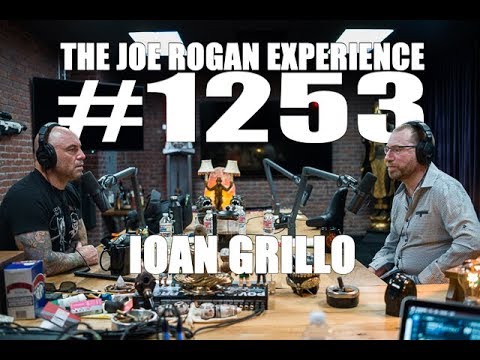
Joe Rogan Experience #1253 - Ioan Grillo
Joe Rogan (host), Ioan Grillo (guest), Narrator, Narrator
In this episode of The Joe Rogan Experience, featuring Joe Rogan and Ioan Grillo, Joe Rogan Experience #1253 - Ioan Grillo explores inside Mexico’s Narco War: Corruption, Cartels, and Cross‑Border Consequences Journalist Ioan Grillo recounts two decades reporting on Mexican drug cartels, describing how localized trafficking evolved into a sprawling hybrid of crime and war. He details extreme corruption, from police and generals on cartel payrolls to politicians and state capture, and shares harrowing stories of kidnappings, massacres, and social collapse in parts of Mexico and Central America.
Inside Mexico’s Narco War: Corruption, Cartels, and Cross‑Border Consequences
Journalist Ioan Grillo recounts two decades reporting on Mexican drug cartels, describing how localized trafficking evolved into a sprawling hybrid of crime and war. He details extreme corruption, from police and generals on cartel payrolls to politicians and state capture, and shares harrowing stories of kidnappings, massacres, and social collapse in parts of Mexico and Central America.
Grillo and Joe Rogan explore how U.S. drug demand, gun trafficking from the U.S. to Mexico, and failed drug policies fuel the violence, while discussing legalization, treatment, and social interventions as partial solutions. They also examine the recruitment of child assassins, the psychological roots of violence, and efforts by social workers and local leaders to reclaim communities.
The conversation ranges from the Chapo Guzmán trial and cartel structures to the migrant caravans, border security debates, and the complex role of U.S. gun laws. Throughout, Grillo emphasizes that despite the brutality, much of Mexico remains functional and vibrant, making the contrast with its hidden war zones even more striking.
Key Takeaways
Drug prohibition has created a massive illicit market that funds extreme violence.
Grillo estimates Americans spend around $100 billion annually on illegal drugs, with tens of billions flowing to Mexican cartels, enabling them to buy weapons, bribe officials, and sustain paramilitary-style operations.
Get the full analysis with uListen AI
Corruption in Mexico goes far beyond bribes and reaches into full “state capture.”
Examples include generals tried for trafficking, police commanders moonlighting as cartel trainers teaching decapitation, and governors implicated in drug and oil theft, blurring the line between state and criminal power.
Get the full analysis with uListen AI
Violence escalated when traditional political control over cartels broke down.
As Mexico democratized and centralized PRI-era corruption fractured, rival parties and security forces aligned with different cartels, and decapitation tactics and public terror campaigns exploded after 2006.
Get the full analysis with uListen AI
Cartels systematically recruit traumatized, abandoned youth and turn them into killers.
Grillo’s interviews show many sicarios were abused or abandoned children drawn in at 12–14; gang leaders deliberately select kids with hatred and no protective family ties, then desensitize them through brutal acts.
Get the full analysis with uListen AI
Targeted social programs can measurably reduce homicide in high‑violence cities.
Post-war social investment in Ciudad Juárez and Medellín—community work, education, and infrastructure in poor neighborhoods—coincided with significant drops in murder rates, suggesting scalable models for prevention.
Get the full analysis with uListen AI
U.S. guns significantly arm Mexican cartels, aided by legal loopholes.
Studies suggest over 200,000 guns a year move south; traffickers exploit private-sale loopholes and lax show regulations to buy AR‑15s and . ...
Get the full analysis with uListen AI
Focusing solely on killing or capturing kingpins often worsens violence.
Decapitating cartels creates power vacuums where younger, more reckless lieutenants fight for control, fragmenting groups into smaller, more volatile gangs—paralleling dynamics seen in U. ...
Get the full analysis with uListen AI
Notable Quotes
“Corruption isn’t even a strong enough word for it. Sometimes I call it state capture.”
— Ioan Grillo
“You’re not gonna stop people from doing drugs. When you make drugs illegal, only criminals are gonna sell those drugs.”
— Joe Rogan
“These places have levels of violence way worse than Medieval Europe… way worse than the Wild West.”
— Ioan Grillo
“I can see from these young kids who’s gonna be able to kill… I need someone who’s got hate, who’s got that anger in them.”
— Ioan Grillo, recounting a cartel recruiter
“If you really want no police, you really want to live where they can just kidnap your kid and send you a video like that with no protection?”
— Ioan Grillo
Questions Answered in This Episode
To what extent would broad drug legalization or decriminalization in the U.S. actually reduce cartel power, given their diversification into oil theft, extortion, and human smuggling?
Journalist Ioan Grillo recounts two decades reporting on Mexican drug cartels, describing how localized trafficking evolved into a sprawling hybrid of crime and war. ...
Get the full analysis with uListen AI
What concrete models of social intervention in places like Ciudad Juárez or Medellín could realistically be adapted to U.S. inner-city neighborhoods or Central American hotspots?
Grillo and Joe Rogan explore how U. ...
Get the full analysis with uListen AI
How could U.S. gun policy be reformed to curb southbound trafficking without undermining legitimate gun ownership and Second Amendment concerns?
The conversation ranges from the Chapo Guzmán trial and cartel structures to the migrant caravans, border security debates, and the complex role of U. ...
Get the full analysis with uListen AI
Given the deep entanglement of cartels with Mexican institutions, what does a realistic, long-term police and judicial reform strategy look like?
Get the full analysis with uListen AI
How should journalists ethically balance access to violent actors (like sicarios) with the risks of glorification, retaliation, or inadvertently aiding law enforcement or cartels?
Get the full analysis with uListen AI
Transcript Preview
Here we go. Five, four, three, two, one. (hand thuds) First of all, how many people get your name wrong when they try to pronounce it?
Well, so many people, I don't even care anymore.
(laughs)
(laughs)
I just, I just... However it comes out an- 'Cause I live in... It's a funny name where I come from.
Right.
From England, well, growing up, it was a funny name. But in Mexico, it's even stranger name. So I just normally make it Ian. And my second name, Grillo, which in Spanish is Grillo.
Right.
So everyone I n-
They mess that up, too, if they see it spelled?
Yeah.
Pull this, uh, microphone about a fist from your face, right there.
Yeah.
There we go. Um, Ioan, I don't think I've ever heard that name before.
There's an actor called Ioan Gruffudd.
What's he in?
He's in Fantastic Four.
Oh, really?
He's the stretchy guy-
Oh, no shit.
... in Fantastic Four. So yeah, he kind of... He's made that name a little bit more.
A little bit more acceptable? (laughs)
(laughs)
(laughs)
Um, how did you wind up living in Mexico City?
So I, I came to Mexico, or went to Mexico, uh, in the year 2000. And, uh, I kind of messed around for a few years in the UK. Wanted to get into journalism. So I found one way to get into it was to start working in a foreign country, rather than going to my local newspaper and work, and go to a foreign country and start working. And I had a romantic idea about Latin America, thinking I'd be like... I saw the movie Salvador.
Ah.
You know, Oliver Stone's movie from-
Yeah.
... the '80s. I kind of had a, had a, had a romantic idea about running around with guerillas, um, fighting military dictatorships. Um, so I arrived in Mexico in 2000, and got a job at an English language newspaper.
How old were you?
27 when I first left the UK, yeah. 28 when I... I, I, I messed around for a bit in Mexico as well, and then got the job when I was 28.
Mexico City's a wild place.
Yeah, yeah.
It's so packed, it's, it's hard to b- I've only been there twice for, uh, UFC events.
Yeah.
But every time I'm there, I'm just shaking my head, like, "I can't believe how this traffic works." It's crazy.
Yeah. 18 years, and I've spent a lot of time in that traffic.
Nobody cares about red lights, green lights. They don't care.
It's stressful. Everyone cut- wants to cut you up all the time.
Yeah.
People shout at you a lot. You have to get used to people calling you, like, pendejo.
Install uListen to search the full transcript and get AI-powered insights
Get Full TranscriptGet more from every podcast
AI summaries, searchable transcripts, and fact-checking. Free forever.
Add to Chrome