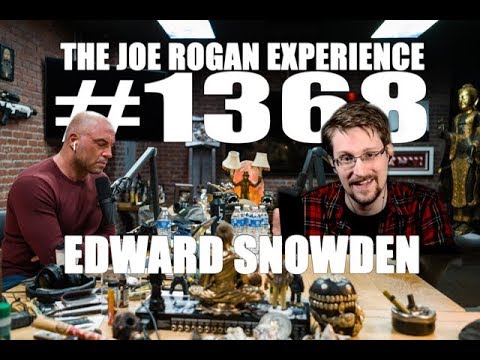
Joe Rogan Experience #1368 - Edward Snowden
Edward Snowden (guest), Joe Rogan (host), Narrator, Narrator, Narrator
In this episode of The Joe Rogan Experience, featuring Edward Snowden and Joe Rogan, Joe Rogan Experience #1368 - Edward Snowden explores edward Snowden Exposes Turnkey Tyranny Of America’s Surveillance State Edward Snowden recounts his path from federal-family technologist to CIA/NSA contractor, and how discovering the Stellar Wind program and mass warrantless surveillance pushed him to become a whistleblower.
Edward Snowden Exposes Turnkey Tyranny Of America’s Surveillance State
Edward Snowden recounts his path from federal-family technologist to CIA/NSA contractor, and how discovering the Stellar Wind program and mass warrantless surveillance pushed him to become a whistleblower.
He explains how post‑9/11 fear, secret legal opinions, and political self‑interest allowed U.S. intelligence agencies to invert constitutional norms and collect data on entire populations, not just suspects.
Snowden details the mechanisms of modern digital tracking via phones and apps, the legal doctrines that enable bulk collection, and why both governments and corporations conceal the extent of their data harvesting.
Speaking from Russia, he describes his life in exile, his conditions for returning to the U.S., and argues that ordinary people must make “heroic decisions” to resist a permanent, unaccountable surveillance infrastructure.
Key Takeaways
Mass surveillance flipped the Constitution’s logic from targeted suspicion to blanket collection.
Snowden explains that programs like Stellar Wind moved the U. ...
Get the full analysis with uListen AI
Secret law and captured oversight let intelligence agencies police themselves.
Key legal authorizations were hidden even from most of Congress and the courts; select lawmakers were implicated and gagged, inspectors general wrote misleading public summaries, and the FISA Court operated in secret, leaving the public and most representatives unable to challenge abuses.
Get the full analysis with uListen AI
Your phone constantly broadcasts your presence and behavior, even when “idle.”
Snowden breaks down how devices ping cell towers, Wi‑Fi points, and app servers; carriers and platforms log these interactions, creating detailed movement and behavior profiles that are retained for years and accessible to governments and data brokers.
Get the full analysis with uListen AI
The third‑party doctrine turns your life’s data into someone else’s property.
Using a 1970s case as precedent, U. ...
Get the full analysis with uListen AI
Whistleblowers are prosecuted under a law that forbids explaining their motives.
The Espionage Act is a strict‑liability statute: in court, defendants like Snowden (or Daniel Hale) cannot argue public interest, intent, or benefits of disclosure; juries may only decide whether they disclosed classified information, making a “fair trial” in the common‑sense meaning impossible.
Get the full analysis with uListen AI
Fear is the lever that expands executive power and enables “turnkey tyranny.”
Snowden argues that moments of crisis—9/11, terrorism scares, social instability—are exploited by executives and security bureaucracies to demand new powers, which then persist and are available to future, potentially more authoritarian leaders to “turn the key.”
Get the full analysis with uListen AI
Individuals can’t eliminate all risk, but they can meaningfully resist data exploitation.
While perfect privacy on modern devices is unrealistic, Snowden urges people to push for visible, user‑controlled networking on phones, minimize unnecessary app permissions, understand that “free” services monetize them, and politically challenge the normalization of bulk data collection.
Get the full analysis with uListen AI
Notable Quotes
“We were constructing a system of turnkey tyranny. Even if you trust it to Obama, you never know whose hand is going to be on that key next.”
— Edward Snowden
“The scandal isn’t how they’re breaking the law. The scandal is that they don’t have to break the law.”
— Edward Snowden
“What you know doesn’t matter. What matters is what we all know, and the only way we can all know it is if somebody can prove it.”
— Edward Snowden
“Patriotism is not about loyalty to government. Patriotism is a constant effort to do good for the people of your country.”
— Edward Snowden
“There are no heroes. There are only heroic decisions. You are never further than one decision away from making a difference.”
— Edward Snowden
Questions Answered in This Episode
If secret legal interpretations can quietly expand surveillance powers, how can a democracy ensure that law and policy genuinely reflect public consent?
Edward Snowden recounts his path from federal-family technologist to CIA/NSA contractor, and how discovering the Stellar Wind program and mass warrantless surveillance pushed him to become a whistleblower.
Get the full analysis with uListen AI
To what extent is it ethical—or even feasible—for ordinary people to opt out of pervasive corporate and government data collection without withdrawing from modern life?
He explains how post‑9/11 fear, secret legal opinions, and political self‑interest allowed U. ...
Get the full analysis with uListen AI
Should the U.S. rewrite or replace the Espionage Act to distinguish between spying for foreign powers and disclosing information to the press for public benefit?
Snowden details the mechanisms of modern digital tracking via phones and apps, the legal doctrines that enable bulk collection, and why both governments and corporations conceal the extent of their data harvesting.
Get the full analysis with uListen AI
How might future political leaders use today’s massive troves of stored data—search histories, location logs, social graphs—in ways we haven’t yet anticipated or legislated against?
Speaking from Russia, he describes his life in exile, his conditions for returning to the U. ...
Get the full analysis with uListen AI
What concrete technical and legal changes (e.g., data ownership rules, mobile OS design, warrant standards) would most effectively rebalance power between individuals, corporations, and the state?
Get the full analysis with uListen AI
Transcript Preview
And, uh... Okay, that'll just be-
Dude, you're very professional.
... be rolling. (laughs) You know, people are like, uh, "H- how do you live?" And, and things like that.
Yeah.
They're like, "You taking money from the Russians?" And, of course, the answer's no. But, uh, I, I do this for a living, like I, I speak. Um, I don't have a YouTube channel where it's, you know, I'm, I'm Joe Rogan, but, uh, I give speeches at universities and things like that. I do a lot of interviews. And so-
We're recording now, right?
I've got my, my own setup.
C- is it possible that you could do a YouTube channel? Would that work?
(laughs) I mean, if... Yeah. Like I, I mean, if you introduced me so like I get followers, yeah, we could do that. (laughs)
Dude, I'm all in. W- that, that could absolutely happen. Do you wanna do that? Is that something you wanna do?
Uh, no. I mean, this is a big question. So I, I came on, um, because I had just, uh, written a book, uh, called Permanent Record, um, which is the, the story of my life because that's what publishers make you do when, when you're writing your first book. Um, but it, it's more than that because I didn't just wanna talk about me. It, it's actually about the changing of technology, uh, and the changing of government in this sort of post-9/11 era, which, you know, our, our generation just sort of happened, uh, to be growing up during. Uh, and I was at the CIA and the NSA and all this stuff, but the day that the book came out, uh, the government hit me with a lawsuit, um, and they hit the publisher of the books, uh, with a, with a lawsuit, um, because they don't wanna see books like this get written. They especially don't wanna see books like this, uh, get read. Um, and so the big thing was, you know, we, we didn't know where this was going. We didn't know what was gonna happen. Um, and my publisher, of course, wanted me, uh, very badly to let people know this book existed, uh, in case the government leaned hard and hard and hard, and we didn't know where, where that's going. (laughs) Um, the government is still, uh, pursuing that case quite strongly. Um, they're more focused on the, the financial censorship side of it, uh, basically taking any money that I made from it, uh, kind of as a warning to the others, um, and getting a, uh, legal judgment against the publishers saying, you know, "You can't pay this guy," that kind of thing, more so than taking the book off the shelves. But that's not because, uh, they're okay with the book being on the shelves. It's because thankfully we, we've got the First Amendment, and so they can't. Uh, and that's a very rare and, and, and good thing. Uh, but anyway, i- in the context of that, um, uh, they were like, "Well, what about Joe Rogan?" And, you know, I, I, I'd heard about you, uh, at this point, but, you know, uh, the only thing that I had really seen that I really understood, um, had familiarity with was, like, you talking to Bernie Sanders, which, by the way, I very much appreciated, uh, hearing that, because, uh, a lot of people don't give the guy time to talk. Um-
Install uListen to search the full transcript and get AI-powered insights
Get Full TranscriptGet more from every podcast
AI summaries, searchable transcripts, and fact-checking. Free forever.
Add to Chrome