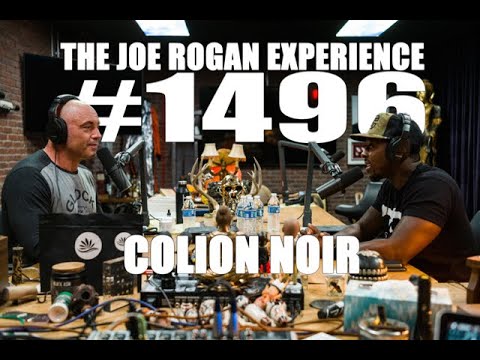
Joe Rogan Experience #1496 - Colion Noir
Joe Rogan (host), Colion Noir (guest), Narrator
In this episode of The Joe Rogan Experience, featuring Joe Rogan and Colion Noir, Joe Rogan Experience #1496 - Colion Noir explores joe Rogan and Colion Noir Deconstruct Guns, Power, and Chaos in America Joe Rogan and firearms attorney/commentator Colion Noir use COVID, the George Floyd protests, riots, and police controversies as a backdrop to examine Second Amendment rights and public attitudes toward guns.
Joe Rogan and Colion Noir Deconstruct Guns, Power, and Chaos in America
Joe Rogan and firearms attorney/commentator Colion Noir use COVID, the George Floyd protests, riots, and police controversies as a backdrop to examine Second Amendment rights and public attitudes toward guns.
They argue that many “anti-gun” people were forced by recent chaos to confront their own vulnerability and legal misconceptions about gun ownership, waiting periods, and background checks.
The conversation broadens into policing, systemic poverty and inner-city violence, Black Lives Matter vs. its leadership, media bias, shadowbanning of pro‑gun voices, mental health, and how power corrupts—whether in governments, police, or quasi‑autonomous zones like CHAZ.
Throughout, Noir contends that widespread, responsible firearms education and personal self‑reliance are more realistic safeguards than further gun restrictions in a country that already has hundreds of millions of firearms.
Key Takeaways
Crisis exposed how fragile reliance on government protection really is.
COVID lockdowns, police stand‑downs, and spikes in crime and unrest made many previously anti‑gun people line up for firearms, revealing that when institutions falter, individuals suddenly recognize their need for self‑defense options.
Get the full analysis with uListen AI
Existing gun control is extensive; more laws won’t disarm criminals, only complicate life for the law‑abiding.
Noir notes there are hundreds of federal gun laws and tens of thousands at the state/local level; he argues bans, magazine limits, and waiting periods mainly burden responsible owners while criminals ignore them and access weapons through illegal channels.
Get the full analysis with uListen AI
Waiting periods can cost lives as well as potentially save them.
While advocates claim cooling‑off periods prevent impulsive violence, Noir counters with real cases of women under immediate threat who couldn’t get a gun in time, arguing instant background checks plus prompt access is safer for those in danger.
Get the full analysis with uListen AI
Urban gun violence is more about poverty and power vacuums than lax gun laws.
They highlight Chicago, Harlem, and South Side Chicago as examples where strict gun laws coexist with high shootings, pointing instead to extreme poverty, gang wars after drug‑lord arrests, and systemic neglect as root drivers.
Get the full analysis with uListen AI
Police reform should prioritize training and leadership, not blanket defunding.
Both emphasize that many officers are undertrained in firearms and hand‑to‑hand skills, that good cops pay for private courses out of pocket, and that bad leadership and lack of accountability for repeat offenders create “systemic” abuse.
Get the full analysis with uListen AI
Black Lives Matter sentiment and BLM organization are not the same thing.
Noir supports the idea that Black lives matter and the need to address police brutality, but criticizes BLM’s founders’ admitted Marxist orientation and what he sees as an attempt to use legitimate protest energy to push broader revolutionary goals.
Get the full analysis with uListen AI
Mental health and psychotropic medications are strongly under‑examined in discussions of mass shootings.
They argue that nearly all mass shooters are on some kind of psychiatric medication, yet public and political focus centers on guns instead of investigating how certain drugs, emotional numbing, and untreated illness might intersect with violent acts.
Get the full analysis with uListen AI
Notable Quotes
“We are a well‑armed society. Period. The alternative is not to pretend we’re not—it’s to get better educated.”
— Colion Noir
“The day I have to use a gun to defend myself, I’m gonna need therapy.”
— Colion Noir
“This country has a mental health problem disguised as a gun problem.”
— Joe Rogan
“The government is supposed to be value‑added to what I’m already capable of doing myself.”
— Colion Noir
“If you want to make America great, you would want less losers. How do you have less losers? Give people more of an opportunity to get better.”
— Joe Rogan
Questions Answered in This Episode
If we accept that crises like pandemics and riots can happen with little warning, what is a realistic, long‑term balance between individual self‑defense and reliance on state protection?
Joe Rogan and firearms attorney/commentator Colion Noir use COVID, the George Floyd protests, riots, and police controversies as a backdrop to examine Second Amendment rights and public attitudes toward guns.
Get the full analysis with uListen AI
How could the U.S. practically implement widespread, non‑partisan firearms education without it being framed as “promoting guns” or tied to any political party?
They argue that many “anti-gun” people were forced by recent chaos to confront their own vulnerability and legal misconceptions about gun ownership, waiting periods, and background checks.
Get the full analysis with uListen AI
What would an ideal police training and accountability system look like if we treated officers more like elite professionals (e.g., Navy SEAL–level standards) rather than minimally trained enforcers?
The conversation broadens into policing, systemic poverty and inner-city violence, Black Lives Matter vs. ...
Get the full analysis with uListen AI
How can society address the intersection of psychiatric medication, untreated mental illness, and access to weapons without further stigmatizing patients who legitimately need those drugs?
Throughout, Noir contends that widespread, responsible firearms education and personal self‑reliance are more realistic safeguards than further gun restrictions in a country that already has hundreds of millions of firearms.
Get the full analysis with uListen AI
Is it possible to preserve the core goals of movements like Black Lives Matter—ending unjust police violence—while preventing ideological capture or mission creep by more radical leadership?
Get the full analysis with uListen AI
Transcript Preview
Boom, and we're live. Hey, great to see you. Thank you for being here. Appreciate you, man.
Good to be back.
Wore this just for you.
Hey, yeah-
Bam.
... I like it. I like it. (laughs)
Um, and thank you for the gift too, man.
You're just pandering at this point, brother.
No.
(laughs)
Come on, man. I do... I, I wore this for you.
(laughs)
I, I had it. I knew I had it. I had to, I had to go find it.
Yeah. (laughs)
My daughter's friend's ex-boyfriend worked for Glock.
Ah, okay.
So-
Okay.
... um, what we're talking about.
Yeah. No, I had to get you a gift, man. So it's, uh, it's, uh, so my LifePod. It's, like, my portable safe 'cause you know out here in California, you have to... If you're gonna travel with a firearm-
Right.
... it has to be in a locked case.
Right.
And so when I travel out here to California, I do bring a firearm with me. I can't carry 'cause my, you know, my license isn't recognized out here, but I can keep a gun in, like, my hotel and so forth now.
What do you have to do t-... Like, Ted Nugent can carry everywhere.
Mm-hmm.
'Cause he's, like, a sheriff or some shit.
Yeah. There's always, you know, you have those little special licenses, right?
Yeah. You gotta, you gotta... (laughs)
(laughs)
Did you ever see that Steven Seagal m- show, the TV show, where he was a cop?
Uh...
It's like Steven Seagal: Lawman or some shit. But it's a real-
I think so. I think I was younger when he, when it came out, but-
He was a real cop.
Uh-huh.
Like, he was arresting people.
(laughs)
Like, he was showi- (laughs) He was showing up at people's houses, you know, with a gun drawn.
(laughs)
And they're like, "Are you fucking Steven Seagal?" Like-
(laughs)
... "Hey, man, what's going on here?"
Wait. Hold on. So it was like a reality show?
A reality show.
Stop it.
This is it right here. Yeah. And he would pull people, and because he was in New Orleans-
(laughs)
... he developed this... Give me some, some volume on this. You gotta hear his accent. Mike, I don't know if he can. Oh, we'll get, we'll get kicked off of YouTube if we give you some vol-... But you gotta watch it on your own. He developed this, like, (Louisiana accent) serious Louisiana accent.
Stop.
Oh, yes he did. Oh, yes he did. Oh, yes he did.
(laughs)
Oh, yes he did. It was me and my friend Tom Segura's favorite show.
Install uListen to search the full transcript and get AI-powered insights
Get Full TranscriptGet more from every podcast
AI summaries, searchable transcripts, and fact-checking. Free forever.
Add to Chrome