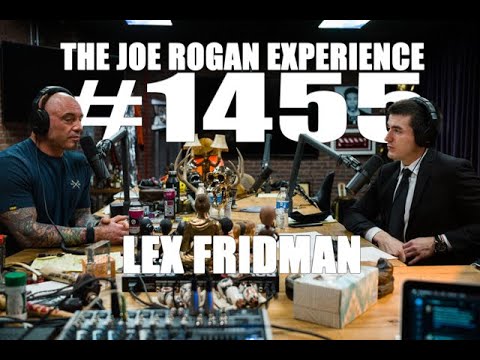
Joe Rogan Experience #1455 - Lex Fridman
Joe Rogan (host), Lex Fridman (guest), Guest (guest), Narrator, Guest (guest)
In this episode of The Joe Rogan Experience, featuring Joe Rogan and Lex Fridman, Joe Rogan Experience #1455 - Lex Fridman explores masks, Viruses, and Humanity: Joe Rogan and Lex Fridman Reflect Joe Rogan and Lex Fridman discuss COVID-19 in its early 2020 phase, focusing heavily on scientific uncertainty, mask effectiveness, immune health, and how society and media are responding. Fridman explains the Masks4All movement, the role of AI and virology research, and why rigorous studies are required before touting treatments. They branch into broader themes: historical pandemics and WWII, the fragility of civilization, political leadership, media failures, and how crises expose both social division and community solidarity. The episode ends on a more personal, philosophical note with Lex performing original music, talking about family, memory, and love as a response to suffering.
Masks, Viruses, and Humanity: Joe Rogan and Lex Fridman Reflect
Joe Rogan and Lex Fridman discuss COVID-19 in its early 2020 phase, focusing heavily on scientific uncertainty, mask effectiveness, immune health, and how society and media are responding. Fridman explains the Masks4All movement, the role of AI and virology research, and why rigorous studies are required before touting treatments. They branch into broader themes: historical pandemics and WWII, the fragility of civilization, political leadership, media failures, and how crises expose both social division and community solidarity. The episode ends on a more personal, philosophical note with Lex performing original music, talking about family, memory, and love as a response to suffering.
Key Takeaways
Homemade masks primarily protect others, not the wearer.
Fridman explains that in a mask-scarce environment, N95s and surgical masks should be reserved for healthcare workers, while homemade cloth masks can significantly reduce viral spread from asymptomatic carriers—your mask protects others, and their masks protect you.
Get the full analysis with uListen AI
Demand evidence before embracing COVID-19 cures or drugs.
On treatments like hydroxychloroquine, Lex stresses that promising mechanisms or anecdotes are not enough; well-designed studies are needed to know what actually works for this specific virus, just as with masks, drugs, and epidemiological models.
Get the full analysis with uListen AI
Support your immune system with fundamentals, not magic bullets.
Rogan emphasizes sleep, exercise, nutrition, vitamins (C and D), and thermal stress (saunas, hot baths, cold plunges) as practical ways to bolster health, while acknowledging they don’t replace infection control or proven therapies.
Get the full analysis with uListen AI
Crises expose both the strength and brittleness of institutions.
They criticize WHO and major media for early missteps and conflicting guidance, noting how institutional incentives, political framing, and click-driven news can distort public understanding exactly when clarity is most needed.
Get the full analysis with uListen AI
Social distancing has deep psychological and cultural costs.
While accepting that distancing and closures are necessary, they worry about long-term effects on human connection—masks hiding facial expression, people flinching from one another in grocery stores, and the erosion of everyday warmth.
Get the full analysis with uListen AI
Economic pain will lag health headlines and may be severe.
They point out that unemployment spikes, small business closures, and long-term economic damage are just beginning to show, with many people not yet realizing they’re effectively out of work, and that this will shape public mood and politics.
Get the full analysis with uListen AI
Love, community, and meaning-making are crucial antidotes to fear.
Drawing on Camus’ ‘The Plague’ and WWII stories, Lex argues that in absurd, uncontrollable suffering, turning inward or panicking is destructive, while acts of love, gratitude, and shared struggle give crises their redemptive potential.
Get the full analysis with uListen AI
Notable Quotes
“Your mask protects me, my mask protects you.”
— Lex Fridman
“We’re so sensitive now, on the verge of giving into the fear on a mass scale.”
— Lex Fridman
“This is the craziest time I’ve ever experienced being alive.”
— Joe Rogan
“This is our little World War II moment… it’s a global catastrophe.”
— Lex Fridman
“Some days we’ll sink in sadness… don’t lose yourself to madness. The way out is love.”
— Lex Fridman (song lyric)
Questions Answered in This Episode
If homemade masks mainly protect others, how do we motivate highly individualistic societies to adopt them widely and consistently?
Joe Rogan and Lex Fridman discuss COVID-19 in its early 2020 phase, focusing heavily on scientific uncertainty, mask effectiveness, immune health, and how society and media are responding. ...
Get the full analysis with uListen AI
What structural changes to media and public health communication would reduce misinformation without sliding into censorship?
Get the full analysis with uListen AI
How can societies balance necessary infection control with preserving the social rituals—touch, gatherings, live events—that make life feel meaningful?
Get the full analysis with uListen AI
In what ways might the COVID-19 crisis permanently reshape our expectations of government competence and the design of political leadership roles?
Get the full analysis with uListen AI
What personal practices—like Lex’s gratitude runs or Rogan’s sauna routine—are sustainable ways to carry crisis-born insights into post-pandemic life?
Get the full analysis with uListen AI
Transcript Preview
Hello, Lex.
(laughs) You might be wondering why... what I'm wearing on my face.
Uh, I'm not wondering.
No?
No. It's coronavirus time. Everybody out there is wearing a mask, so I'm assuming that's what you're wearing on your face.
Yeah, so this is a homemade mask. Takes 30 seconds to make.
30 seconds? Did you time yourself?
I don't know. Yeah-
If you have a bra, can you, like, cut a cup and, like, a strap tie it on? That would work, right?
But there's no... Yes, probably, but it probab-... There... As far as I'm aware, there's no scientific study of how effective bras are at filtering.
How effective is that thing?
So there i-... It's... I'm glad you asked, Joe.
(laughs)
So, I'm, um, uh, part of this... And I'll take this off in a few minutes. I just want to... One, I wanna talk about some of the science, and two, I wanna remove some of the stigma that's around masks. So, I'm part of this group of scientists that, uh, have put together a survey paper showing that masks work. And it started as a movement called Masks4All, hashtag, uh, in, uh, the Czech Republic, that essentially one of the critical components of s- stopping the spread of coronavirus is everybody has to wear masks. And the science is twofold, so... I mean, uh, I need to break this apart, but...
You're gonna take the mask off eventually, right?
Yeah.
So let's just take it off now-
If you'll just-
... so I can hear you 'cause y-
There's an audio? Is... You can't hear that?
Oh, that's so much better.
Oh, yeah. Nice. So-
It's like taking a condom off.
(laughs) The before and after. So you probably shouldn't be wearing a mask when you're doing podcasts.
Definitely not.
But everywhere else, yes.
So when you're going out to the grocery store, you should wear a mask everywhere.
Everywhere, and that's... Okay, so some, some questions. Do homemade masks work? So there's, uh, currently a shortage of s-... N95 respirator masks, which should be exclusively used as PPE, personal protective equipment, by healthcare workers. Okay. There's also a shortage of surgical masks, which are these non-woven fabric masks that work very well for the thing I'm talking about. But because there's a shortage of them, we should not be buying them and should be saving them for healthcare workers. And then the open question was whether homemade masks, like the one I just described, uh, work to stop as a filtration mechanism. This is the confusing thing for the individual-centric society that we live in. Masks are the most... W- what are they actually effective for? What they're effective for is to prevent me, if I'm infected, asymptomatic, s- from spreading the infection to you. So that's where the movement of Masks4All started, which is your mask protects me, my mask protects you. And th- the idea there is, is, is not... I'm not protecting... I'm not creating a wall from the rest of society. I am contributing to the, sort of the bigger aggregate picture of it by n- uh, not allowing the infection to spread. So it... Masks is, uh... Masks allow you to reduce that transmission rate to one, to below one, so allowing you to decrease the transmission rate while also allowing people to be in public. So like-
Install uListen to search the full transcript and get AI-powered insights
Get Full TranscriptGet more from every podcast
AI summaries, searchable transcripts, and fact-checking. Free forever.
Add to Chrome