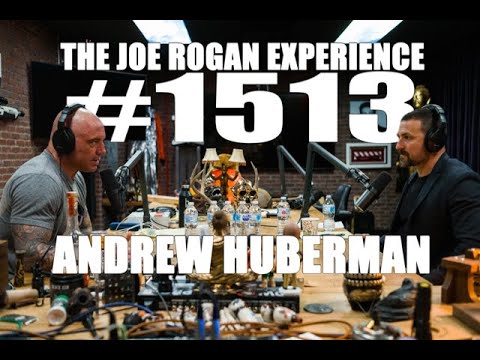
Joe Rogan Experience #1513 - Andrew Huberman
Joe Rogan (host), Andrew Huberman (guest), Narrator, Narrator, Narrator
In this episode of The Joe Rogan Experience, featuring Joe Rogan and Andrew Huberman, Joe Rogan Experience #1513 - Andrew Huberman explores andrew Huberman Explains Stress, Sleep, Neuroplasticity, and Human Potential Neuroscientist Andrew Huberman joins Joe Rogan to break down how the nervous system creates our states of mind—stress, focus, sleep, courage, and learning—and how we can deliberately influence those states. He outlines the core brain–body circuits governing sensation, perception, emotion, thought, and action, emphasizing the role of the autonomic nervous system and neurochemicals like norepinephrine, acetylcholine, and dopamine. They discuss practical tools for better sleep, faster learning, and stress control, including specific breathing patterns, hypnosis, deep rest, and carefully timed high‑intensity effort. The conversation ranges from brain–machine interfaces and vision restoration to social media, riots, obesity, COVID communication failures, and how our brains get hijacked by modern technology and politics.
Andrew Huberman Explains Stress, Sleep, Neuroplasticity, and Human Potential
Neuroscientist Andrew Huberman joins Joe Rogan to break down how the nervous system creates our states of mind—stress, focus, sleep, courage, and learning—and how we can deliberately influence those states. He outlines the core brain–body circuits governing sensation, perception, emotion, thought, and action, emphasizing the role of the autonomic nervous system and neurochemicals like norepinephrine, acetylcholine, and dopamine. They discuss practical tools for better sleep, faster learning, and stress control, including specific breathing patterns, hypnosis, deep rest, and carefully timed high‑intensity effort. The conversation ranges from brain–machine interfaces and vision restoration to social media, riots, obesity, COVID communication failures, and how our brains get hijacked by modern technology and politics.
Key Takeaways
To change your brain as an adult, you must pair intense focus with deep rest.
Neuroplasticity isn’t a single event but a two‑step process: high‑urgency, high‑attention effort (driven by norepinephrine and acetylcholine) triggers plasticity, and deep sleep or very deep relaxation (where “duration–path–outcome” thinking shuts off) consolidates and rewires circuits.
Get the full analysis with uListen AI
Well‑timed stress can dramatically accelerate learning and performance.
Short bouts of deliberate, high‑arousal focus—potentially amplified by tools like cold exposure, caffeine, or intense breathing—ramp up adrenaline and attention, making the brain tag specific synapses for change, provided they are followed by sufficient recovery.
Get the full analysis with uListen AI
Deep rest states (naps, hypnosis, or pseudo‑sleep) are performance tools, not luxuries.
Brief, sleep‑like states during the day restore our capacity for complex thinking and motor sequencing and also make it easier to access high‑quality nighttime sleep, directly improving learning, creativity, and emotional regulation.
Get the full analysis with uListen AI
Dopamine fuels persistence by buffering stress and marking what to remember.
Dopamine is released not only when we succeed but when we believe we’re on the right path; it both tags neural circuits for later change and pushes back against rising norepinephrine, extending how long we can sustain effort before quitting.
Get the full analysis with uListen AI
Breathing patterns can rapidly shift your stress level and brain state.
A ‘physiological sigh’—two quick inhales through the nose followed by a long exhale—rapidly lowers CO₂ and calms the nervous system, while repeated deep, rapid breathing (Tummo‑style) spikes norepinephrine, boosts alertness, and can even transiently enhance immune responses.
Get the full analysis with uListen AI
Phones and social media hijack our attention and plasticity systems.
Constant low‑level dopamine hits from scrolling train the brain toward scattered, shallow focus and make it harder to sustain the deep, high‑effort concentration required for real learning and meaningful work, while also amplifying emotional contagion and polarization.
Get the full analysis with uListen AI
Vision loss may soon be slowed or partially reversed with new therapies.
Huberman describes human trials using specific VR visual stimulation, growth‑factor injections, and emerging gene‑based ‘rejuvenation’ approaches (e. ...
Get the full analysis with uListen AI
Notable Quotes
“States of mind are fundamentally the most important aspect of trying to understand how the brain works.”
— Andrew Huberman
“Neuroplasticity is not an event, it’s a process, and it has two parts: high focus and then deep rest.”
— Andrew Huberman
“Dopamine gets released any time an animal or human thinks it’s on the right path.”
— Andrew Huberman
“We are wasting our cognition. We’re wasting the most precious gift we were given by Mother Nature and evolution.”
— Andrew Huberman
“Forward movement balanced by rest is the solution that’s worked for us for tens of thousands of years.”
— Andrew Huberman
Questions Answered in This Episode
How could you redesign a typical work or training day to alternate deliberately between high‑stress focus periods and structured deep‑rest intervals to maximize learning and performance?
Neuroscientist Andrew Huberman joins Joe Rogan to break down how the nervous system creates our states of mind—stress, focus, sleep, courage, and learning—and how we can deliberately influence those states. ...
Get the full analysis with uListen AI
In what ways are your phone and social media habits currently shaping your brain’s plasticity—toward deeper focus or toward distraction?
Get the full analysis with uListen AI
How might simple tools like the physiological sigh, controlled cold exposure, or hypnosis change how you handle acute stress or anxiety in your own life?
Get the full analysis with uListen AI
If dopamine reinforces beliefs simply by thinking about them, how can individuals and societies create environments that encourage belief updating rather than ideological hardening?
Get the full analysis with uListen AI
Given the emerging ability to restore vision and interface directly with the brain, where should we draw ethical lines between healing, enhancement, and fundamentally changing what it means to be human?
Get the full analysis with uListen AI
Transcript Preview
Andrew, how are you? What's happening, man?
Doing great.
Nice to meet you.
Nice to meet you too.
R- really excited to talk to you about this. Um, just sort of f- for an introduction, tell people what you do.
So I'm a neuroscientist, uh, meaning I'm a professor of neurobiology and ophthalmology, Stanford School of Medicine. So I run a laboratory. I teach a little bit. I teach neuroanatomy to medical students. But mainly, my lab does research, so I've got students and post-docs, and we're trying to figure out the answers to two problems. The first problem is how to regenerate the damaged nervous system, in particular, the connections between the eye and the brain, to restore vision to the blind, so that's a big mission of ours, and to prevent vision loss in people that are losing their vision. And the other thing that we're doing is we're focusing a lot on stress and other states of mind. So I'm obsessed with the idea that all our states of mind come from the brain and the body, and we're trying to figure out what happens in the brain and body when we're stressed and how to control it, what happens in the brain and body when we are creative and how to control it, and essentially, for all states of mind. But rather than try and tackle the really high level stuff like flow and states of awe, we're really focused on these states of stress and things like focus and the ability to think clearly and do certain things athletically or cognitively because, first of all, there's a lot of suffering. There are a lot of people out there that are suffering from an inability to control their states of mind. And also, there's great potential for people who aren't suffering to be able to create and perform and do better things once we can understand how those states come about.
That's an interesting way of putting it, suffering 'cause they can't control their states of mind. Um, that- that is the case, but that's not, like, a politically correct way of, uh, describing it.
I guess I never thought about that.
Would that be accurate?
Well, I think that it's fair to say that all our states of mind and body, and I say mind and body 'cause the nervous system, which is the brain, the spinal cord, and all that stuff, it connects to our body-
Mm-hmm.
... and our bo- body connects to our brains, so we can't really separate those. But states of mind, which include the stuff in our skull and the body, those essentially dictate our whole life experience, right? So whether or not we're feeling calm when we wanna be calm, whether or not we're feeling stressed when we'd rather be calm, whether or not we are feeling focused when we need to do work, or whether or not we're feeling creative when we wanna be creative, all of that stems from the nervous system. The other organs are, of the body are involved, but the nervous system, the brain and those connections is really what it's about. So if you see somebody who's in a state of depression, or you see somebody who's in a state of flow and creativity, you can be pretty sure that that's reflecting the activity of neurons in the brain.
Install uListen to search the full transcript and get AI-powered insights
Get Full TranscriptGet more from every podcast
AI summaries, searchable transcripts, and fact-checking. Free forever.
Add to Chrome