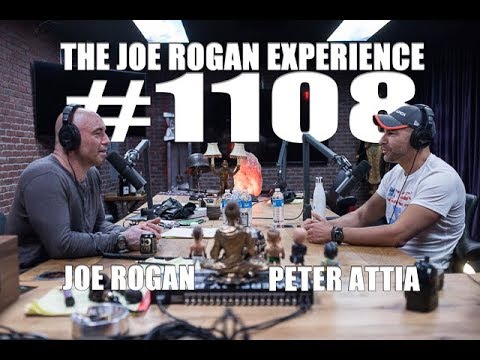
Joe Rogan Experience #1108 - Peter Attia
Joe Rogan (host), Peter Attia (guest)
In this episode of The Joe Rogan Experience, featuring Joe Rogan and Peter Attia, Joe Rogan Experience #1108 - Peter Attia explores peter Attia Explores Extreme Endurance, Predators, Fasting, and Longevity Science Peter Attia recounts his history as an ultra-endurance open‑water swimmer, including brutal long‑distance ocean crossings and near shark encounters, to illustrate human limits, fear, and “emotional acceleration.”
Peter Attia Explores Extreme Endurance, Predators, Fasting, and Longevity Science
Peter Attia recounts his history as an ultra-endurance open‑water swimmer, including brutal long‑distance ocean crossings and near shark encounters, to illustrate human limits, fear, and “emotional acceleration.”
He and Joe Rogan then move into a long discussion on animals, predators, and human interactions with wildlife, using coyotes, sharks, seals, and hunting stories to explore ecology and behavior.
The conversation pivots to Attia’s current work on longevity, covering intermittent fasting, carbohydrate restriction, hormones, rapamycin, and the difficulty of interpreting biomedical research for real‑world health decisions.
They close by discussing training adaptations, performance vs. health tradeoffs, and Attia’s personal practices—archery, race‑car driving, one‑meal‑a‑day eating, and how he structures his life around extending both lifespan and healthspan.
Key Takeaways
Extreme endurance is as much psychological as it is physical.
Attia’s marathon swims—hours in cold, dark water, puking and fighting currents—show that enduring profound discomfort and fear is largely about mental framing and the contrast between suffering and eventual relief, which he calls “emotional acceleration.”
Get the full analysis with uListen AI
Women may have advantages in ultra‑distance swimming.
He notes that in marathon swimming women often outperform men, likely due to higher pain tolerance, greater body fat (for insulation and buoyancy), and hip fat distribution that reduces drag by improving body position in the water.
Get the full analysis with uListen AI
Human–wildlife coexistence is messy and often driven by our behavior.
Stories of shark attacks, coyotes killing chickens, seals grabbing children, and tame monkeys and coatimundis eating junk food underscore that feeding and habitat changes created by humans alter animal behavior, sometimes dangerously.
Get the full analysis with uListen AI
Intermittent fasting mainly improves metabolic flexibility and convenience, not guaranteed longevity.
Attia often fasts 16–22 hours per day; he reports steadier energy and more dietary leeway during eating windows, but stresses that most strong longevity claims come from animal data and may not translate directly to humans.
Get the full analysis with uListen AI
Carbohydrate sensitivity and fat gain are driven by hormonal fuel partitioning, not just willpower.
He explains that hormones like insulin, cortisol, testosterone, estrogen, and hormone‑sensitive lipase decide whether calories go into or out of fat cells; some people are so insulin‑resistant that even “normal” diets keep them obese and require aggressive interventions.
Get the full analysis with uListen AI
Rapamycin is a promising but not yet ready longevity drug.
Animal and early human data suggest that carefully pulsed doses of rapamycin can improve immune function and markers like cardiac ejection fraction, potentially via increased autophagy, but optimal dosing and long‑term safety in healthy humans remain unresolved.
Get the full analysis with uListen AI
Pursuing peak performance can conflict with long‑term health.
He points out that extreme endurance sports like pro cycling or Tour de France racing can damage heart structure (e. ...
Get the full analysis with uListen AI
Notable Quotes
“In life, velocity means very little, acceleration means everything.”
— Peter Attia
“Happiness is only interesting when it’s juxtaposed with sadness.”
— Peter Attia
“If our ancestors couldn’t function when they were hungry, we wouldn’t be here.”
— Peter Attia
“You don’t want to lose weight; you want to lose fat.”
— Peter Attia
“Moderation is the only thing worth doing in moderation.”
— Peter Attia
Questions Answered in This Episode
How far should healthy people go with intermittent fasting before risking negative hormonal or psychological effects?
Peter Attia recounts his history as an ultra-endurance open‑water swimmer, including brutal long‑distance ocean crossings and near shark encounters, to illustrate human limits, fear, and “emotional acceleration.”
Get the full analysis with uListen AI
At what point do performance‑enhancing strategies (like rapamycin or growth hormone) become ethically or medically justifiable for longevity rather than sport?
He and Joe Rogan then move into a long discussion on animals, predators, and human interactions with wildlife, using coyotes, sharks, seals, and hunting stories to explore ecology and behavior.
Get the full analysis with uListen AI
Can we realistically personalize nutrition and hormone protocols enough to overcome severe insulin resistance in most people?
The conversation pivots to Attia’s current work on longevity, covering intermittent fasting, carbohydrate restriction, hormones, rapamycin, and the difficulty of interpreting biomedical research for real‑world health decisions.
Get the full analysis with uListen AI
How should societies balance conservation biology with hunting, eradication of invasive species, and the growing presence of predators like coyotes in cities?
They close by discussing training adaptations, performance vs. ...
Get the full analysis with uListen AI
Given the sheer volume of low‑quality or contradictory research, how can non‑experts meaningfully evaluate health claims about diets, supplements, and “longevity hacks”?
Get the full analysis with uListen AI
Transcript Preview
Four, three, two, one. (claps) Hello, Peter.
Hello, Joe.
What's going on, man?
A lot.
You were just telling me something that wa- is one of the most ridiculous things I've ever heard, that you swam from Maui to Lanai.
Right.
And you're the one- only human to ever do that.
I'm told I was the first person to swim from Maui to Lanai and back.
Oh.
The- the one-way is a pretty famous swim race that's done every year.
You're the first person to do it-
The round trip.
... and go back? Fuck, dude. Why'd you do that? (laughs)
How long you got?
(laughs)
(laughs)
"It started when I was a boy. They told me I couldn't do it."
(laughs)
(laughs) What- what made you wanna do that? It's a ridiculous proposition.
Um, so I got into ... I decided in ... (laughs) This is gonna sound silly. I read a book in January of 2004 about this woman named Penny Dean who, uh, still to this day holds the record for the fastest crossing of the Catalina Channel, so swimming from Catalina Island to San Pedro or, uh, or, uh, to, uh ... Not, you typically swim to Point- Point Vicente. And she had done it in, like, seven hours and 20 minutes, and I was like, "That's amazing. I want-"
How far is that?
As the crow flies, it's 21 miles.
Whoo.
With the currents it's a little longer. And I was like, "You know, I really wanna do this, um, but I- I gotta learn how to swim first." That seems-
So that's three miles an hour swimming?
She is a phenom. Penny Dean had a stroke rate of 90 strokes per minute, which, I mean, I know that might not mean anything to someone who doesn't swim, but like, to turn, to have a hand hit the water every, you know, third of a, two thirds of a second is a remarkable pace.
That's insane.
Yeah, I- I can't hold a cadence of that for 100 yards.
Wow. And she did it for 20 miles?
Yeah.
What a beast.
She's outta control.
(laughs)
Yeah.
There's certain people like that, man, that freak me out.
I- I think, I think marathon swimming might be one sport where if- if you just look at the numbers, I think women are better than men.
Mm. Well, there's that woman who swam from Cuba to the United States, right? She was the first person ever to do that.
Yeah, Diana Nyad.
And she, didn't she do it, like, at a fairly advanced age?
Yeah. I mean, she's of course got an amazing pedigree of swimming, and-
Right.
... this wasn't her first rodeo.
Right, right, right. Why- why do you think women are better than men as that?
Install uListen to search the full transcript and get AI-powered insights
Get Full TranscriptGet more from every podcast
AI summaries, searchable transcripts, and fact-checking. Free forever.
Add to Chrome