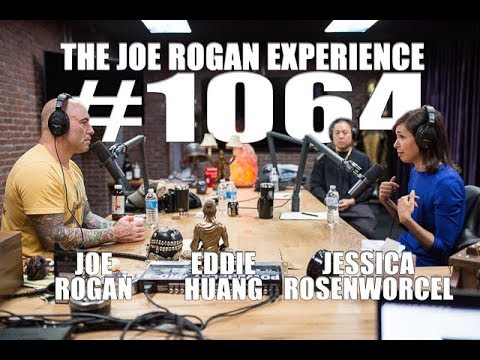
Joe Rogan Experience #1064 - Eddie Huang & Jessica Rosenworcel
Joe Rogan (host), Jessica Rosenworcel (guest), Eddie Huang (guest), Eddie Huang (guest)
In this episode of The Joe Rogan Experience, featuring Joe Rogan and Jessica Rosenworcel, Joe Rogan Experience #1064 - Eddie Huang & Jessica Rosenworcel explores joe Rogan, Eddie Huang, FCC Commissioner Battle Over Net Neutrality’s Future Joe Rogan hosts chef/author Eddie Huang and FCC Commissioner Jessica Rosenworcel to unpack the FCC’s recent repeal of U.S. net neutrality rules and what it could mean for the internet’s future.
Joe Rogan, Eddie Huang, FCC Commissioner Battle Over Net Neutrality’s Future
Joe Rogan hosts chef/author Eddie Huang and FCC Commissioner Jessica Rosenworcel to unpack the FCC’s recent repeal of U.S. net neutrality rules and what it could mean for the internet’s future.
Rosenworcel explains how removing net neutrality enables broadband providers to legally block, throttle, or prioritize content, threatening free speech, entrepreneurship, and fair competition—especially in areas with effective internet monopolies.
The conversation widens into civic engagement, how citizens can fight the repeal through Congress, courts, and state laws, and why an open internet is central to cultural evolution, innovation, and individual opportunity.
They also explore broader themes: political tribalism, universal basic income, automation, physical and mental resilience, and how the internet empowers people to escape traditional 9–5 constraints and build unconventional careers.
Key Takeaways
Net neutrality repeal hands gatekeeping power to broadband providers.
Without rules against blocking, throttling, or paid prioritization, ISPs now have both the technical ability and legal right to favor some content and services over others, potentially distorting what users see and what businesses can compete.
Get the full analysis with uListen AI
“Let the market decide” fails where there is no real competition.
Rosenworcel cites FCC data showing about half of U. ...
Get the full analysis with uListen AI
Open internet access is crucial for small creators and start-ups.
Both Huang’s career (starting on Blogspot) and countless YouTube/podcast success stories depend on equal access; paid fast lanes or throttling would tilt the field toward big companies that can afford deals with ISPs.
Get the full analysis with uListen AI
Citizens still have concrete tools to fight policy decisions.
Rosenworcel urges people to call their representatives, support a Congressional Review Act resolution, back state-level net neutrality bills, and pay attention to litigation—sustained public pressure can still shape outcomes.
Get the full analysis with uListen AI
The internet has radically democratized information and opportunity.
From Uber reducing drunk driving to niche craftspeople selling globally, the panel sees the internet as a civilizational shift that enables people to find communities, learn skills, and escape rigid 9–5 paths—making its openness a public-interest issue.
Get the full analysis with uListen AI
Political tribalism obscures broadly shared interests like net neutrality.
Despite 83% public support across parties, the issue has been framed as left vs. ...
Get the full analysis with uListen AI
Preparing for automation may require rethinking work and social safety nets.
Rogan and Huang revisit universal basic income in light of self-driving vehicles and robotics, arguing that guaranteeing basic needs could free people to retrain, explore creative paths, and adapt to a more contract-based, less linear career world.
Get the full analysis with uListen AI
Notable Quotes
““The future of the internet’s the future of everything.””
— Jessica Rosenworcel
““Right now, your broadband provider has the technical ability to block content… and now the FCC just gave them the legal green light.””
— Jessica Rosenworcel
““Without the internet, without Blogspot, without that ability to just project my voice and hope someone connects, I never would’ve happened.””
— Eddie Huang
““The internet is our ability… it directly affects our ability to evolve as a culture.””
— Joe Rogan
““Being a citizen’s a job. You actually have to spend some time and think about what you’re authorizing for the world.””
— Jessica Rosenworcel
Questions Answered in This Episode
If ISPs begin using their new powers subtly—through small throttling or preferential routing—how will ordinary users even detect that their online experience is being manipulated?
Joe Rogan hosts chef/author Eddie Huang and FCC Commissioner Jessica Rosenworcel to unpack the FCC’s recent repeal of U. ...
Get the full analysis with uListen AI
What specific safeguards or regulatory models could preserve internet openness while addressing concerns about overregulation and innovation?
Rosenworcel explains how removing net neutrality enables broadband providers to legally block, throttle, or prioritize content, threatening free speech, entrepreneurship, and fair competition—especially in areas with effective internet monopolies.
Get the full analysis with uListen AI
How might a future of widespread automation and contract-based work intersect with the need for universal, affordable high-speed internet access?
The conversation widens into civic engagement, how citizens can fight the repeal through Congress, courts, and state laws, and why an open internet is central to cultural evolution, innovation, and individual opportunity.
Get the full analysis with uListen AI
To what extent should major tech platforms like Google, Amazon, and Facebook be expected to publicly and aggressively defend net neutrality, given their size and influence?
They also explore broader themes: political tribalism, universal basic income, automation, physical and mental resilience, and how the internet empowers people to escape traditional 9–5 constraints and build unconventional careers.
Get the full analysis with uListen AI
What practical strategies can individuals and small businesses adopt now to protect themselves from potential discrimination by ISPs in a post–net-neutrality landscape?
Get the full analysis with uListen AI
Transcript Preview
Five, four, three, two, one. And we're live. Uh, welcome aboard, Jessica Rosenworcel. Did I do it?
You did.
(sighs) I was so nervous about that.
Don't worry (laughs) .
And Eddie Huang, of course. He's been on the podcast many times.
Number one podcast in the world.
Oh, thank you.
JRE.
What's up, brother? How are you?
I'm chilling, man. I'm, I'm good. I just, uh, you know, I wanted to introduce you to the homie-
(laughs)
... the commissioner from the FCC, Jessica Rosenworcel, 'cause thing- things are, things are bad for the internet right now.
Well, you are very concerned, and a lot of people are, about net neutrality. And, uh, we all have some questions about it and we're excited to talk to you about it, so maybe we could, uh, illuminate some of the issues and, and give us a, an understanding or try to l- uh, help us understand what's at stake here and why are people so concerned?
Well, I think people are concerned 'cause the future of the internet's the future of everything.
Right.
I mean, every aspect of our lives is now touched by that connectivity. And it's a funny thing, but the agency where I work in Washington, the Federal Communications Commission, has enormous power and control over our internet experience. And for decades, we've had these policies that have been all about internet openness, and what that means is you can go where you want-
Mm-hmm.
... do what you want online, and your broadband provider can't get in the way or prevent you from looking at some websites or looking at some videos or setting up some businesses. But that changed last month in Washington when the FCC, over my objections, voted to end net neutrality. And as a result, all of our broadband providers now have the legal right to block websites, to throttle content, and to set up sweetheart paid-for prioritization deals. And over the long haul, that could really change the internet and the web as we know it.
Now, one of the arguments f- pro-net neutrality, um, one of the arguments for people that were excited about this being signed, what they were saying that net neutrality was really, uh, only over the last couple years. And before the last couple years, net neutrality as we know it, the last couple years everything was fine and that it'll continue to be fine and that people are just panicked. And there was that really bizarre video that that one dude made where he was saying that, "These are all the things you're gonna be able to do." You work with that cat?
(smacks lips) I do.
(laughs) Ajit.
What is it?
Ajit Pai.
Yeah.
(laughs)
He seems like an odd-
Oof.
... odd fellow.
Yeah.
Yeah, well, uh-
Install uListen to search the full transcript and get AI-powered insights
Get Full TranscriptGet more from every podcast
AI summaries, searchable transcripts, and fact-checking. Free forever.
Add to Chrome