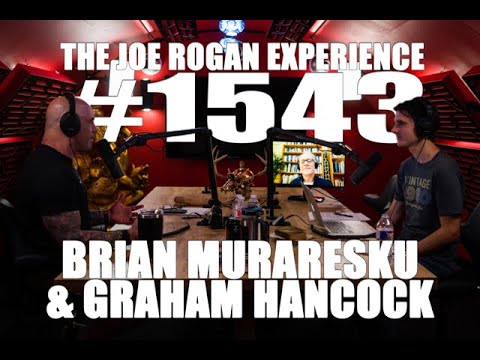
Joe Rogan Experience #1543 - Brian Muraresku & Graham Hancock
Brian C. Muraresku (guest), Graham Hancock (guest), Joe Rogan (host), Narrator, Narrator, Narrator, Graham Hancock (guest), Narrator, Brian C. Muraresku (guest)
In this episode of The Joe Rogan Experience, featuring Brian C. Muraresku and Graham Hancock, Joe Rogan Experience #1543 - Brian Muraresku & Graham Hancock explores ancient Psychedelic Sacraments: Rethinking Christianity, Mysteries, and Consciousness Joe Rogan speaks with author Brian Muraresku and researcher Graham Hancock about the thesis of Muraresku’s book *The Immortality Key*: that psychedelics and drug-infused beverages underpinned the earliest Western religious traditions, including forms of Christianity.
Ancient Psychedelic Sacraments: Rethinking Christianity, Mysteries, and Consciousness
Joe Rogan speaks with author Brian Muraresku and researcher Graham Hancock about the thesis of Muraresku’s book *The Immortality Key*: that psychedelics and drug-infused beverages underpinned the earliest Western religious traditions, including forms of Christianity.
They trace a line from prehistoric beer rituals and Greek mystery cults like Eleusis and Dionysus, through the pharmacology of spiked wine and beer, to early Christian Eucharistic practices that may originally have been genuinely psychoactive.
Muraresku presents archaeological, linguistic, and chemical evidence for ergotized beer and spiked wines used in funerary and initiatory rites, while Hancock connects this with broader patterns of visionary art, shamanism, and the modern suppression of psychedelics.
The conversation also critiques the war on drugs, highlights modern clinical research on psychedelics, and argues that direct mystical experiences—rather than dogma—likely lay at the root of many major religions.
Key Takeaways
Early Greek religious rites likely used psychoactive potions to eliminate fear of death.
At Eleusis and in other mystery cults, initiates consumed a guarded potion (kykeon) described as producing transformative visions and a certainty of life after death—closely paralleling modern reports from controlled psilocybin studies.
Get the full analysis with uListen AI
There is hard archaeological evidence for ergotized beer in a Demeter-Persephone cult.
Muraresku describes a 3rd–2nd century BC ritual farm in Spain (Mas Castellar de Pontos) linked iconographically to Eleusis, where a Greek-style ritual vessel tested positive for both beer and ergot, strongly supporting the 1978 ergot-kykeon hypothesis.
Get the full analysis with uListen AI
Ancient wine was often a drug delivery system, not just mild table alcohol.
Textual sources (like Dioscorides) and residue analyses from Egypt, Israel, and Pompeii show wines spiked with dozens of botanicals—including opium, cannabis, henbane, and nightshade—indicating a sophisticated ‘pharmacopeia in a cup’ used medicinally, ritually, and possibly visionary.
Get the full analysis with uListen AI
Some early Christian communities may have used psychoactive Eucharistic wine.
Muraresku highlights Greek New Testament passages (e. ...
Get the full analysis with uListen AI
Institutional Christianity had strong incentives to suppress psychedelic sacraments.
Hancock argues that once a hierarchical priesthood formed, substances that gave individuals direct access to the divine threatened clerical authority, leading to the destruction of Eleusis and the gradual replacement of entheogenic sacraments with inert symbols.
Get the full analysis with uListen AI
Modern culture’s demonization of psychedelics is historically and scientifically out of step.
The guests contend that 20th-century propaganda and the war on drugs severed humanity from ancient tools for confronting mortality and examining moral behavior, even as contemporary research shows psychedelics can relieve depression, addiction, and end-of-life anxiety.
Get the full analysis with uListen AI
Interdisciplinary work is crucial but institutionally risky—and still largely underfunded.
Researchers who seriously pursue the archaeology of intoxicants often harm their careers or leave academia, so building a robust evidence base on ancient entheogens will require new funding models, collaborations, and more scientists willing to cross disciplinary and cultural taboos.
Get the full analysis with uListen AI
Notable Quotes
“Eleusis was the one thing that holds the entire human race together… If you get rid of Eleusis, life for us will become unlivable.”
— Brian Muraresku (quoting the Roman Praetextatus via Zosimus)
“What Brian has done in *The Immortality Key* has been to present hard and fast evidence that the first Christians were using psychedelics.”
— Graham Hancock
“Taking a psychedelic is the least harmful thing it’s possible to do to anybody. It’s an entirely inward experience… If adults are not free to make sovereign decisions about their own consciousness, then freedom is a meaningless word.”
— Graham Hancock
“Wine in the ancient world is routinely described as unusually intoxicating, seriously mind-altering, occasionally hallucinogenic, and potentially lethal… One of the words used to describe wine for like a thousand years… was pharmakon.”
— Brian Muraresku
“We are a species with amnesia… We’ve just not been given the straight scoop about our past.”
— Graham Hancock
Questions Answered in This Episode
If early Christian sacraments were genuinely psychoactive, how should that reshape modern Christian theology and practice?
Joe Rogan speaks with author Brian Muraresku and researcher Graham Hancock about the thesis of Muraresku’s book *The Immortality Key*: that psychedelics and drug-infused beverages underpinned the earliest Western religious traditions, including forms of Christianity.
Get the full analysis with uListen AI
What kinds of new archaeological or chemical tests would most convincingly confirm or refute the psychedelic Eucharist hypothesis?
They trace a line from prehistoric beer rituals and Greek mystery cults like Eleusis and Dionysus, through the pharmacology of spiked wine and beer, to early Christian Eucharistic practices that may originally have been genuinely psychoactive.
Get the full analysis with uListen AI
How much of global religious mythology could be reinterpreted as encoded descriptions of specific plant and fungal technologies?
Muraresku presents archaeological, linguistic, and chemical evidence for ergotized beer and spiked wines used in funerary and initiatory rites, while Hancock connects this with broader patterns of visionary art, shamanism, and the modern suppression of psychedelics.
Get the full analysis with uListen AI
What political and economic interests most strongly benefit from keeping psychedelic experiences illegal and culturally marginalized today?
The conversation also critiques the war on drugs, highlights modern clinical research on psychedelics, and argues that direct mystical experiences—rather than dogma—likely lay at the root of many major religions.
Get the full analysis with uListen AI
Could a future in which psychedelics are reintegrated into medicine and spirituality meaningfully change how societies deal with death, crime, and governance?
Get the full analysis with uListen AI
Transcript Preview
(drum music) Joe Rogan podcast, check it out.
The Joe Rogan Experience.
Train by day, Joe Rogan podcast by night, all day. (rock music) Joining us by Skype is the great and powerful Graham Hancock. My friend, how are you, sir?
Hi, Joe. It's really good to be back with you. I wish I could be there in person. Uh, it feels very strange to be on this, uh, this technology, but these are the times we live in.
Yeah. Well, I'm just happy we could talk at all in this day and age.
Me too.
Uh, l- it's the little things, like little victories.
Yes.
And, uh, Brian, I'm gonna try it, I'm gonna try it, Muraresku.
You nailed it, bro. (laughs)
Ta! Thank you. And, uh, your b- this is the first time we've ever done one of these as well in the studio where one per- maybe ever visual. We've never done ... Well, we did one with you guys. Remember we did Randall Carlson and you.
Yeah, and Mark, Mark Defant came in by telephone, I think.
Yes.
Yes.
Whi- which was very strange. It was like a sound coming from nowhere.
Yeah.
At least I could see you. But we've never done one of these like this. But this book, tell me ... This is, uh, The Immortality Key: The Secret of Hi- The Secret History of Religion ... Of the Religion with No Name. I'll, I'll say that again. The Secret History of the Religion With No Name. Um, now this is ob- obviously when I found out the subject matter, Graham, this is right up your alley. And, uh-
Yeah.
... it made total complete sense why you and Brian worked together on this. So, uh, who wants to start and explain? Why don't ... Graham, why don't we have you start since you're, you know-
Yeah.
... you're over there in the UK.
(laughs)
Yeah, absolutely. Well, I, I mean, for me, I, I ... In fact, Joe, I think you and I originally got in touch because of my interest in psychedelics in human culture, uh, and a book that I published in 2006 called Supernatural.
Yes.
Which, which looks at the huge role that psychedelics have played in cultures and in religions, uh, all around the world. Uh, and I touched in that book, uh, on the role of psychedelics in the origins of Christianity, uh, which of course is a dynamite subject. Uh, and what Brian has done in The Immortality Key has been to present hard and fast evidence that the first Christians were using psychedelics and that their religious experiences were mediated by psychedelic experiences.
And Brian, how did you get involved in this?
It's a long story. (laughs)
You look like a stoner, by the way.
(laughs)
Install uListen to search the full transcript and get AI-powered insights
Get Full TranscriptGet more from every podcast
AI summaries, searchable transcripts, and fact-checking. Free forever.
Add to Chrome