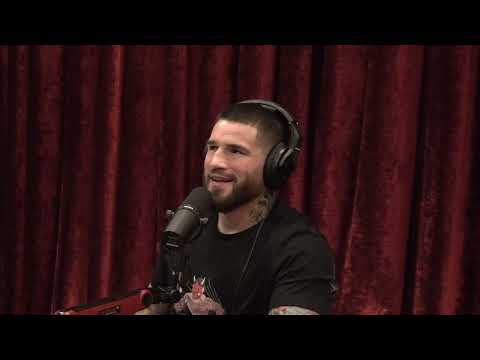
JRE MMA Show #152 with Sean Brady
Joe Rogan (host), Sean Brady (guest), Narrator, Narrator
In this episode of The Joe Rogan Experience, featuring Joe Rogan and Sean Brady, JRE MMA Show #152 with Sean Brady explores sean Brady Reveals Training, Recovery, And Mindset Behind UFC Success Joe Rogan and Sean Brady dive deep into the realities of elite MMA: constant injuries, brutal weight cuts, and the challenge of balancing strength work with skill training. Brady breaks down how sleep tech, mouth taping, CBD, and tools like Oura and Morpheus help him manage recovery and performance. They cover strength and conditioning philosophy, safer lifting alternatives, the evolving science at the UFC PI, and the ethics and limits of anti‑doping and banned therapies like peptides and IVs. Brady also details his mental shift after his first loss, his win over Kelvin Gastelum, and his goals for future fights, including a potential matchup with Colby Covington.
Sean Brady Reveals Training, Recovery, And Mindset Behind UFC Success
Joe Rogan and Sean Brady dive deep into the realities of elite MMA: constant injuries, brutal weight cuts, and the challenge of balancing strength work with skill training. Brady breaks down how sleep tech, mouth taping, CBD, and tools like Oura and Morpheus help him manage recovery and performance. They cover strength and conditioning philosophy, safer lifting alternatives, the evolving science at the UFC PI, and the ethics and limits of anti‑doping and banned therapies like peptides and IVs. Brady also details his mental shift after his first loss, his win over Kelvin Gastelum, and his goals for future fights, including a potential matchup with Colby Covington.
Key Takeaways
Respect injuries early or they become chronic and career‑threatening.
Brady describes training through groin pain after the Belal fight, tearing it twice and losing a scheduled bout, illustrating how ‘pushing through’ turns a six‑week issue into a six‑month layoff.
Get the full analysis with uListen AI
Sleep quality is a massive performance lever, not a luxury.
By taping his mouth at night, using CBD (no THC), and tracking with an Oura ring and Eight Sleep mattress, Brady saw deep sleep and recovery scores spike, reinforcing how better sleep measurably boosts readiness.
Get the full analysis with uListen AI
Train like an athlete, not a powerlifter, to extend your career.
He’s moved from heavy straight‑bar deadlifts and back squats to trap‑bar deadlifts, front squats, sleds, and belt squats, emphasizing safer joint positions and general physical preparedness over ego lifting.
Get the full analysis with uListen AI
Over‑obsessing on wearables can hurt decision‑making in camp.
Brady notes that Whoop/Oura often show ‘red’ in hard camps when backing off isn’t an option, so fighters must learn to distinguish genuine fatigue from data noise instead of blindly obeying readiness scores.
Get the full analysis with uListen AI
Weight cutting is now highly systematized, but still brutal.
Using UFC PI protocols, Brady plans to be on weight the night before, then precisely rehydrates and eats to hit specific calorie and carb targets—but he still regains over 20 pounds by fight night.
Get the full analysis with uListen AI
Mental skills and visualization can be as important as physical training.
After his first loss, Brady began working with mental performance coaches on presence, reset cues, affirmations, and detailed visualization (from shower to walkout to post‑fight interview), which he credits for feeling fully present vs. ...
Get the full analysis with uListen AI
Small, tightly run teams can rival mega‑camps for elite development.
Brady’s Philly team (Marquez MMA) has multiple UFC fighters and brings in targeted partners (e. ...
Get the full analysis with uListen AI
Notable Quotes
““If you don’t give injuries respect, they get chronic… instead of being out six weeks, now you’re out six months.””
— Joe Rogan
““I realized I wasn’t even fighting to win, I was fighting just to stay undefeated.””
— Sean Brady
““The minute I lost, it felt like a bronco was lifted off my shoulders.””
— Sean Brady
““Sleep is the number one thing you can do, 100%.””
— Sean Brady
““There’s no other sport like it… I’m doing 22 or 23 workouts in a week.””
— Sean Brady
Questions Answered in This Episode
How far can MMA performance improve if teams fully integrate mental skills training like Brady describes, rather than treating it as optional?
Joe Rogan and Sean Brady dive deep into the realities of elite MMA: constant injuries, brutal weight cuts, and the challenge of balancing strength work with skill training. ...
Get the full analysis with uListen AI
Should athletic commissions revisit bans on IVs and certain peptides if evidence shows they primarily aid recovery rather than enhance performance unfairly?
Get the full analysis with uListen AI
What is the optimal balance between strength and conditioning vs. skill work for MMA fighters, and does it differ by style (wrestler vs. striker)?
Get the full analysis with uListen AI
Given how extreme modern weight cuts are, would stricter hydration checks or additional weight classes make the sport safer without ruining competition?
Get the full analysis with uListen AI
Do mega‑camps or small, tightly knit teams create better long‑term champions, and what trade‑offs in coaching attention, sparring quality, and culture matter most?
Get the full analysis with uListen AI
Transcript Preview
(drumming music) Joe Rogan podcast, check it out. The Joe Rogan Experience. Train by day, Joe Rogan podcast by night, all day. (rock music) All right. Well, what's up?
What's going on, Joe?
Good to see you, brother. What's happening?
Thank you for having me, man.
So we were just talking about injuries. Like, uh ...
Yeah.
... the life of a fighter.
Yeah.
There's always ... You always have something wrong, right?
(laughs) Yeah. It's, uh, it's rough. Like, especially for someone m- Like, I'm getting a little bit older now and I'm being smarter, but like, I was training, I still kind of do, like almost three times a day. So like, I would do a morning skill session, an afternoon run or an afternoon strength session, and then another skill session at night. And I did that for 10 plus years.
Wow.
So, but I, but I love it, though. So, um, but I'm finding now, like I'm find- trying to find that balance of like, if it's a hard morning, like MMA, like sparring session, nighttime will be jujitsu, and I'll try to make it light. But you know how that like, you drill-
Right.
... then you start rolling. And when you're rolling hard, it's almost just as ... I get injured sometimes more during jujitsu, so ...
The whole rolling light is-
It doesn't happen.
Never happens. (laughs)
I was telling my wife, 'cause my hand, I was coming out here, I was like, "Maybe I can go and I can just like drill with Gordon and those guys." She was like, "You ain't fucking drilling with no ... If you guys start rolling light, like there ain't, there's not gonna be any of that."
(laughs)
And I'm like, "You're 100% right."
Yeah.
So yeah. All-
That's smart, though.
Yeah, I'm-
That's like-
And I'm-
... smarter Sean, like older.
100%.
Yeah.
And that's where, like before I was like, "Nah, fuck that. Like, I'm going, I'm gonna go hard," and then I'd be injured.
Yeah.
And then I wouldn't be able to fight, so yeah.
But the problem with injuries is, if you don't give them respect, they get chronic. They just, they just ...
Yeah.
They, they ... If ... There's so many guys that have a, an injury, and they try to train through it.
Yep.
And it just gets worse and worse and worse.
Yep.
And then instead of being out for six weeks, now you're out for six months.
And that was me after my Belal fight. So I came home from Abu Dhabi. I didn't have any injuries. I wanted to get back and I wanted to get that taste out of my mouth. So I'm back training, I'm back running, and then I started to feel that pain I was telling you about. And I literally just kept running. Like, I would run, once I was warmed up, like you know how it is, you warm up, the injuries kinda go away. Like, you feel good until you cool down. And I did that for a couple of months, and I had a fight scheduled and I tore my groin.
Install uListen to search the full transcript and get AI-powered insights
Get Full TranscriptGet more from every podcast
AI summaries, searchable transcripts, and fact-checking. Free forever.
Add to Chrome