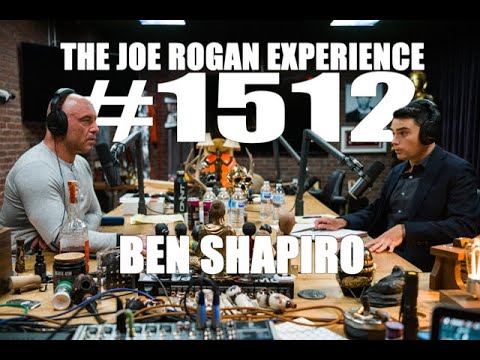
Joe Rogan Experience #1512 - Ben Shapiro
Joe Rogan (host), Ben Shapiro (guest), Narrator, Narrator
In this episode of The Joe Rogan Experience, featuring Joe Rogan and Ben Shapiro, Joe Rogan Experience #1512 - Ben Shapiro explores ben Shapiro and Joe Rogan Debate America’s Chaos and Future Direction Joe Rogan and Ben Shapiro cover COVID-19, urban decline, policing, race, culture, and personal responsibility through a mix of humor, personal anecdotes, and ideological argument.
Ben Shapiro and Joe Rogan Debate America’s Chaos and Future Direction
Joe Rogan and Ben Shapiro cover COVID-19, urban decline, policing, race, culture, and personal responsibility through a mix of humor, personal anecdotes, and ideological argument.
They criticize policy decisions around homelessness, lockdowns, protests, and media narratives, arguing that legal constraints, activist pressure, and inconsistent elites worsened social disorder.
On race and policing, Shapiro pushes a data-and-personal-agency frame while Rogan presses the importance of environment, trauma, and structural disadvantage in poor communities.
They broaden out to cultural issues—marriage, sex, social media, China, cancel culture, statues, and Colin Kaepernick—asking whether America’s core system is fundamentally good but flawed or fundamentally rotten.
Key Takeaways
Legal and activist constraints reshaped how cities handle homelessness and crime.
Shapiro traces L. ...
Get the full analysis with uListen AI
Inconsistent COVID rules and protest exceptions undermined public trust.
Both argue that banning funerals and beachgoing while greenlighting mass protests—sometimes explicitly only for certain causes—convinced many people the rules were political, not purely scientific.
Get the full analysis with uListen AI
Rogan and Shapiro agree police need reform but reject “defund” as dangerous.
They support targeted changes like curbing qualified immunity, restructuring police unions, and creating a national misconduct registry, but see broad defunding as fueling crime spikes in cities like New York and Chicago.
Get the full analysis with uListen AI
They clash over whether history or personal agency matters more in entrenched poverty.
Rogan emphasizes the crushing influence of environment, broken families, and lack of role models, while Shapiro insists that despite historical injustice, progress hinges on decisions about crime, education, and family formation now.
Get the full analysis with uListen AI
Shapiro views America’s system as fundamentally good but imperfect; many activists do not.
He criticizes the 1619 Project and contemporary antiracism frameworks for redefining racism as any unequal outcome and using that to justify tearing down markets, meritocracy, and even the founding narrative itself.
Get the full analysis with uListen AI
Cultural and technological shifts are quietly reshaping identity and relationships.
They warn that ubiquitous porn, addictive social media, beauty filters, and “hookup” norms destabilize young people’s expectations, self-worth, and ability to form durable relationships, arguing for more intentional discipline in sex, marriage, and tech use.
Get the full analysis with uListen AI
Symbol battles—statues, flags, slogans—risk obscuring deeper policy questions.
From Confederate monuments to Columbus to Colin Kaepernick’s protest, they argue that focusing on symbolic purity over concrete reforms or historical complexity fuels polarization and distracts from practical improvements.
Get the full analysis with uListen AI
Notable Quotes
“Either fundamentally the American system is good but flawed and we need to work on the flaws within the system, or fundamentally the American system sucks and we need to rip down the entire system.”
— Ben Shapiro
“What’s the worst thing you can say to a kid? ‘You’re born behind the eight ball and no matter what you do you’re not gonna succeed.’”
— Ben Shapiro
“If you have to go this far to find things to be offended over, there’s not that much to be offended over.”
— Ben Shapiro
“I think an alternative solution is there has to be some sort of large-scale intervention in these communities to do something about what has already been set in motion.”
— Joe Rogan
“Accepting reality is a real tough one. It’s a problem with advertising too, right? ’Cause advertising shows you what you think it is versus what it is.”
— Joe Rogan
Questions Answered in This Episode
Where is the right balance between acknowledging systemic and historical injustice and emphasizing individual agency and responsibility?
Joe Rogan and Ben Shapiro cover COVID-19, urban decline, policing, race, culture, and personal responsibility through a mix of humor, personal anecdotes, and ideological argument.
Get the full analysis with uListen AI
What specific, evidence-based interventions (beyond money transfers) have actually improved outcomes in high-crime, high-poverty communities?
They criticize policy decisions around homelessness, lockdowns, protests, and media narratives, arguing that legal constraints, activist pressure, and inconsistent elites worsened social disorder.
Get the full analysis with uListen AI
How can we build a shared, nuanced narrative of American history that recognizes both its brutal injustices and its genuine progress?
On race and policing, Shapiro pushes a data-and-personal-agency frame while Rogan presses the importance of environment, trauma, and structural disadvantage in poor communities.
Get the full analysis with uListen AI
What guardrails—legal, cultural, or technological—should be placed around social media and porn to protect kids without heavy-handed censorship?
They broaden out to cultural issues—marriage, sex, social media, China, cancel culture, statues, and Colin Kaepernick—asking whether America’s core system is fundamentally good but flawed or fundamentally rotten.
Get the full analysis with uListen AI
If symbols like flags and statues are so contested, what new shared symbols or rituals—if any—could help unify Americans across political and racial lines?
Get the full analysis with uListen AI
Transcript Preview
(claps) Hello, Ben. We're here.
Hey. How's it going, dude?
We're here. We did it.
We did. We're both alive.
First of all, congratulations on your thinness.
Oh, thank you.
You look slender and healthy. You look good.
Oh, thank you. I appreciate it. Turns out running away from my children for four months straight- (laughs)
(laughs)
... will do that to you. I literally took up running just to get away from my three children.
Really?
Oh, yeah.
Just going outside just for some m- mind space?
Well, it's LA, man. You can't get outside-
Yeah.
... unless you're actively exercising or they come and arrest you. Or I could allude at a footk- lot, Foot Locker. Right? Then, then they would've, that would have been okay.
Do you run with a mask on?
No. (laughs)
Does anybody yell at you?
No.
No?
No.
What do you run... Do you go to a track? Like, what do you do?
No, I literally just run around on the streets-
Yeah?
... hoping that one day I will be hunted down by the rioters. (laughs)
(laughs)
So I don't have to go deal with my... Children screaming at me. But yeah, that's-
(sighs)
... that's the, that's the goal.
Did you try to get healthier when COVID hit? Like, were you worried and-
Uh, yeah, a little bit. It really wasn't about COVID. It was just-
Oh.
... I was eating out too much and-
Oh.
... when I was relegated to home, it was like, I had to learn how to use the barbecue.
Oh.
Which I, I'd never learned how to use a barbecue actually. And then it turned out it was actually not that hard. So I don't know what I was doing for years.
I gotta give you some elk meat. Are you barbecuing right now?
Uh, yeah.
Are you still doing it?
Yeah.
All right. I'll give you some elk sausages. It's very easy.
Well, we have to, we have to do kosher, right? So I have to like-
Oh, that's not kosher at all.
I, I'll actually... Well, we'll have to go get the elk and I'll have to actually like, kill it myself and get a rabbi-
Is that what you have to do? You'd have to get the elk and then you'd have to slice its throat or something like that?
Oh, yeah. It's good times.
What, how did... Well, what's the logic behind that?
So I mean, not to get-
The original.
... too fast into the biblical stuff-
Right.
... but, uh, the, the original logic was that you were supposed to kill the animal in the most humane way, was the idea. Now, do I know if it's the most humane way now? I have no idea, but-
Install uListen to search the full transcript and get AI-powered insights
Get Full TranscriptGet more from every podcast
AI summaries, searchable transcripts, and fact-checking. Free forever.
Add to Chrome