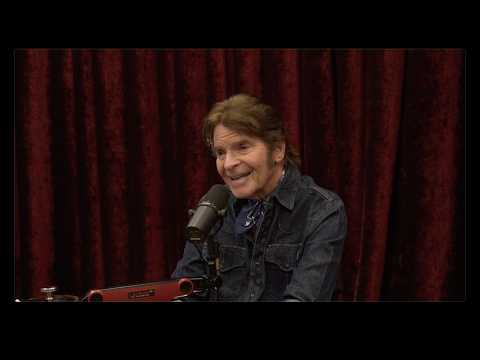
Joe Rogan Experience #2485 - John Fogerty
Joe Rogan (host), John Fogerty (guest)
In this episode of The Joe Rogan Experience, featuring Joe Rogan and John Fogerty, Joe Rogan Experience #2485 - John Fogerty explores john Fogerty recounts CCR battles, creativity, faith, and redemption journey Fogerty details how record-label power dynamics and litigation shaped his career, including being sued for “sounding like himself” and fighting to preserve artistic identity.
John Fogerty recounts CCR battles, creativity, faith, and redemption journey
Fogerty details how record-label power dynamics and litigation shaped his career, including being sued for “sounding like himself” and fighting to preserve artistic identity.
He recounts CCR’s internal fractures—especially resentment over songwriting control—culminating in the widely panned Mardi Gras album and the band’s breakup.
Fogerty explains his creative process as disciplined daily work paired with sudden “received” inspiration, illustrating how songs like “Fortunate Son” and “Proud Mary” came together.
He describes a period of bitterness and alcohol abuse after business betrayals, followed by a turning point through meeting his wife Julie and rebuilding a healthier, happier life.
The conversation connects art, ethics, and spirituality, with both Rogan and Fogerty arguing that humility, kindness, and living as if God exists support better creativity and a better life.
Key Takeaways
Music-business contracts can function like long-term ownership traps.
Fogerty describes label practices—publishing grabs, name/image leverage, and catalog control—that exploit young artists’ inexperience and desire to “just make a record.”
Get the full analysis with uListen
Litigation can be used as a weapon to control an artist’s future output.
He frames the “sued for sounding like myself” case as an attempt to own his style and prevent him from succeeding outside Fantasy, noting years of depositions, costs, and stress.
Get the full analysis with uListen
Band “democracy” fails without comparable creative contribution.
Fogerty says CCR initially claimed everyone would write, but others didn’t produce songs until fame arrived; when forced on Mardi Gras, the results hurt the band and fueled blame games.
Get the full analysis with uListen
Great songs often arrive fast, but only after years of preparation.
“Fortunate Son” came in ~20 minutes and “Proud Mary” in about an hour, but Fogerty credits decades of listening, writing since age eight, and routine daily work for making that possible.
Get the full analysis with uListen
Creativity is both mystical and procedural—show up daily to ‘receive’ ideas.
Fogerty and Rogan align on the muse concept: inspiration feels external (“tuning in a radio”), but it favors disciplined repetition and a receptive, humble mindset.
Get the full analysis with uListen
Unresolved injustice can convert success into a delayed emotional crash.
After Centerfield vindicated him, Fogerty says repressed rage surfaced, producing a darker, less authentic follow-up (Eye of the Zombie) and worsening alcohol abuse.
Get the full analysis with uListen
Stability and supportive relationships can restore both life and art.
Fogerty credits his wife Julie with saving his life and describes current fulfillment playing with his sons—reducing ego conflicts and restoring joy in performance.
Get the full analysis with uListen
Notable Quotes
“I got sued for sounding like myself.”
— John Fogerty
“How unfair would it be that at some point somebody takes ownership of your style and now says, ‘You have to go back and invent some other style.’”
— John Fogerty
“Walked in… and 20 minutes later, walked out with the whole song.”
— John Fogerty
“It’s like tuning in a radio.”
— John Fogerty
“If you’re all angry and treating people mean… I’m closing the book. I’m not sending you nothing.”
— John Fogerty
Questions Answered in This Episode
In the ‘sued for sounding like yourself’ trial, what specific musical elements did the plaintiffs claim were “CCR-owned,” and what finally persuaded the court to side with you?
Fogerty details how record-label power dynamics and litigation shaped his career, including being sued for “sounding like himself” and fighting to preserve artistic identity.
Get the full analysis with uListen AI
On the Castle Bank/offshore plan: what warning signs did you notice first, and what do you wish your attorneys/accountants had done differently when you asked for a full accounting (‘the shoebox’)?
He recounts CCR’s internal fractures—especially resentment over songwriting control—culminating in the widely panned Mardi Gras album and the band’s breakup.
Get the full analysis with uListen AI
When CCR members demanded equal songwriting on Mardi Gras, what compromises (if any) did you propose to avoid a full stylistic shift while still giving them a voice?
Fogerty explains his creative process as disciplined daily work paired with sudden “received” inspiration, illustrating how songs like “Fortunate Son” and “Proud Mary” came together.
Get the full analysis with uListen AI
You described the band learning songs as instrumentals before hearing the full vocal arrangement—how did that workflow shape CCR’s tight sound, and why did you prefer it?
He describes a period of bitterness and alcohol abuse after business betrayals, followed by a turning point through meeting his wife Julie and rebuilding a healthier, happier life.
Get the full analysis with uListen AI
You said you wrote “Fortunate Son” as an intentional ‘all-out screaming rocker’—what were your reference points (records, grooves, tempos) when designing that sonic ‘commission’?
The conversation connects art, ethics, and spirituality, with both Rogan and Fogerty arguing that humility, kindness, and living as if God exists support better creativity and a better life.
Get the full analysis with uListen AI
Transcript Preview
Joe Rogan Podcast, check it out.
The Joe Rogan Experience.
Train by day, Joe Rogan Podcast by night. All day. [upbeat rock music]
Think I can just step on the floor right here?
It doesn't matter. You can leave it on the table. It's fine. There's water there, too, uh, in this metal cup, and then there's coffee.
Oh, thanks so much.
There's coffee in here.
Okay, yeah.
If you'd like some coffee.
Yeah, ready to... I have some notes that I'll probably never look at, but-
You got notes?
Me?
What, what's on the notes?
Uh, just stuff, like what I went through with CCR and all that. But tell me something, did you, did you read up on me or anything, or-
I'm a huge fan. I don't have to read up on you.
Okay.
I read up on you a little bit, just to catch up about how you got out of the, the... Well, you did do military service.
Mm-hmm.
But you got out by smoking a lot of weed and not eating. I read that. Is that true?
No.
Is that true? They lied? There was a story about you smoking a lot of weed and, uh-
Oh
... getting emaciated so you can get out of the Army.
Well, i- it's not quite in that sequence, but those things did happen.
[laughs]
Yeah. I had, I had determined to lose a lot of weight, right? So I was kinda really s- skinny by 1967, '68. Uh, I mean, like 100... I think it was 129 pounds.
Whoa.
Yeah. Um, and then I was gonna go, uh, to the, I think it was the Presidio, and I had to meet with a Army doctor, right? And my friends gave me a couple of joints, and I stuck 'em in... You know, I used to smoke in those days, cigarettes. I stuck it in the cigarette, and going across the Bay Bridge [laughs] I smoked 'em. My, that's so fu- I hadn't even thought about it. So if you want, yeah, man, he, he, he went on a starvation di- a protest diet, and then smoked a lot of weed.
That's what I heard.
Wasn't quite that way, but yeah, okay. But it's, it's essentially some truth.
Some truth to it.
Yeah.
Uh, you had a legendary career, my friend. Legendary.
[laughs] Thank you. Still working on it.
It's incredible, man. You, you are, like, one of the main voices of rock and roll in America, if you really think about it. Your songs, I mean, they're... You have so many gigantic hits. You know, when, uh, the UFC, uh, has a lot of walkout songs, you know when fighters come out and walk out? A lot of guys walk out to your music. I don't even know if you're aware of it.
I've been-
But Fortunate Son is a big one.
Yeah.
Bad Moon Rising, that's another big one people walk out to.
Great. Wow.
Install uListen to search the full transcript and get AI-powered insights
Get Full TranscriptGet more from every podcast
AI summaries, searchable transcripts, and fact-checking. Free forever.
Add to Chrome