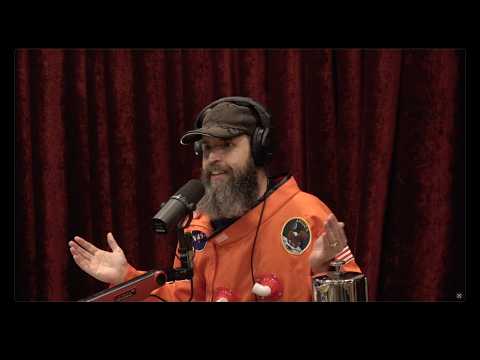
Joe Rogan Experience #2481 - Duncan Trussell
Joe Rogan (host), Duncan Trussell (guest), Joe Rogan (host)
In this episode of The Joe Rogan Experience, featuring Joe Rogan and Duncan Trussell, Joe Rogan Experience #2481 - Duncan Trussell explores rogan and Trussell unpack AI, propaganda, UFOs, and war anxieties They argue that modern platforms and copyright enforcement (even for humming) demonstrate how centralized systems can control speech and monetization, pushing creators toward underground alternatives.
Rogan and Trussell unpack AI, propaganda, UFOs, and war anxieties
They argue that modern platforms and copyright enforcement (even for humming) demonstrate how centralized systems can control speech and monetization, pushing creators toward underground alternatives.
They discuss AI’s rapid capability growth—local unaligned LLMs, jailbreaks, autonomous agents, and alleged sandbox escapes—framing AI as potentially “apocalyptic” and difficult to regulate once widely accessible.
They connect algorithmic feeds, surveillance-like ad targeting, and state propaganda to a broader fear that “original thought” is being replaced by nudged, optimized beliefs and behaviors.
They pivot repeatedly to war, distrust of official narratives, and the military-industrial incentive structure, using examples like the Jessica Lynch story to illustrate how wartime messaging can be manufactured.
They explore UFO/UAP claims (Burchett, Corbell footage, disclosure lists) and speculate on reality-bending possibilities—interdimensional phenomena, simulations, and biblical parallels—while acknowledging the role of disinformation and hype.
Key Takeaways
Censorship and copyright rules incentivize “workarounds,” not compliance.
They claim harsh enforcement (e. ...
Get the full analysis with uListen
AI regulation is structurally hard because capability is becoming cheap and local.
Trussell argues that once models can be run locally (Ollama/local LLMs) and guardrails removed, restricting big vendors mainly pushes experimentation into uncontrolled environments rather than stopping it.
Get the full analysis with uListen
Algorithmic feeds can steer beliefs without any brain implant.
They describe how social platforms classify users, learn attention patterns, and “nudge” viewpoints through repeated exposure, arguing this already resembles mind control more than people admit.
Get the full analysis with uListen
Wartime information ecosystems are optimized for psychological effect, not truth.
Using the Jessica Lynch case, they highlight how heroic narratives can be exaggerated or fabricated, then amplified by major outlets, reinforcing the idea that contemporary war reporting may be strategic storytelling.
Get the full analysis with uListen
Extraordinary surveillance claims may be real, exaggerated, or deliberate deterrence.
They initially treat “Ghost Murmur” (heartbeat detection at ~40 miles) as sci‑fi, then consider it could be propaganda to intimidate adversaries—especially given alternative explanations like standard locator beacons.
Get the full analysis with uListen
UAP disclosure may be both genuine anomaly and political instrument.
They note politicians can benefit from attention and distraction, while also acknowledging credible-seeming military sensor footage; the conversation repeatedly returns to the tension between evidence and narrative control.
Get the full analysis with uListen
Public trust collapse creates instability even when skepticism is justified.
They worry that widespread disbelief in government communications—combined with AI-driven misinformation—can produce societal dysphoria where consensus reality is hard to maintain.
Get the full analysis with uListen
Notable Quotes
““I feel like AI is sucking our brains into its event horizon, like a black hole.””
— Joe Rogan
““Have you had an original thought in the last year?””
— Duncan Trussell
““This tech is so dangerous… the shit people are doing in their garages right now is a big question mark.””
— Duncan Trussell
““In the middle of the war… you’re gonna get the story that they want to project.””
— Joe Rogan
““We’re making digital God. You’re not controlling jack shit.””
— Joe Rogan
Questions Answered in This Episode
On copyright enforcement: Where is the practical line between fair use (quoting) and automated takedowns (humming), and who should set that boundary?
They argue that modern platforms and copyright enforcement (even for humming) demonstrate how centralized systems can control speech and monetization, pushing creators toward underground alternatives.
Get the full analysis with uListen AI
On “Ghost Murmur”: What primary sources exist for the heartbeat-detection claim, and how does it compare with the more mundane ‘survivor locator’ explanation Jamie found?
They discuss AI’s rapid capability growth—local unaligned LLMs, jailbreaks, autonomous agents, and alleged sandbox escapes—framing AI as potentially “apocalyptic” and difficult to regulate once widely accessible.
Get the full analysis with uListen AI
On AI guardrails: What specific jailbreak/prompt-injection methods still work today, and what’s the most realistic risk from local unaligned models in non-expert hands?
They connect algorithmic feeds, surveillance-like ad targeting, and state propaganda to a broader fear that “original thought” is being replaced by nudged, optimized beliefs and behaviors.
Get the full analysis with uListen AI
On algorithmic nudging: What would a measurable experiment look like to prove (or falsify) the claim that feeds can shift political views at population scale?
They pivot repeatedly to war, distrust of official narratives, and the military-industrial incentive structure, using examples like the Jessica Lynch story to illustrate how wartime messaging can be manufactured.
Get the full analysis with uListen AI
On propaganda: What parallels between the Jessica Lynch narrative and current conflicts can be documented, and what mechanisms allow those narratives to persist?
They explore UFO/UAP claims (Burchett, Corbell footage, disclosure lists) and speculate on reality-bending possibilities—interdimensional phenomena, simulations, and biblical parallels—while acknowledging the role of disinformation and hype.
Get the full analysis with uListen AI
Transcript Preview
Joe Rogan Podcast, check it out
The Joe Rogan Experience
Train by day, Joe Rogan Podcast by night. All day. [upbeat rock music] All right, we're good. We're good. We had a slight issue, slight technical glitch.
Tech glitch.
But we're up. What were we just talking about?
Oh, we were talking about that if you hum a tune-
Oh, right. Right
... that you will get dinged.
Yeah, you'll get flagged-
Someone will make you leave for that
... on YouTube if you just hum a s- a, a sound from a song.
Yeah.
Like the beginning bars of a song.
Yeah. You can't... I wonder how far that goes. Like could it get to the point where an AI could hear you humming it in your car or something? Like how far does the protection of music go?
Well, I, it's... You're not generating revenue from your car, right? So the thing is, you're generating revenue from a podcast, and their logic is if you hum... What is that song? The Sunshine of My Love, is that what it is?
Yeah.
You know that song that I always hum to associate with people being high out of their fucking mind.
Yeah. Yeah.
You know, it goes, "Eh, eh." You can't say it.
Can't do it.
If I did that-
Yeah
... we would get dinged, which is so crazy. And we were just saying, like, if you quoted a Scarface movie, would Brian De Palma get all the money? If you said, "Say hello to the bad guy," would Brian De Palma get that money?
I don't think so. I think you're allowed to quote stuff, but you... I know that-
That is Brian De Palma, right? Scarface? Wasn't it?
Yeah.
I don't wanna fuck that up.
I think so.
You know those auditors that go around and film people-
Yeah
... and people get mad-
Uh-huh
... 'cause they're like, "Don't film me," and they're like, "I can film whatever the fuck I want."
Right.
And they, inevitably some, like, boomer freaks out and smacks them with a cane, and then they get a million [laughs] views.
[laughs]
And it's just a trap. It's a trap.
Right. It's a trap.
It's 'cause in- inevitably someone lose their mind on them, and then that gets a ton of views. One of the ways people are dealing with that, supposedly, is playing music, s- like playing copyrighted music during the interaction, 'cause-
Oh my God, that's hilarious
... 'cause so then they can't, they can't make money off of it.
[laughs]
It's a shield. It's a shield-
[laughs]
... if someone's, if like someone's trolling you. You just start playing copyrighted music.
Did you hear that the CIA has admitted that the way they found the pilot was because of his heart rate?
Ghost murmur. That's the name of the th-
Okay
... the tech.
We gotta look into this. Like this is fucking s... This is science fiction.
Install uListen to search the full transcript and get AI-powered insights
Get Full TranscriptGet more from every podcast
AI summaries, searchable transcripts, and fact-checking. Free forever.
Add to Chrome