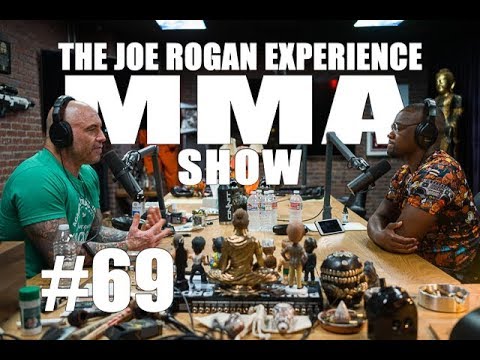
JRE MMA Show #69 with Yves Edwards
Joe Rogan (host), Yves Edwards (guest), Narrator, Narrator, Narrator, Narrator
In this episode of The Joe Rogan Experience, featuring Joe Rogan and Yves Edwards, JRE MMA Show #69 with Yves Edwards explores yves Edwards, Fight IQ, and the Future of MMA and Language Joe Rogan and Yves Edwards have a long, free‑flowing conversation that jumps between language and political correctness, perception and consciousness, combat sports culture, and the evolution of MMA. They reminisce about travel, Japan’s pachinko halls, gambling, and the strange charm of Vegas, while also touching on social issues like protests, tiger attacks in India, and online outrage culture.
Yves Edwards, Fight IQ, and the Future of MMA and Language
Joe Rogan and Yves Edwards have a long, free‑flowing conversation that jumps between language and political correctness, perception and consciousness, combat sports culture, and the evolution of MMA. They reminisce about travel, Japan’s pachinko halls, gambling, and the strange charm of Vegas, while also touching on social issues like protests, tiger attacks in India, and online outrage culture.
The core MMA portions dig into weight cutting, tournament formats, fighter development paths, and detailed breakdowns of elite fighters such as Khabib Nurmagomedov, Dustin Poirier, Tony Ferguson, Francis Ngannou, Ben Askren, and others. Edwards gives insider commentary on training room realities, fighter psychology, and why some styles or careers unfold the way they do.
They also highlight the Professional Fighters League (PFL) season-and-points format, the financial upside of its million‑dollar tournaments, and how that contrasts with traditional UFC matchmaking. The episode closes with plugs for upcoming PFL cards, ESPN’s role in MMA’s growth, and Edwards’ new podcast 'SupFam.'
Key Takeaways
Intent matters more than specific words, but society currently punishes words first.
Rogan and Edwards note that many terms once considered neutral are now taboo, and argue that without mind‑reading we judge people mostly on language, even when the same word can be affectionate in one context and hateful in another.
Get the full analysis with uListen AI
Fighter development is often rushed in major promotions, hurting long‑term potential.
They contrast boxing’s careful record‑building with MMA’s tendency to throw young prospects into elite UFC competition too soon, which can damage confidence and derail otherwise championship‑level careers.
Get the full analysis with uListen AI
Weight cutting is 'legal cheating' that could be replaced by smarter systems.
Rogan praises ONE Championship’s hydration and natural‑weight approach and criticizes extreme cuts (e. ...
Get the full analysis with uListen AI
Tournament and league formats like the PFL create new strategic layers and opportunities.
Edwards explains the PFL scoring (3 points for a win plus bonus points for early finishes) and how fighters must chase stoppages to make the playoffs, culminating in three fights for a potential $1 million purse—an attractive alternative to traditional matchmaking.
Get the full analysis with uListen AI
Elite fighters are separated by mental resilience and conditioning as much as skill.
Stories about Tony Ferguson’s insane gas tank, Khabib’s suffocating grappling, and Gregor Gillespie’s marathon‑level running emphasize that champion‑level performance comes from obsessive conditioning and a refusal to break under stress.
Get the full analysis with uListen AI
Public perception often erases champions as soon as they lose once.
They point out how quickly fans and media stopped talking about Stipe Miocic after a single KO loss to Cormier, despite Stipe being the most successful UFC heavyweight champion ever—underscoring how unforgiving fight culture can be.
Get the full analysis with uListen AI
Online anonymity empowers harsh, uninformed criticism that fighters should mostly ignore.
Edwards describes the pain of hearing accusations that he 'threw' a fight and Rogan characterizes many commenters as young or deeply unsuccessful; both argue fighters should avoid reading comments and focus on feedback from qualified peers.
Get the full analysis with uListen AI
Notable Quotes
“Fighting solves everything… The worst thing that could happen today is a fight.”
— Yves Edwards
“Weight cutting is the dumbest thing in all of combat sports.”
— Joe Rogan
“You’re only as good as your last fight—that’s the part of fighting I don’t like.”
— Yves Edwards
“There’s levels to this… that’s not just true in fighting; it’s in the mental game too.”
— Joe Rogan
“I’m a kid from the Bahamas—there’s no reason someone in Japan should know my name, except for my dedication to this sport.”
— Yves Edwards
Questions Answered in This Episode
How would MMA look if major organizations universally adopted ONE Championship–style hydration testing and natural weight classes?
Joe Rogan and Yves Edwards have a long, free‑flowing conversation that jumps between language and political correctness, perception and consciousness, combat sports culture, and the evolution of MMA. ...
Get the full analysis with uListen AI
In what ways does the PFL’s season-and-points format change how fighters train, strategize, and manage risk compared to the UFC’s event‑by‑event matchmaking?
The core MMA portions dig into weight cutting, tournament formats, fighter development paths, and detailed breakdowns of elite fighters such as Khabib Nurmagomedov, Dustin Poirier, Tony Ferguson, Francis Ngannou, Ben Askren, and others. ...
Get the full analysis with uListen AI
Can the sport meaningfully reduce online toxicity toward fighters, or is harsh anonymous criticism an unavoidable part of modern combat sports culture?
They also highlight the Professional Fighters League (PFL) season-and-points format, the financial upside of its million‑dollar tournaments, and how that contrasts with traditional UFC matchmaking. ...
Get the full analysis with uListen AI
What specific training methods or camp structures best prepare a striker like Dustin Poirier to deal with Khabib Nurmagomedov’s relentless wrestling over 25 minutes?
Get the full analysis with uListen AI
How much of Tony Ferguson’s seemingly bottomless gas tank and pace is genetic versus the product of unique, replicable training methods—and could other fighters safely emulate it?
Get the full analysis with uListen AI
Transcript Preview
(paper rustling) Doot, doot. (hand slamming) Yves Edwards, ladies and gentlemen. Hello, sir.
Hey.
Good to see you, brother. What's going on?
Um, everything and nothing, man.
Everything and nothing?
Yeah.
You were telling me you're, uh, this is a crazy w- time for you. You're, you're a vagabond. You're traveling around, man.
Yeah.
Like a gypsy.
I, I, I like the term nomad.
Nomad's good.
Yeah.
It's a good term.
Yeah, vagabond makes it sound like I'm poor-
Right, right, right.
... and I got, like, a stick with my-
Yeah.
... clothes tied in a back and...
Yeah, nomad's like a gypsy with money.
Yeah.
No, but gypsies are... Is that a derogatory term?
Right.
I- it didn't used to be. I think it might be now.
(laughs)
They can say it. Like, King of the Gypsies is, uh, Tyson Fury. He's allowed to say it.
He's allowed to say it.
Might be one of them things.
Yeah, we got a word like that.
(laughs)
(laughs)
A lot of people do. Those words are expanding. There's more of those words than before.
Uh, can, can... See, I'm gonna get in trouble right now.
(laughs)
(laughs) Can, can midgets call themselves midgets?
I don't know, man. I don't know. That's a good one. That used to be a normal one. You know, if you... And you know what's really crazy? If you look at when kids had, were born with Down syndrome, the original term was mongoloid idiot. That used to be, like, they would put that on, uh, birth certificates.
(laughs) Like, are, are, like, when you say the original term, are any of those people still alive? Like, is that still on somebody who's alive-
Hmm.
... his birth certificate?
(clicks tongue) That's a good question. Do people with Down syndrome live less? They don't live as long, right?
I think that's the case.
Yeah.
Yeah.
Yeah, you don't, you don't see a lot of older people-
Yeah, with Down syndrome.
... with Down syndrome. I don't know. This, like, we're tightening up the word... I just can't wait till we can read minds.
(laughs)
So, uh, th- all this nonsense will just go out the window. I think once we can read minds and then you just see intent and there's no, like, words. Like, 'cause right now it's just words that convey intent and some of those words are forbidden. But some of those words have, uh, like bitch, perfect example. Like, you could say, "That's a bad bitch."
Yeah.
Like, "This bitch is crazy." Like, or, "This bitch is fine." Th- th- you know, you could say, "This bitch is hot. This bitch is c- th- that bitch is so cool." Or you could say, "Oh my God, this girl's a bitch." You know?
Install uListen to search the full transcript and get AI-powered insights
Get Full TranscriptGet more from every podcast
AI summaries, searchable transcripts, and fact-checking. Free forever.
Add to Chrome