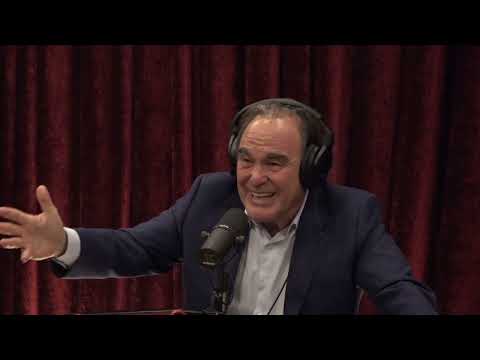
Joe Rogan Experience #1992 - Oliver Stone
Narrator, Oliver Stone (guest), Joe Rogan (host)
In this episode of The Joe Rogan Experience, featuring Narrator and Oliver Stone, Joe Rogan Experience #1992 - Oliver Stone explores oliver Stone And Joe Rogan Argue Nuclear Power Can Save Earth Oliver Stone joins Joe Rogan to discuss his documentary *Nuclear Now*, arguing that nuclear power is a misunderstood but essential solution to climate change and global energy demand.
Oliver Stone And Joe Rogan Argue Nuclear Power Can Save Earth
Oliver Stone joins Joe Rogan to discuss his documentary *Nuclear Now*, arguing that nuclear power is a misunderstood but essential solution to climate change and global energy demand.
They contrast the real-world safety and efficiency of nuclear energy with the massive, ongoing harms from coal, gas, air pollution, and the limits of wind and solar.
Stone traces how public fears were shaped by nuclear weapons, Hollywood, activism, and misreported accidents like Three Mile Island, Chernobyl, and Fukushima.
The conversation explores radiation realities, waste storage, new reactor technologies, global nuclear expansion, political resistance, and the psychological challenge of changing entrenched beliefs.
Key Takeaways
Nuclear energy’s risks are vastly overstated compared to fossil fuels.
Stone cites data that coal and air pollution kill millions annually, while confirmed deaths from civilian nuclear power are extremely low and largely limited to Chernobyl first responders.
Get the full analysis with uListen AI
Most people confuse nuclear power with nuclear weapons and fiction.
The association with bombs, Cold War fears, and Hollywood depictions (e. ...
Get the full analysis with uListen AI
Nuclear waste is small in volume and safely manageable with current tech.
All U. ...
Get the full analysis with uListen AI
Wind and solar alone cannot reliably replace fossil fuels at scale today.
Because they are intermittent and currently depend on gas as backup and on imperfect battery/storage tech, Stone argues they must be paired with nuclear if we want reliable, low-carbon baseload power.
Get the full analysis with uListen AI
Global leaders outside the U.S. are already betting big on nuclear.
China plans at least 150 new reactors and massive investment; Russia and India are expanding advanced designs, while France has long run ~70% of its electricity on nuclear, in stark contrast to Germany’s shutdowns.
Get the full analysis with uListen AI
Changing the narrative on nuclear requires education and cultural shifts.
Stone emphasizes clear, accessible explanations (his film, TikTok educators, campus talks) and notes younger generations—more worried about climate than war—are increasingly pro-nuclear once they see the data.
Get the full analysis with uListen AI
We must be willing to update beliefs as new evidence emerges.
Rogan and Stone stress that many anti-nuclear positions came from sincere but misinformed activism; they argue maturity means separating identity from ideas and being ready to say, “I was wrong, here’s what I’ve learned now.”
Get the full analysis with uListen AI
Notable Quotes
“This nuclear energy is a beautiful, incredible, almost a miracle that was given to us.”
— Oliver Stone
“When you went over the data… the amount of deaths overall ever from nuclear, it's stunning.”
— Joe Rogan
“Nuclear has been around. It's been discredited constantly, but it won't die… because it's good.”
— Oliver Stone
“You're not your ideas. They're just ideas.”
— Joe Rogan
“Even if you don't believe in climate change, I would still go nuclear, because it is the cleanest of all.”
— Oliver Stone
Questions Answered in This Episode
If the safety record and waste profile of nuclear are so favorable, what specific policy or regulatory changes would be needed to rapidly expand nuclear capacity in the U.S.?
Oliver Stone joins Joe Rogan to discuss his documentary *Nuclear Now*, arguing that nuclear power is a misunderstood but essential solution to climate change and global energy demand.
Get the full analysis with uListen AI
How should governments and educators systematically counter decades of fear-based nuclear narratives from media, activism, and entertainment?
They contrast the real-world safety and efficiency of nuclear energy with the massive, ongoing harms from coal, gas, air pollution, and the limits of wind and solar.
Get the full analysis with uListen AI
What mix of nuclear, renewables, and other technologies does the evidence actually support for reaching net-zero by 2050 without massive lifestyle cuts?
Stone traces how public fears were shaped by nuclear weapons, Hollywood, activism, and misreported accidents like Three Mile Island, Chernobyl, and Fukushima.
Get the full analysis with uListen AI
How can democracies overcome short-term political risk and polling fears to adopt long-term nuclear build-out strategies like China’s or France’s?
The conversation explores radiation realities, waste storage, new reactor technologies, global nuclear expansion, political resistance, and the psychological challenge of changing entrenched beliefs.
Get the full analysis with uListen AI
What criteria should an open-minded skeptic use to reassess their stance on nuclear power after watching *Nuclear Now* and hearing arguments like those in this conversation?
Get the full analysis with uListen AI
Transcript Preview
(drumbeats) Joe Rogan podcast, check it out.
The Joe Rogan Experience.
Train by day, Joe Rogan podcast by night, all day. (instrumental music) Yeah, I, I have been fascinated by the subject for a long time and I'm very, very happy that you made this documentary. And it's a very good documentary, by the way.
Thank you.
Thank you for making it, and thank you for highlighting this very, very important issue that seems to have been really confused. And I'm, I'm really glad how you covered it in this, uh, documentary about Three Mile Island and Chernobyl and Fukushima. We have these ideas in our mind about the dangers of nuclear power, and I love the analogy that you made in the film about how driving a car is not scary, but it's dangerous. Flying in a plane feels scary, but it's far safer.
Yeah.
And this is a great analogy to nuclear power. When you went over the, the data, when you talked about the amount of deaths from coal every year, when you talk about the amount of deaths overall ever from nuclear, it's r- it's stunning.
It is.
It's stunning.
Yeah.
And then when you cut to... In the documentary you showed the anti-nuclear movement that happened after Three Mile Island.
Yeah.
And how crazy it was.
Yeah.
Uh, there's all these stars and celebrities, and they're doing concerts, "We've gotta stop nuclear power," and what a mess.
That happens on a... When, when a fad, I mean, becomes fashionable-
Yeah.
... then it was a very successful movement. You're talking about the negatives here.
Mm-hmm.
And the accidents and, uh, we, we cover all that in the film, which is called Nuclear Now. And the idea that was behind it was because I really was like you. I mean, I, I went along with those things in the '70s and the '80s because-
Mm-hmm.
... I didn't know better. I didn't... I wasn't educated. I w- I really wanted to know, what is nuclear power? I wanted to go back to the source. And you gotta go back to the beginning and you gotta go back to Marie Curie and Albert Einstein and World War II and all... How it could, how it got developed. This nuclear energy is a beautiful, incredible, almost a miracle that was given to us, that we have in Earth. It's all, it's in the earth, uranium, it's everywhere, the planet, the earth, the sun. And we, m- in a sense, uh, we took it like Prometheus in a way, kind of misinterpreted it, misused it, which is not... Which is kinda normal for, given the, what we do with natural things. World War II was happening just as the at- as the nuclear fission was being understood and that made the bomb. They made the bomb with it because there was a war on, and they, they rushed it and they did a, they did an amazing job, Oppenheimer down in, uh, the, the, in Los Alamos. But... And they got it, they were successful. But, uh, as you know, it was misunderstood at that point that nuclear energy was not nuclear bomb. In the contrary, it was pr- a bomb is very difficult to build, and it takes a lo- it takes years sometimes, it takes scientists and they have to enrich the plutonium and they have to work at it. There's all f- configurations in the bomb that don't exist in nuclear energy. So when people see a nuclear energy plant they, uh, subconsciously, they cross it with both war and they cross it with horror films that they've seen in the 1950s with radioactivity and monsters had come out of that. You know spider-
Install uListen to search the full transcript and get AI-powered insights
Get Full TranscriptGet more from every podcast
AI summaries, searchable transcripts, and fact-checking. Free forever.
Add to Chrome