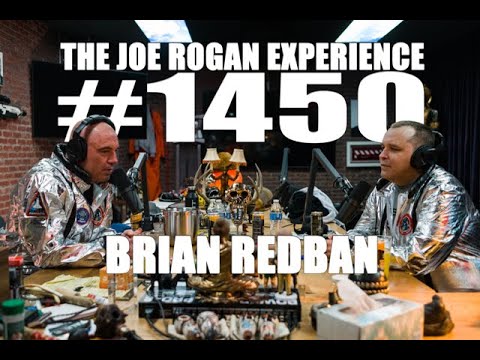
Joe Rogan Experience #1450 - Brian Redban
Joe Rogan (host), Brian Redban (guest), Jamie Vernon (guest), Guest (unidentified, friend/associate on mic) (guest), Guest (unidentified, friend/associate on mic) (guest), Guest (unidentified, friend/associate on mic) (guest), Guest (unidentified, brief interjection) (guest), Guest (unidentified, brief interjection) (guest), Guest (unidentified, brief interjection) (guest), Guest (unidentified, friend/associate on mic) (guest)
In this episode of The Joe Rogan Experience, featuring Joe Rogan and Brian Redban, Joe Rogan Experience #1450 - Brian Redban explores joe Rogan And Brian Redban Deconstruct Life In A Viral Apocalypse Joe Rogan and Brian Redban riff for hours about the early COVID‑19 lockdowns, bouncing between pandemic anxieties, media distrust, civil-liberties worries, and absurd stoner tangents.
Joe Rogan And Brian Redban Deconstruct Life In A Viral Apocalypse
Joe Rogan and Brian Redban riff for hours about the early COVID‑19 lockdowns, bouncing between pandemic anxieties, media distrust, civil-liberties worries, and absurd stoner tangents.
They discuss how easily viruses spread in modern societies, compare COVID to past flu outbreaks, and question government and media responses without fully embracing conspiracies.
The conversation frequently detours into ecology, invasive species, guns, VR gaming, tech design, stand-up comedy, and how daily life, entertainment, and social habits may be permanently changed.
Underlying the humor is a consistent theme: humans are fragile, systems are imperfect, and this crisis might both humble people and accelerate long-term shifts in technology and culture.
Key Takeaways
Lockdowns slow spread but cannot fully stop a highly connected virus.
Rogan repeatedly notes that even with lockdowns, essential workers, delivery drivers, and hospital staff ensure 'fingers in the dike' rather than a total seal, meaning persistence and adaptation are required, not a fantasy of total containment.
Get the full analysis with uListen AI
Media bias and clickbait can dangerously distort public-health messaging.
They argue outlets use Trump stories and sensational headlines (like misreporting the chloroquine poisoning case) to drive clicks, which can misinform people about what was actually said or recommended.
Get the full analysis with uListen AI
COVID-19 is serious, but we ignore other large-scale health threats.
Rogan reads flu statistics showing tens of thousands of deaths annually, emphasizing that society accepts this 'virus war zone' every year without comparable panic, highlighting how novelty and media framing shape reaction.
Get the full analysis with uListen AI
Economic shutdowns have real health costs through depression and despair.
They acknowledge Trump’s clumsy framing but agree that long-term unemployment and business collapse can drive suicide, addiction, and mental illness, and that policymakers must weigh both viral and economic mortality.
Get the full analysis with uListen AI
Crises expose how vulnerable civil liberties are to emergency measures.
Rogan worries that tank deployments, travel checkpoints, fines for being outside, and possible health checkpoints could normalize a more authoritarian baseline, even if initially justified by the pandemic.
Get the full analysis with uListen AI
Personal health and immune strength become more obviously non‑optional.
They argue people should take immune health seriously—better diet, vitamins, exercise, saunas—since pandemics and seasonal flus repeatedly expose underlying vulnerabilities, especially in compromised lungs or lifestyles like heavy vaping.
Get the full analysis with uListen AI
VR and remote tech are poised to accelerate as physical life is restricted.
Redban describes immersive Half-Life VR and virtual comedy/gaming, and both suggest that work meetings, sports, and entertainment could move further into digital/VR environments as people avoid crowds.
Get the full analysis with uListen AI
Notable Quotes
“What we’re experiencing now is a dry run for a real apocalyptic event. This is nothing compared to what could happen.”
— Joe Rogan
“The media’s hatred of Trump is getting in the way of the accuracy of some people’s reporting of the news.”
— Joe Rogan
“We live in a virus war zone that takes out thousands of people every year in this country, and I don’t think most of us are really keeping our eye on that.”
— Joe Rogan
“If you wanted to take over a civilization, it would be with diseases. I’m not saying that’s what’s happening, but that’s how you’d do it.”
— Joe Rogan
“I think this is just fucking weird. If I was single right now, I would not be able to take this.”
— Brian Redban
Questions Answered in This Episode
How should societies balance viral risk against economic and mental-health damage when deciding the length and severity of lockdowns?
Joe Rogan and Brian Redban riff for hours about the early COVID‑19 lockdowns, bouncing between pandemic anxieties, media distrust, civil-liberties worries, and absurd stoner tangents.
Get the full analysis with uListen AI
What concrete standards should exist to prevent media outlets from sensationalizing or misrepresenting health information for clicks during crises?
They discuss how easily viruses spread in modern societies, compare COVID to past flu outbreaks, and question government and media responses without fully embracing conspiracies.
Get the full analysis with uListen AI
Which pandemic-era restrictions on movement and assembly, if any, should remain in place once COVID-19 subsides, and who decides?
The conversation frequently detours into ecology, invasive species, guns, VR gaming, tech design, stand-up comedy, and how daily life, entertainment, and social habits may be permanently changed.
Get the full analysis with uListen AI
How might the normalization of VR, remote work, and virtual entertainment permanently alter cities, live performance, and social interaction?
Underlying the humor is a consistent theme: humans are fragile, systems are imperfect, and this crisis might both humble people and accelerate long-term shifts in technology and culture.
Get the full analysis with uListen AI
What lessons from ecological mistakes—like invasive species and fire suppression—apply to how we intervene in complex systems like public health and the economy?
Get the full analysis with uListen AI
Transcript Preview
Yee-haw! How you hanging in there, fella?
Great, man.
I think these things are gonna annoy a lot of people.
(laughs)
If you're listening, we're wearing aluminum foil. (laughs)
(laughs)
We're let- we're wearing spacesuits.
Yeah.
God, they're so crunchy.
There's not many left for me to get. This is the-
This is dope.
Now I'm getting into the- Yeah, the real-
This is my favorite one.
(laughs)
I like the orange one for some strange reason.
Yeah.
The white one just seems like I'm a cleanup person.
(laughs) Yeah.
You know? Like you're doing some NASA cleanup, like there's alien bodies you're trying to get rid of. But this feels like we're about to do something special.
Yeah.
About ... We're protected.
Yeah. I just hope it doesn't start making us sweat and we lose like 100 pounds. Well, I mean-
This is the same shit that's on the outside of the lunar module that, that land... You know what I mean? That cheap-looking aluminum foil.
Oh, yeah. (laughs)
It looks like it was stuck on there with gum.
Heat shield?
Yeah, the heat shield.
Is that what they call it, heat shield?
Mm-hmm.
Whatever it is.
Yeah.
Whatever that fucking fake stuff is.
Or the Alien.
On the-
You ever see the Alien, where he had to put that big sheet that was made out of this material at the very end? You ever see that movie?
Was it the-
The-
Predator or Alien?
No, no, the Alien ... The one with Matt Damon, and he's like lost in space.
Martian.
The Martian.
Oh, the Martian.
The Martian.
(laughs)
Jesus.
Oh yeah, these are ... Well, they have these for people that get like lost hiking. Like, they're blankets. They'll keep you alive. You won't be cozy, but they'll keep you alive. They're like these real thin aluminum foil-looking blankets.
Yeah.
I guess they just retain heat pretty good.
Right.
Pretty good. You know, like, you're not getting a good night's sleep, but you might stay alive.
Yeah. How are you holding up?
I'm all right.
Yeah?
Yeah. You know, um ... Look, there's people that got it rough. The people that got it rough are, number one, medical workers. Anybody, you know ... Much love to anybody that's working in hospitals right now. Doctors, nurses, everybody. Interns, everybody. Everybody. People working the desk, goddamn, you guys have it rough. You know, those are the people number one. Number two, ho- any- anybody in the hospitality industry. People serving food, uh, restaurants, bars-
Grocery store workers.
Fuck.
Jesus.
Yeah, they have it rough, but they have jobs. You know, it's rough, but they- their jobs are still open. The, the thing that drives me crazy is there's so many restaurants where these people, you know, employed 50, 60 people, and, you know, restaurants are hard. It's hard to stay open when things are great. You know, restaurants are a fucking ... Th- but the ... What is the- it's one of the number one businesses that fails. Like, the ... What is the ... See if you can find the statistic, but it's something crazy like 70% of all restaurants fail within the first year.
Install uListen to search the full transcript and get AI-powered insights
Get Full TranscriptGet more from every podcast
AI summaries, searchable transcripts, and fact-checking. Free forever.
Add to Chrome