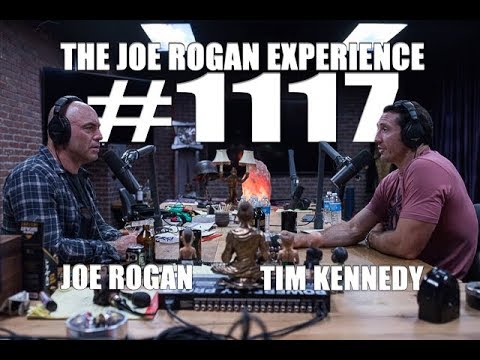
Joe Rogan Experience #1117 - Tim Kennedy
Tim Kennedy (guest), Joe Rogan (host), Narrator
In this episode of The Joe Rogan Experience, featuring Tim Kennedy and Joe Rogan, Joe Rogan Experience #1117 - Tim Kennedy explores tim Kennedy, War, Hunting, Nazis, Torture, And America’s Softening Edge Joe Rogan and Tim Kennedy range across topics from Tim’s obsessive attention to detail and his MMA career to long‑range shooting, hunting ethics, wildlife management, and the public’s disconnect from where food and security come from.
Tim Kennedy, War, Hunting, Nazis, Torture, And America’s Softening Edge
Joe Rogan and Tim Kennedy range across topics from Tim’s obsessive attention to detail and his MMA career to long‑range shooting, hunting ethics, wildlife management, and the public’s disconnect from where food and security come from.
They dive deeply into controversial conservation issues like long‑range hunting, predator reintroduction, feral hog eradication, African trophy hunting, and how hunters fund most modern wildlife conservation despite animal‑rights opposition.
Kennedy then describes his shows *Hunting Hitler* and *Hard to Kill*, revealing how many high‑level Nazis escaped to South America and how their descendants still live in insulated German communities, and he recounts disturbing stories of torture at places like Colonia Dignidad.
The conversation closes with frank discussion of U.S. soft power: declining physical fitness and recruiting crises in special operations, the ethics and reality of waterboarding versus true torture, and whether Americans understand the hard, dangerous work that underlies their comfortable lives.
Key Takeaways
Most modern wildlife conservation money comes from hunters, not animal‑rights groups.
Through mechanisms like the Pittman–Robertson Act’s 11% excise tax on firearms and ammunition, billions of dollars annually fund habitat, species recovery, and access—creating a paradox where hunting bans often reduce, not increase, protection for animals.
Get the full analysis with uListen AI
Ethical hunting depends less on distance and more on shooter responsibility.
Kennedy argues that while 600‑ to 1,000‑yard shots are technically possible, an ethical hunter must be nearly certain of a quick kill and avoid shots where wind, animal movement, and bullet flight time create unnecessary wounding risk.
Get the full analysis with uListen AI
Invasive species like feral hogs force uncomfortable choices for non‑hunters.
Texas hogs cause massive agricultural damage and ecological harm; attempts to trap or donate meat have largely failed, revealing that “just don’t kill them” is not a viable policy and challenging simplistic vegan or animal‑rights positions.
Get the full analysis with uListen AI
Protected game animals often only survive where they have economic value.
Kennedy cites African and South American examples where bans on hunting led landowners to abandon game, resulting in rapid poaching and population crashes—whereas regulated, expensive hunts incentivize local communities to protect animals and habitat.
Get the full analysis with uListen AI
Large Nazi networks survived and adapted in South America after WWII.
Based on *Hunting Hitler* research, Kennedy describes tens of thousands of Nazis and their families building German‑only enclaves, collaborating with local dictatorships, and in some cases maintaining racist ideologies and torture practices into the 1990s and beyond.
Get the full analysis with uListen AI
Special operations face a real recruiting and readiness crisis due to national health trends.
Kennedy reports that obesity, low fitness, drug use, and poor test scores have shrunk the pool of eligible candidates so severely that many Special Forces teams are undermanned, despite ongoing global security demands.
Get the full analysis with uListen AI
Waterboarding is not equivalent to the worst forms of torture but raises real moral questions.
Kennedy distinguishes between waterboarding and irreversible physical mutilation he’s seen in combat zones, arguing that waterboarding cowards can yield actionable intelligence with far less harm—yet acknowledges the ethical and definitional debate around “torture.”
Get the full analysis with uListen AI
Notable Quotes
“Everything I've ever had has been from hard work, and that would have been easy.”
— Tim Kennedy (on why he never used performance‑enhancing drugs)
“People who hunt and eat meat, they're not monsters.”
— Joe Rogan
“They bought that land with Nazi money. What do you do with that?”
— Tim Kennedy (about Colonia Dignidad in Chile)
“We are going to have the biggest deficit of eligible Special Forces candidates that we’ve ever had in history.”
— Tim Kennedy
“Pouring water on somebody’s face is not torture. I know what torture is.”
— Tim Kennedy
Questions Answered in This Episode
If hunting provides the bulk of conservation funding, how could societies realistically replace that money in a world with less or no hunting?
Joe Rogan and Tim Kennedy range across topics from Tim’s obsessive attention to detail and his MMA career to long‑range shooting, hunting ethics, wildlife management, and the public’s disconnect from where food and security come from.
Get the full analysis with uListen AI
Where should we draw the ethical line on long‑range hunting—by distance, shooter skill, or some other standard?
They dive deeply into controversial conservation issues like long‑range hunting, predator reintroduction, feral hog eradication, African trophy hunting, and how hunters fund most modern wildlife conservation despite animal‑rights opposition.
Get the full analysis with uListen AI
How should governments deal with dangerous invasive species like feral hogs when non‑lethal methods are impractical or ineffective?
Kennedy then describes his shows *Hunting Hitler* and *Hard to Kill*, revealing how many high‑level Nazis escaped to South America and how their descendants still live in insulated German communities, and he recounts disturbing stories of torture at places like Colonia Dignidad.
Get the full analysis with uListen AI
Given the documented Nazi legacy in South America, what responsibility—if any—do modern states have to address these communities and their histories today?
The conversation closes with frank discussion of U. ...
Get the full analysis with uListen AI
Is there a morally acceptable interrogation framework that can both protect human rights and reliably prevent large‑scale terrorist attacks, or is some degree of moral compromise inevitable?
Get the full analysis with uListen AI
Transcript Preview
I don't know if I can handle that.
What? The clock's wrong?
No, does it ... I mean, just s- subtly. S- subtly.
Are we live? Yeah. Yeah. One of 'em's wrong. Which one? Which one is it? I think they're both wrong. It's 12:11. That says-
Oh, 15.
... that says 12:11. One says 12:15.
It's 12:13 on my phone.
12:13.
(laughs)
Yeah, so they're both wrong. This, this one says 12:14, that one says 12:11.
This is averaging. And when I ... I wanna strap C4 to this, and this one I wanna spike-
(laughs)
... against the wall. Yeah, that's what I wanna do.
Are you OCD with time?
Dude-
Or with everything?
I ... With everything.
Yeah?
Yeah. Like, my reloading room is disgustingly perfect. And if I load the dishwasher, all the forks have to be symmetrical on one side, and the spoons have to be in the other. And all ... Like, all the mugs, the tall ones have to be on one side, and then like ... Yeah.
What's that all about?
I don't know. I, I think it came back to, um ...
Pull the sucker up to your face.
The, uh ... When you c- ... When everything's the same and something's not the same, it's easy, it's easiest to see that way.
Right.
Right? So, like counterfeiting. Like, if you're, if you're buying a chick in ... A 13-year-old girl in Tijuana, and you're gonna wanna get the guy for counterfeit money and you wanna get him for human trafficking, um, and he starts handing you crappy bills, the easiest way to spit, spot the bills is to be able to see ... Have all of your proper bills all in the right order so the one that's fake is gonna stick out. And then you're like, "Oh, man, I'm gonna-"
Only you would use that example. When you're going to Tijuana and someone's trafficking human slavery-
But that's a good example.
... with h- counterfeit money. It is a good example.
Mm-hmm. Yeah. And if you have a 13-year-old girl with a bunch of 18-year-old girls, you can see the 13-year-old get a little, little bit easier.
Right.
Yeah. So it applies to everything. You know?
Yeah.
And if you have, like, 100, a bunch of ... If you reload and you have a bunch of grain bullets and you're gonna measure and then lot them all .5 separation in grain, so it's like 175, 175.5, 176, 174.5 and so on, when you stack them all together, the easiest way to, to group them instead of measuring every single one is to look at them and just put the ones that are similarly sized all together, smallest to largest, and then you can, then you can weigh them in kinda batches.
Install uListen to search the full transcript and get AI-powered insights
Get Full TranscriptGet more from every podcast
AI summaries, searchable transcripts, and fact-checking. Free forever.
Add to Chrome