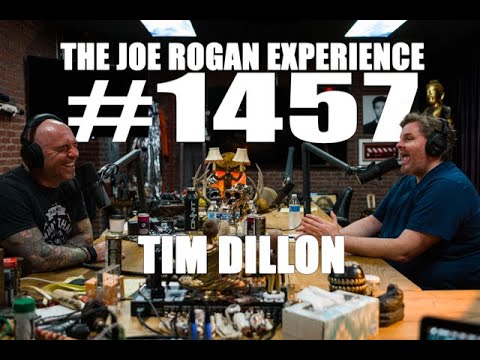
Joe Rogan Experience #1457 - Tim Dillon
Joe Rogan (host), Tim Dillon (guest), Jamie Vernon (guest), Narrator, Narrator, Narrator
In this episode of The Joe Rogan Experience, featuring Joe Rogan and Tim Dillon, Joe Rogan Experience #1457 - Tim Dillon explores tim Dillon, Joe Rogan Tackle COVID, Conspiracies, Cruisers, And Collapse Joe Rogan and Tim Dillon spend nearly three hours riffing on COVID-19, media panic, conspiracy culture, and government overreach, mixing genuine concern with dark comedy. They question the virus’ origins, the reliability of information, and how quickly civil liberties can erode under the guise of safety. Along the way they skewer the news media, celebrity culture, cruise ships, higher education debt, and U.S. political leadership across both parties. The episode is less about definitive answers and more about how confused, anxious, and easily misled people can be in a crisis—and how comedy processes that chaos.
Tim Dillon, Joe Rogan Tackle COVID, Conspiracies, Cruisers, And Collapse
Joe Rogan and Tim Dillon spend nearly three hours riffing on COVID-19, media panic, conspiracy culture, and government overreach, mixing genuine concern with dark comedy. They question the virus’ origins, the reliability of information, and how quickly civil liberties can erode under the guise of safety. Along the way they skewer the news media, celebrity culture, cruise ships, higher education debt, and U.S. political leadership across both parties. The episode is less about definitive answers and more about how confused, anxious, and easily misled people can be in a crisis—and how comedy processes that chaos.
Key Takeaways
Nobody really understands COVID-19 yet, so all models and rules are provisional.
Rogan and Dillon repeatedly note conflicting reports on transmission, reinfection, and death rates; they stress that even doctors and scientists are revising their views in real time, which makes rigid certainty (online or political) suspect.
Get the full analysis with uListen AI
Media incentives drive fear and distortion, further destroying public trust.
They criticize headlines that exaggerate risks (“13 feet! ...
Get the full analysis with uListen AI
Emergencies are prime moments for governments to expand power and not give it back.
Using the Patriot Act after 9/11 as precedent, they worry COVID tracing, health checkpoints, and mandatory status apps might normalize surveillance and movement control that outlast the pandemic.
Get the full analysis with uListen AI
Conspiracy thinking grows where institutions are opaque or clearly dishonest.
From China’s opaque death counts to Epstein, CIA mind-control programs, and Bill Gates vaccine fears, they argue that real past abuses and secrecy make outlandish theories more plausible to many, even when evidence is thin.
Get the full analysis with uListen AI
Class lines are stark: some can bunker comfortably, others risk exposure for low pay.
They highlight grocery clerks and other “essential” workers who face infection for minimal wages and little protection, arguing they deserve hazard pay, debt relief, or structural benefits—not just applause.
Get the full analysis with uListen AI
Lockdowns may save lives but also threaten livelihoods and social stability.
They anticipate massive business failures, unemployment spikes, and rising crime (using Brazil and home-invasion stories as examples), and suggest future policy must balance disease control with economic and societal damage.
Get the full analysis with uListen AI
Comedy and long-form conversation are coping mechanisms for chaos and ambiguity.
Both men frame their riffing as a way to stay sane—using absurdity, exaggeration, and self-deprecation to process fear, conflicting information, and the feeling that ‘no one knows what’s going on.’
Get the full analysis with uListen AI
Notable Quotes
“One day I wake up, I go, ‘This virus is fake.’ The next day I wake up, I go, ‘I’m gonna die today.’”
— Tim Dillon
“We’re in the no man’s land of logic.”
— Tim Dillon
“When you dismiss all conspiracies, it’s the same thing as believing all conspiracies.”
— Tim Dillon
“Having a popularity contest to see who controls the nukes is crazy.”
— Joe Rogan
“You cannot, you can’t, as you’ve said it, like Nerf the world. You can’t make it safe for everybody.”
— Tim Dillon (paraphrasing Joe Rogan’s idea
Questions Answered in This Episode
How do we draw a practical line between reasonable skepticism and destructive conspiracy thinking when institutions have genuinely failed before?
Joe Rogan and Tim Dillon spend nearly three hours riffing on COVID-19, media panic, conspiracy culture, and government overreach, mixing genuine concern with dark comedy. ...
Get the full analysis with uListen AI
What specific civil liberties are you personally willing—or unwilling—to trade for pandemic safety measures like tracing apps or health checkpoints?
Get the full analysis with uListen AI
In a future with recurring pandemics, what does a sustainable balance look like between public health, economic survival, and individual freedom?
Get the full analysis with uListen AI
Given the mistrust in media and government, who or what would you actually trust to communicate accurate risk during a crisis?
Get the full analysis with uListen AI
How much responsibility do comedians and podcasters have to fact-check versus openly speculate, especially when audiences treat them as trusted sources?
Get the full analysis with uListen AI
Transcript Preview
(taps finger) Three, two, one. Later today, (taps finger) young Tim Dillon will find out whether or not he has the antibodies.
Yes. Yes. And if I do, I'm going to Wuhan to do a, like, a fun little video in a wet market-
(laughs)
... and eat a bat. If I have the antibodies, it's not-
I don't-
It's okay. Is it safe?
I don't know what this is.
Yeah, no one knows. We've never been in a time-
Yeah.
... where literally nobody knows.
I have a string of text messages from, uh, Alex Jones-
Yeah.
... like, uh, that will, uh, change your opinion if you, if you smoke enough weed. And you don't smoke weed. Were you ever a weed smoker?
I smoked a lot of weed for a very long time.
But were you-
That's when I discovered Alex Jones-
(laughs)
... when I was 13 when I was smoking weed listening to him on the GCN network.
But when you got clean, it wasn't weed that was a problem, right? It was-
No, it was the cocaine and the-
Yeah.
... the booze and the pills, but weed was always there.
I've never been a cocaine user.
Yeah.
I've never used it, but I do love that Buckcherry song.
Oh, yeah, it's great.
(laughs)
It's great.
It almost makes you wanna-
Yeah.
... do cocaine.
Y- y- it's a great drug. I mean, don't do it if you're-
No.
... having problems, but-
But Alex left ... I, I haven't even gotten to them 'cause I got ... the, the, there's a real pr- I changed my phone number not that long ago.
Yeah. Right.
And I change it every few months now.
Yeah.
And it doesn't matter.
Do you get random texts from just anybody?
Oh, yeah, random.
Yeah.
Yeah, but this, this is, these are all, all of these are voicemail messages. And look at all these videos he sent me to watch and all these websites. He's convinced-
Yeah.
... that it's a weaponized, uh, virus that leaked from a lab.
Well, there's a lot of people that are saying that in Wuhan, obviously, they have that lab, right?
Yes.
Whether it's a bio defense or bio research laboratory.
There's something there.
Something's there.
Something in Wuhan where the disease i- originated.
Somebody said, now this is kind of convincing, that maybe there were people se- backdoor selling the animals that they were experimenting on to wet markets. Like, if you're broke-
Oh, Jesus.
... and you were a guard at the Wuhan lab, you're like, "Hey, I'm just selling bats and dogs for extra money." And he sold maybe one of the wrong ones and now we have this issue.
Install uListen to search the full transcript and get AI-powered insights
Get Full TranscriptGet more from every podcast
AI summaries, searchable transcripts, and fact-checking. Free forever.
Add to Chrome