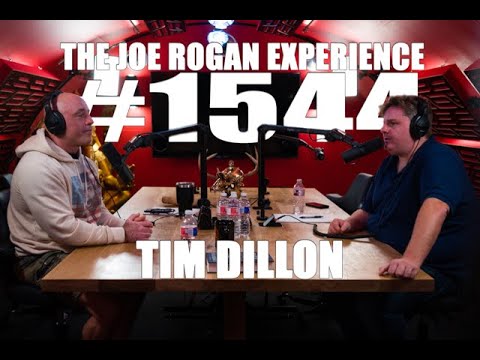
Joe Rogan Experience #1544 - Tim Dillon
Joe Rogan (host), Narrator, Tim Dillon (guest), Narrator, Narrator, Narrator
In this episode of The Joe Rogan Experience, featuring Joe Rogan and Narrator, Joe Rogan Experience #1544 - Tim Dillon explores rogan and Dillon Riff on COVID, Tech Control, and Cultural Meltdowns Joe Rogan and Tim Dillon spend several hours free‑associating about COVID-19, lockdowns, and government overreach, arguing that personal risk assessment and economic survival should carry more weight in public policy. They dive into how social media, surveillance, and big tech manipulate attention and behavior, referencing documentaries like *The Social Dilemma* and tools like Signal and the Light Phone.
Rogan and Dillon Riff on COVID, Tech Control, and Cultural Meltdowns
Joe Rogan and Tim Dillon spend several hours free‑associating about COVID-19, lockdowns, and government overreach, arguing that personal risk assessment and economic survival should carry more weight in public policy. They dive into how social media, surveillance, and big tech manipulate attention and behavior, referencing documentaries like *The Social Dilemma* and tools like Signal and the Light Phone.
The conversation veers into conspiracies, intelligence agencies, and elite wrongdoing, including Jeffrey Epstein, child trafficking, and historic sex-abuse scandals, framing them as partial validation for QAnon-style paranoia without endorsing QAnon itself. They also discuss media polarization, the 2020 election, big-city decay in LA and New York, and how comedy and podcasting are reacting to a highly censored, outrage-driven culture.
Throughout, they repeatedly stress skepticism toward institutions—from public-health authorities to billionaires like Bill Gates—while defending open conversation on taboo topics such as transgender issues, vaccines, and cancel culture. The tone is mostly comedic, but underpinned by a distrust of centralized power and a belief that individuals must protect their own mental health, privacy, and livelihoods.
Key Takeaways
Lockdowns create serious collateral damage that must be weighed against COVID risk.
Rogan and Dillon argue that while COVID is real and dangerous, prolonged shutdowns have driven spikes in suicide, child abuse, and economic ruin; they stress Thomas Sowell’s idea that policy is about trade-offs, not perfect solutions.
Get the full analysis with uListen AI
High-risk individuals should self-shield, while others retain freedom to work and gather.
They suggest that people who are elderly or live with vulnerable relatives should avoid high-risk activities, but argue that adults living independently should be free to attend shows, work in public, and accept personal risk.
Get the full analysis with uListen AI
Social media design intentionally amplifies outrage and division.
Referencing *The Social Dilemma*, they describe how platforms are built to maximize engagement via dopamine hits, negative content, and tribal conflict, and recommend logging off, going offline into nature, or using minimalist tools like the Light Phone to regain sanity.
Get the full analysis with uListen AI
Protecting your attention and avoiding online fights is crucial for productivity.
Rogan describes strict personal rules—no reading comments, no arguing on Twitter—to avoid being derailed by critics, emphasizing that you cannot build anything meaningful if you spend your day defending yourself online.
Get the full analysis with uListen AI
Mass surveillance and data harvesting pose long-term risks beyond COVID.
They warn that tools like contact tracing and big-data tracking can easily be repurposed to target dissidents, blackmail public figures, or enforce ideological conformity, and highlight alternatives like Signal and Apple’s new tracking controls as partial defenses.
Get the full analysis with uListen AI
Elite abuse and trafficking scandals fuel conspiratorial thinking—and some fears are grounded.
By citing Epstein, the Franklin Scandal, and recent child-rescue operations, they argue that real high-level complicity in trafficking makes it easier for people to slide into more extreme, unfounded theories like QAnon’s celebrity-clone narratives.
Get the full analysis with uListen AI
Comedy depends on exploring “unsayable” thoughts, which clashes with a gotcha culture.
They defend provocative jokes and reckless riffing as core to the art form, noting that holding comics’ off-the-cuff lines to legalistic standards kills curiosity and makes long-form conversation impossible in a clip-driven outrage ecosystem.
Get the full analysis with uListen AI
Notable Quotes
“There are no solutions. There are only trade-offs.”
— Tim Dillon (quoting economist Thomas Sowell)
“If you take my opinion seriously, listen to me—I don’t even take my opinion seriously.”
— Joe Rogan
“You want to be successful? You want to get things done? You can’t argue with people about who you are.”
— Joe Rogan
“Comedy is often saying things that you’re not supposed to say.”
— Joe Rogan (paraphrasing Louis C.K.)
“When you open up those gates [of chaos], you have no idea what’s gonna happen.”
— Tim Dillon
Questions Answered in This Episode
How should societies balance personal freedom, economic survival, and public health during pandemics without sliding into authoritarian control?
Joe Rogan and Tim Dillon spend several hours free‑associating about COVID-19, lockdowns, and government overreach, arguing that personal risk assessment and economic survival should carry more weight in public policy. ...
Get the full analysis with uListen AI
To what extent are we personally responsible for protecting our own attention and mental health from social media’s manipulation engines?
The conversation veers into conspiracies, intelligence agencies, and elite wrongdoing, including Jeffrey Epstein, child trafficking, and historic sex-abuse scandals, framing them as partial validation for QAnon-style paranoia without endorsing QAnon itself. ...
Get the full analysis with uListen AI
Where is the line between legitimate investigation of elite wrongdoing and destructive conspiracy thinking that harms innocent people?
Throughout, they repeatedly stress skepticism toward institutions—from public-health authorities to billionaires like Bill Gates—while defending open conversation on taboo topics such as transgender issues, vaccines, and cancel culture. ...
Get the full analysis with uListen AI
Should tech platforms and governments have the power to define which conversations are ‘too dangerous’ to have, especially on topics like gender transition or vaccines?
Get the full analysis with uListen AI
What role should comedians and podcasters play in pushing back against cultural taboos and political orthodoxy, and where—if anywhere—should their limits be?
Get the full analysis with uListen AI
Transcript Preview
(drum roll) Joe Rogan podcast, check it out.
The Joe Rogan Experience.
Train by day, Joe Rogan podcast by night. All day. (instrumental music) I'm here with the COVID kid. COVID kid, baby.
No, you're free. You're free.
I'm free.
You're COVID free.
Antibodies are negative.
Are you worried? You're traveling-
Um.
... in some r- r- risky circumstances.
Yeah. Well, a lot of these clubs that you work are ... They're pretty full. They're-
I- I-
... pretty full.
I've been looking at those lines outside your club. I'm like-
Yeah.
... how big is this place? Where are you gonna socially distance all these people?
Yeah.
(laughs)
It doesn't seem, it doesn't seem that socially distanced, but-
At all.
I don't know, but we also don't know. Nobody, you know ... I ... Is it airborne? Can you get it?
Yes.
It's ... It is airborne?
100%
Well, that's not correct.
No, you definitely can get it from the air.
Okay.
But here's the thing, man. It's ... This is so politicized. It's been so politicized. If you look at the numbers of deaths, the numbers of deaths are way down. They talk about the numbers of, like, cases are up.
Right.
But the deaths are way down.
Yeah.
But-
They're much better at treating it.
Yeah, way better.
Yeah.
But also, it's like people are better at taking care of themselves if they're gonna go out and do things, too.
Right.
They understand you gotta take ... Most people are aware of vitamin D now.
I take it every day.
Yeah.
5000IU's. Yeah.
See? There you go.
Yeah.
A lot of people are aware of zinc. A lot of people are aware of vitamin C. And a lot of people are also that are high risk, they're not going.
Yeah.
They're, they're not going places.
I mean, sometimes you look at people in the clubs ... Like, I'll look at some members of my audience and I'm like, "You shouldn't be here." (laughs)
Right.
Like, you're taking-
Yeah.
... you're taking way too big of a risk.
For a few ha-has and hehe's.
Yeah, but I'm happy about the ticket.
Yeah.
And thanks for coming, but I'm, like, just looking at them going, "I wouldn't be in that chair if I were you."
Would you, though?
But you gotta make your own decision.
You might, though. Make sure-
Maybe you have to.
I would ... I think if I was locked up for six months-
Yeah.
... and I couldn't go out-
Yeah.
... and then one of my favorite comics was in town-
Install uListen to search the full transcript and get AI-powered insights
Get Full TranscriptGet more from every podcast
AI summaries, searchable transcripts, and fact-checking. Free forever.
Add to Chrome