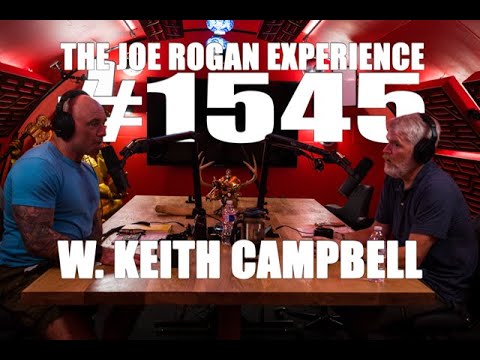
Joe Rogan Experience #1545 - W. Keith Campbell
W. Keith Campbell (guest), Joe Rogan (host), Guest (guest), Guest (guest)
In this episode of The Joe Rogan Experience, featuring W. Keith Campbell and Joe Rogan, Joe Rogan Experience #1545 - W. Keith Campbell explores narcissism, Ego, Psychedelics, and UFOs: Redefining the Modern Self Joe Rogan and psychologist W. Keith Campbell explore narcissism in depth—what it is, how it develops, when it becomes a disorder, and how it impacts relationships, work, and ideas of success.
Narcissism, Ego, Psychedelics, and UFOs: Redefining the Modern Self
Joe Rogan and psychologist W. Keith Campbell explore narcissism in depth—what it is, how it develops, when it becomes a disorder, and how it impacts relationships, work, and ideas of success.
They contrast grandiose and vulnerable narcissism, discuss the limits of parenting and genetics, and examine how social media and modern culture amplify entitlement, status-seeking, and fragile egos.
The conversation then branches into how failure, competition, martial arts, and psychedelics can reduce ego and promote growth, including early findings on ayahuasca’s effects on personality.
In the final stretch, they touch on UFOs, indigenous cultures, technology’s impact on human psychology, and the tension between our ancient wiring and today’s hyper-complex world.
Key Takeaways
Narcissism is a trait spectrum, not just a diagnosis.
Campbell distinguishes between everyday narcissistic traits, vulnerable narcissism, and full narcissistic personality disorder, emphasizing that only when these traits cause significant impairment (especially in relationships or work) do they become a clinical problem.
Get the full analysis with uListen AI
Grandiose narcissism often boosts status and income but harms intimacy.
Less agreeable, more antagonistic people tend to earn more and gain status, but they frequently pay for it with poor marriages, damaged friendships, and workplace toxicity due to low empathy and a constant need for validation.
Get the full analysis with uListen AI
You can’t “engineer” your child’s personality, but you can buffer narcissism.
Personality is heavily heritable and shaped by non-shared environment; parenting has limited power to change core traits, but focusing on “CPR”—Compassion, Passion, and Responsibility—helps kids avoid becoming entitled, fragile narcissists.
Get the full analysis with uListen AI
Failure and real competition are essential medicine for ego.
Shielding kids (or adults) from losing—through participation trophies or overprotection—prevents them from building a “psychological immune system”; Rogan argues that sports and Brazilian jiu-jitsu are powerful tools for learning to accept loss and grow from it.
Get the full analysis with uListen AI
Social media both feeds and exposes narcissism and insecurity.
Platforms like Instagram reward image-crafting, filters, and status displays, creating fertile ground for both grandiose narcissism (showing off) and vulnerable narcissism (resentment, envy, feeling shadow-banned or overlooked), while intensifying social comparison and depression.
Get the full analysis with uListen AI
Psychedelics may reduce neuroticism and vulnerability more than entitlement.
Early research Campbell cites on ayahuasca suggests decreases in neuroticism and vulnerable aspects of narcissism (anxiety, insecurity), with less clear impact on entitlement; psychedelics may “loosen the clay” of personality but require expert, careful use.
Get the full analysis with uListen AI
Our ancient brains are struggling in a hyper-complex, tech-saturated world.
The pair argue that many modern psychological issues stem from Stone Age wiring exposed to social media, nonstop information, and urban light pollution, and they question whether future tech like brain–computer interfaces will solve this or erode what’s left of our “humanness.”
Get the full analysis with uListen AI
Notable Quotes
“If it works for you, then it’s not a disorder.”
— W. Keith Campbell
“You can’t be interesting and right 100% of the time.”
— W. Keith Campbell
“Protecting yourself from that feeling of loss is actually dangerous for you.”
— Joe Rogan
“Parenting doesn’t make much of a difference, but it matters.”
— W. Keith Campbell
“All my biggest growth moments in my life have come from colossal failures.”
— Joe Rogan
Questions Answered in This Episode
How can someone honestly assess whether their drive and confidence are healthy ambition or creeping narcissism that’s damaging relationships?
Joe Rogan and psychologist W. ...
Get the full analysis with uListen AI
What practical steps can a high-achieving, ego-driven person take to keep their boldness while reducing meanness and entitlement?
They contrast grandiose and vulnerable narcissism, discuss the limits of parenting and genetics, and examine how social media and modern culture amplify entitlement, status-seeking, and fragile egos.
Get the full analysis with uListen AI
In a world shaped so heavily by social media, what concrete habits could reduce the toxic comparison and status anxiety that Campbell describes?
The conversation then branches into how failure, competition, martial arts, and psychedelics can reduce ego and promote growth, including early findings on ayahuasca’s effects on personality.
Get the full analysis with uListen AI
If psychedelics mainly reduce vulnerability and neuroticism but not entitlement, could they unintentionally make some narcissists more effective—and is that a moral problem?
In the final stretch, they touch on UFOs, indigenous cultures, technology’s impact on human psychology, and the tension between our ancient wiring and today’s hyper-complex world.
Get the full analysis with uListen AI
Given our Stone Age brains and rapidly advancing technology, what balance between “unplugged” experiences and digital life is psychologically sustainable long term?
Get the full analysis with uListen AI
Transcript Preview
(drumming) Joe Rogan podcast, check it out. The Joe Rogan Experience.
Train by day, Joe Rogan podcast by night. All day. (instrumental music plays) Hello, Keith.
Hello, Joe.
What's happening, man? Thanks for coming.
Oh, thanks for having me. This is great. Great to be in the new studio.
It's polarizing. Some like it, some do not. It, uh, it has a weird effect on people.
When-
I didn't th- I never thought it was gonna be a big deal. L- I just thought people would go, "Oh, this place looks weird," and that would be the end of it.
Well, it's kind of a interdimensional hyper tube. What, do you... The Red Pill?
(laughs)
What's the name?
Um, some people call it the Red Pill. I don't know. It's just the, the, the studio for now.
It's cool.
Thank you.
It feels good to be here. Feels-
Thanks, man.
... good. Nice studio.
Feels good to have you here.
Thank you.
We tested you out.
(laughs)
What were you saying about testing? That it's not g-... Unless you- you're sick, it's not good to test often?
Y- yeah. Well, and no. I mean, as a psychologist, you know, when you're doing psychological testing-
Right.
... if I wanted to see if somebody has a mental disorder, I just don't go screen a bunch of people. I wait for somebody to show up in a hospital that's got troubles.
Right.
Because if I go gi- give the screen to a bunch of people, I'm gonna find a bunch of people who test as mentally ill but aren't. They're not doing anything wrong. Um, they just have some symptoms, but they might not have all the trouble that brings them to a hospital.
Or maybe they do, but they just never m- make their way to a hospital?
Well, or they're, it's, it's working out for them. So, p- part of the...
(laughs)
I'm just kid... Yeah, I mean, the thing is, you can be weird and it works, or you can be an angry person or a mean person or a self-absorbed person, whatever. If it works for you, then it's not a disorder. You kinda just go through your life. If it, if it's impairing, it becomes a disorder and then we treat you.
Mm. But w- how do, how does one define whether or not it's impairing? You're like-
(laughs)
... you could argue that the President of the United States has some psychological disorders. But clearly, he, it isn't, hasn't impaired him from being successful unless you check his taxes.
(laughs) This is the, this is a debate I've had, uh, or discussion I've had a lot. And the question is, so is somebody like Donald Trump, um, if somebody says he has a disorder and you say, "Well, is billionaire President of the United States who doesn't pay a lot of taxes, guy sounds like he's kinda killing it to me."
Install uListen to search the full transcript and get AI-powered insights
Get Full TranscriptGet more from every podcast
AI summaries, searchable transcripts, and fact-checking. Free forever.
Add to Chrome